
← machines, mics, and family nights
Microphone Stands for Karaoke and Singing (the $25 Fix)
A mic stand for karaoke or singing is a $20 to $35 buy in three shapes, and a round base survives a living room better than a tripod because legs get kicked.
 Gus Harmon · Updated July 8, 2026 · how I decide
If you buy through my links the site earns a little. It's never why I pick things.
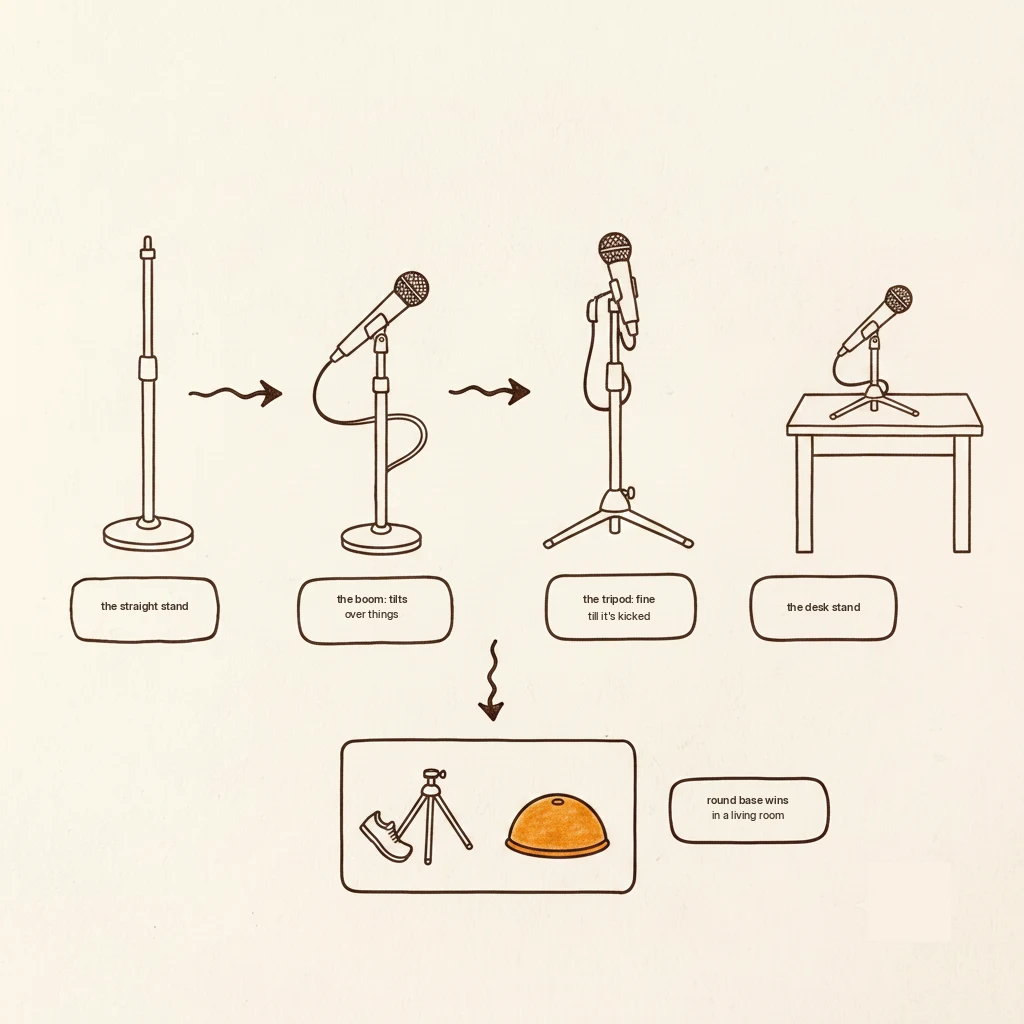
A mic stand for karaoke or singing is a $20 to $35 buy in three shapes: straight (for standing singers), boom (for singing while you play an instrument), and desk or short (for seated singers and kids). Get a round base, not a tripod, for a living room. Tripod legs get kicked; round bases don’t.
This is one of those small buys that quietly fixes the whole night. You’ve been holding the mic, your arm’s tired, the kids are fighting over who holds it next, and the answer costs about twenty-five bucks. Let me get you the right one so you don’t overthink it.
The three shapes, and who needs which
That’s the whole taxonomy. Pick by what you’re doing, not by specs.
- Straight stand. A pole with a base. This is your karaoke stand, for someone standing still and singing.
- Boom stand. A pole with an arm that reaches out sideways. You want this only if you’re singing while playing something, so the mic can reach over a keyboard or in front of a guitar.
- Desk or short stand. A little one for a tabletop or a seated singer, and the friendly choice for small kids.
The party truth: round base beats tripod
In a living room, tripod legs get kicked. Every time. Somebody backs up, catches a leg, and the whole thing goes over. A round-base stand (one weighted disc instead of three splayed legs) costs about $10 more and stays standing. For a house with kids, that weighted round base is the anti-tip answer, and it’s worth every dollar of the difference.
A round-base straight stand. About $35. Nothing to kick, easy to move, holds a mic at any height. This is the one I’d put in a family room.
Flaws, said plainly: a touch heavier to haul than a folding tripod, and a few dollars more. That weight is the point.
A height-adjustable straight stand for kids. About $20. Crank it to their height and the living room becomes a stage. It’s a genuinely great, cheap gift that turns a shy kid loose.
Flaws, said plainly: lighter build than an adult stand, so a weighted or round base is still smarter than a tripod if little ones are running around.
Can I put the karaoke machine on a stand?
Carefully. Those all-in-one machines are heavy, and owners have found out the hard way that a cheap $30 laptop stand gets “a bit wobbly” under one. If you want the machine up off the floor, use a real speaker stand rated for the weight, a sturdy media cart, or just the table it came on. Don’t trust a light tripod with a $300 machine and a kid nearby. That’s the tip-over nobody wants to clean up.
Two small things stores never mention
First, the clip. Fat-handled wireless mics don’t fit a standard mic clip, and a $6 correct-size clip is the difference between a mic that sits and a mic that slides out. Check your mic’s barrel against the clip before party night.
Second, if you saw a “karaoke mic with stand” bundle, the stand is usually fine, but the mic bundled with it is usually the toy tier. Buy the stand for the stand, not for the mic riding along with it.
And a fun one for exactly one reader: if you sing while you drum, you want a low boom stand that reaches over the kit, because every bar band’s drummer has eaten the vocal mic mid-fill at least once.
A stand tips when its center of mass drifts past the edge of its base. A round weighted base keeps almost all the weight low and centered under the pole, so it takes a real shove to walk it over, while a tripod puts its “edges” out at three skinny legs that a foot can catch and lever. Same idea as why a bowling pin is harder to knock over than a broomstick: low, centered weight wins.
Round base for the living room, boom only if somebody plays an instrument while they sing, and bolt on a proper-size clip if your wireless mic has a fat handle. Twenty-five dollars, done, and put the savings toward the second microphone.
If you buy through my links the site earns a little coffee money. Doesn’t change the price, doesn’t change my answer.
If you’re figuring this out, you’re probably also wondering:
Gus Harmon
Gus spent three decades running sound wherever somebody needed it: bar bands, weddings, school shows, and twelve years of Sunday mornings. He can't sing a note. He can make sure you're heard. Now he writes so normal people can buy the right thing the first time.