
← a microphone for singing, at home or on stage
The Best Mic for Singing Live at Your First Gigs
For singing live almost every working singer uses a Shure SM58, about $110 new or less used, because it survives drops and ignores the noise behind you.
 Gus Harmon · Updated July 8, 2026 · how I decide
If you buy through my links the site earns a little. It's never why I pick things.
For singing live, almost every working singer uses a tough dynamic mic, and the tough one everybody means is the Shure SM58. About ninety-nine dollars new, less if you buy it used, and it’s been the standard for decades. It survives getting dropped, it ignores the drum kit behind you, and it sounds right through a PA.
You’ve got your first gigs coming and you’re scared of showing up with the wrong thing. Let me take that off your plate. Get one, get a cable, and go. Buy wireless only when someone’s paying you to walk around the room.
I ran sound for bar bands for the better part of thirty-five years, my own band included, the one that never quite made it. In all that time I watched SM58s get dropped off stages with the monitors screaming, and they kept working.
One guy in a thread said he’s been using his 58 for thirty-eight years. That’s not marketing. That’s just what the thing is.
Your voice doesn’t need a matching mic
I saw somebody describe their own voice in detail, brighter tone, low alto, high tenor, like the mic had to match it the way a shoe matches a foot. It doesn’t. Not at this level.
At your first gigs the mic doesn’t care whether you’re an alto or a tenor. What matters ten times more is how you hold it: ball right up at your chin, sing across it, not into it. That technique will do more for your sound than any mic swap.
So don’t lose sleep matching gear to your range. Get the reliable one and learn to work it.
Why the tough mic, and not the fancy one
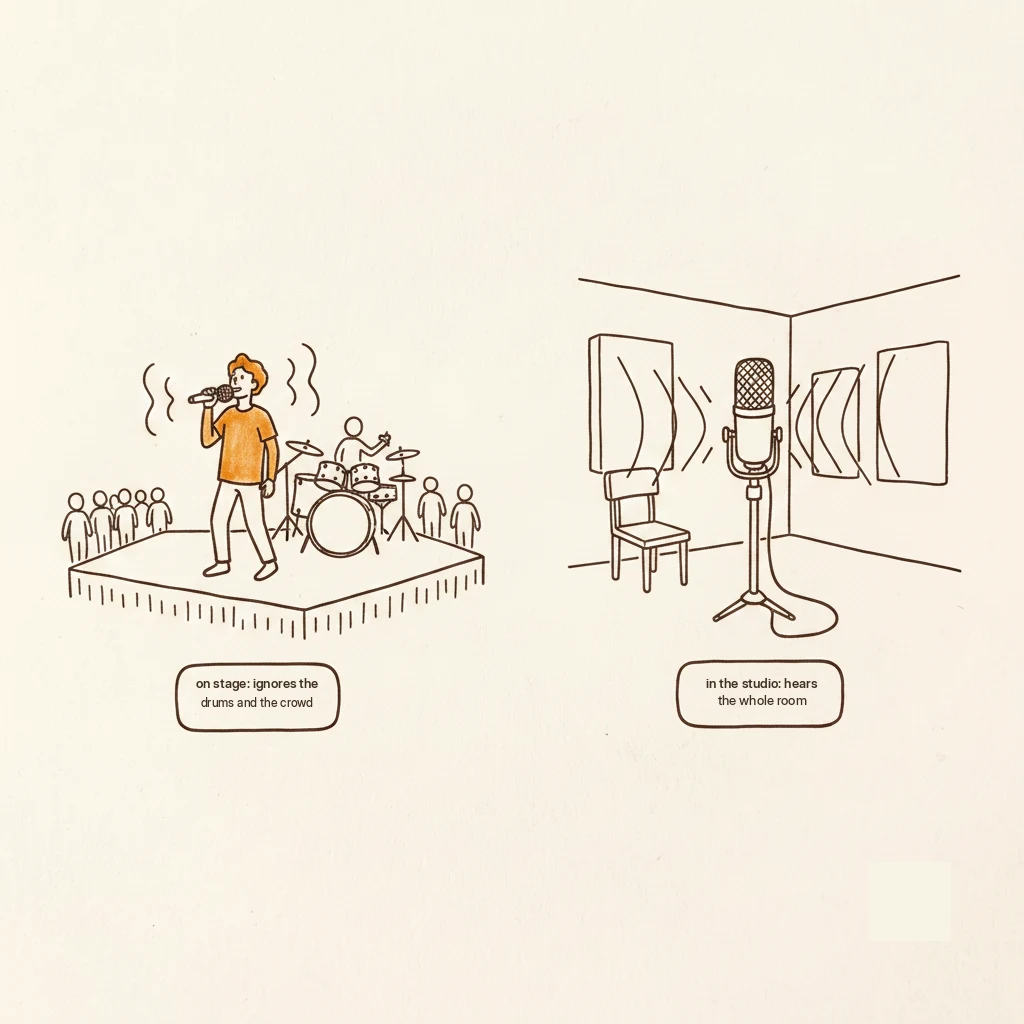
Quick reason, because it’s the one that saves your show. A dynamic mic like the 58 is a little deaf on purpose. It hears you up close and mostly ignores everything else: the monitors, the drums, the crowd. That’s exactly what you want on a loud stage.
The sensitive studio mics, the “vocal condenser” ones some listings will try to sell you, are the opposite. They hear everything, which on a bar stage means they hear the speakers and turn into a feedback machine. Great in a quiet room, wrong for your gig. Recording at home is a different conversation, and I’ve got a separate page for that.
The one real choice to make
If you want to consider an alternative, there’s basically one worth your time: the sE V7, around a hundred dollars. Same job as the 58, a touch brighter. People call it “the 58 killer.”
Pick either and you’re set. That’s the whole decision.
Two traps to sidestep. One, the thirty-dollar “58-style” clones. They feed back exactly where the real one holds steady, and the fake-58 market is genuinely out there, so buy from a real store. Two, don’t let anyone talk you into a studio condenser for stage.
The reason a 58 can get its grille dented and keep sounding fine is that the part that actually does the hearing, the capsule, is suspended inside on little shock mounts, floating away from the metal shell. So you can bang up the outside all you want and the delicate part never feels it. That’s why “buy it used” is real advice here.
A 58, used if you can find one because you genuinely cannot hurt it, a fifteen-dollar cable, and spend whatever’s left on a decent stand. That’s the whole answer for your first hundred gigs. When movement becomes the job, add wireless. Not before.
If you buy through my links the site earns a little coffee money. Doesn’t change the price, doesn’t change my answer.
If you’re figuring this out, you’re probably also wondering:
Gus Harmon
Gus spent three decades running sound wherever somebody needed it: bar bands, weddings, school shows, and twelve years of Sunday mornings. He can't sing a note. He can make sure you're heard. Now he writes so normal people can buy the right thing the first time.