
← a microphone for singing, at home or on stage
The SM58: The Microphone That Won't Die
If you sing out loud anywhere (karaoke, a band, church, practice) the Shure SM58 at about $110 new or $60 used is the answer working sound people have given for fifty years, with one honest exception for quiet desk recording.
 Gus Harmon · Updated July 8, 2026 · how I decide
If you buy through my links the site earns a little. It's never why I pick things.
It seems too cheap and too old to be the real answer
That’s the thing that stops people. You ask what microphone to buy, and every thread, every teacher, every guy at the store says the same three words: get an SM58. It’s ninety-nine bucks. The design is older than you are.
You start to suspect it’s a joke, or a lazy answer, or something people say because they heard other people say it.
It’s none of those. It’s just what happens when a tool is finished.
What it actually does for you
Two things, and neither is glamorous.
First, it ignores the room. Point it at your mouth and it hears your mouth. The band behind you, the speaker in front of you, the gymnasium ceiling: it hears all of that much less than it hears you. That’s why it works in bad rooms, which is where you live.
Second, it does not break. I have dropped these on concrete. I have watched a drummer throw one. I’ve pulled them out of a van in February and plugged them in wet, and they worked.
The honest split
Studio-minded people will tell you never to record with an SM58. They’ll say it’s a stage mic and it’s disappointing in a studio.
They’re not wrong, and I’m not going to pretend otherwise to protect a recommendation.
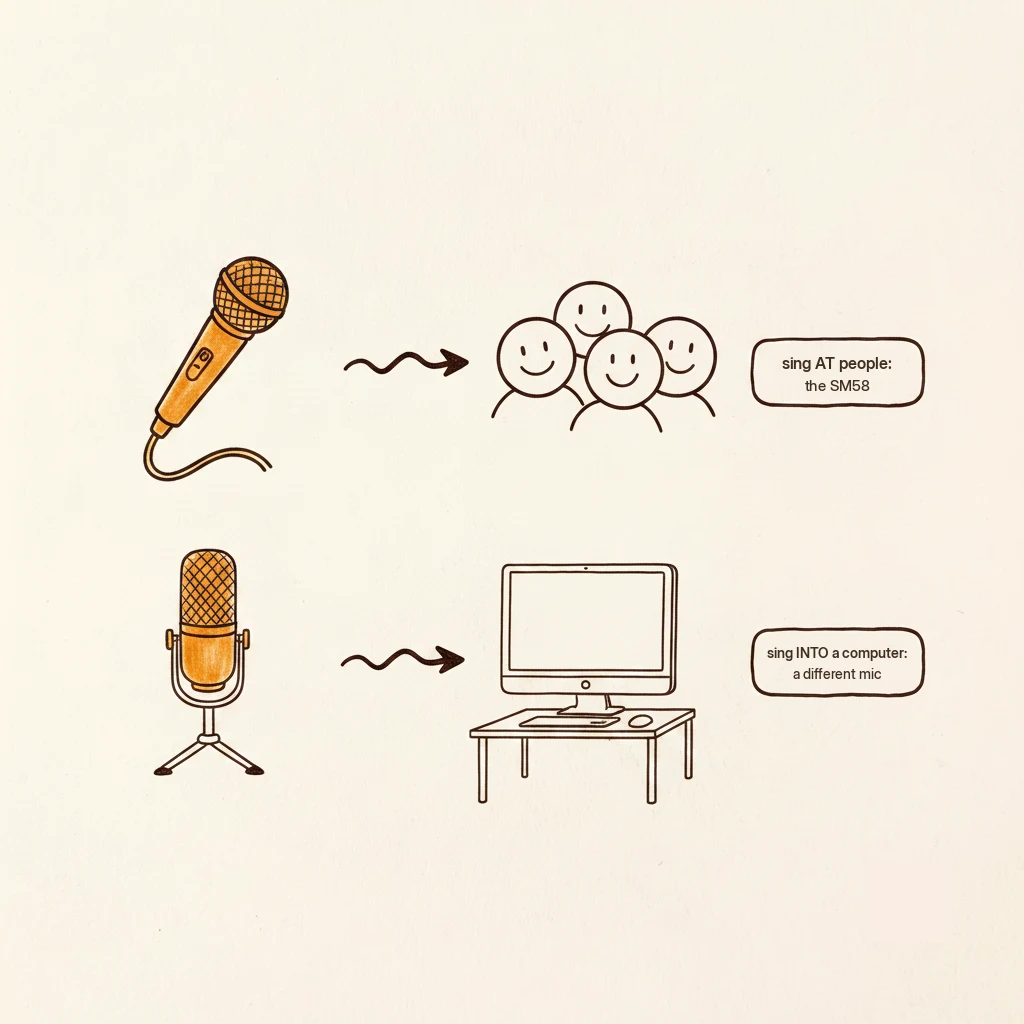
Here’s how those two truths fit together. Ask where your voice needs to come out. Singing at people, through a speaker, in a room? SM58. Singing into a computer, alone, to make a file? Then a mic built to hear detail in a quiet room does that better, and my USB page walks through those.
The SM58 is deaf on purpose. In a studio, deafness is a flaw. On a stage, deafness is the entire point.
The cheaper sibling, and the challenger
You’ll see the Shure SM48, the SM58’s cheaper cousin. Shure has discontinued it, so what’s out there now is mostly secondhand at $55 to $90, and at that money a used SM58 for about $60 is simply the better buy. The 58 is the one you’ll still own in 2050.
You’ll also see the sE V7, around $100, described as an SM58 killer by people who like it. It has real fans. The 58 is still the one with fifty years of receipts.
If you buy through my links the site earns a little coffee money. Doesn’t change the price, doesn’t change my answer.
What thirty-five years looks like
Weddings. School shows. VFW halls. Twelve years of Sunday mornings behind a little mixing board.
Every one of those rooms had SM58s in it, and the ones that were there when I started are mostly still there. Dented. Grille flattened on one side. Working.
If you're figuring this out, you're probably also wondering:
Gus Harmon
Gus spent three decades running sound wherever somebody needed it: bar bands, weddings, school shows, and twelve years of Sunday mornings. He can't sing a note. He can make sure you're heard. Now he writes so normal people can buy the right thing the first time.