
← a microphone for singing, at home or on stage
Microphone for Singing
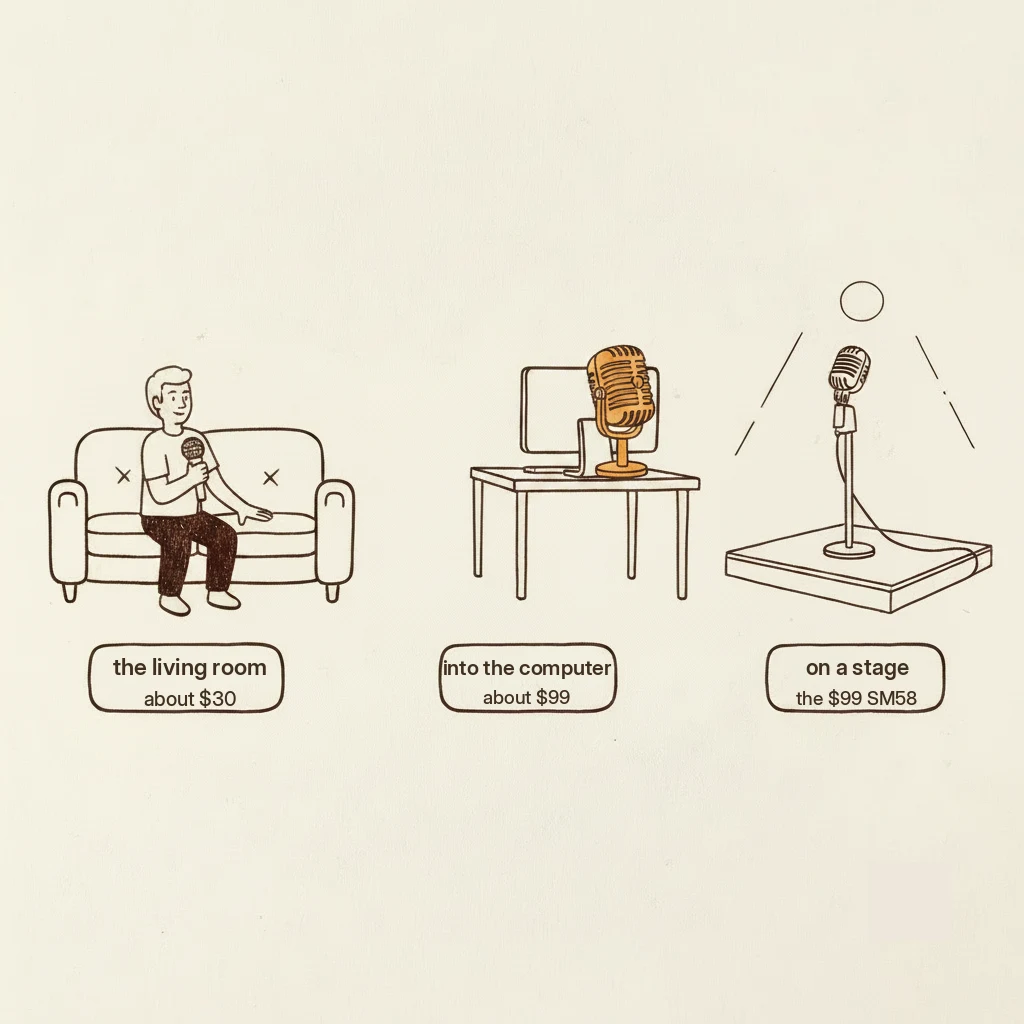
The right microphone for singing depends on where your voice comes out: about $30 for a kid singing in the living room, about $110 for an SM58 if you sing out loud, about $100 for a USB mic if you sing into a computer.
 Gus Harmon · Updated July 8, 2026 · how I decide
If you buy through my links the site earns a little. It's never why I pick things.
What's on this page
Where does your voice come out?
Everybody starts with “what microphone.” That’s the wrong first question, and it isn’t your fault, because it’s the only question anybody sells an answer to.
Ask this instead: after you sing, where does the sound need to end up? Out of a speaker in your living room. Into a computer, saved as a file. Out of a PA at a church, a bar, a school stage.
Those are three different jobs. A mic that’s perfect for one is mediocre at another. Pick the room first and the mic falls out of it.
You might not need to buy anything yet
If you’re just starting to sing and you want to hear yourself back, your phone’s voice memo app is enough. It’s honest, it’s free, and it will tell you more in a week than a $300 mic will.
There’s also a trick worth knowing: an iPhone with AirPods will let you hear yourself live while you practice. Apple calls it Live Listen. Costs nothing if you already own both.
I’d rather tell you that than sell you something. When practicing gets serious enough that the phone annoys you, come back and buy a mic. That’s the right order.
If you sing out loud, in a room
Karaoke, practice with a speaker, a class, a stage, a wedding, a Sunday morning. You want to hold a microphone and be heard.
The answer has been the same for decades and it’s boring: a Shure SM58, about $110. That’s six large pizzas, once, for something you’ll still own in twenty years.
Shure SM58, about $110. The mic singing teachers name when you ask them, the one in the closet of every church and bar in America. Buy it used and spend the difference on a stand. You genuinely cannot kill one.
Flaws, said plainly: it needs something to plug into (a speaker with a mic input, a small mixer, a PA), and studio people will tell you it's not their first choice for recording. They're right.
Where to find it: Sweetwater, Guitar Center, Amazon. If you buy through my links the site earns a little coffee money. Doesn’t change the price, doesn’t change my answer.
If you sing into a computer
Different job. Nothing needs to come out of a speaker. The sound needs to land in the computer as a file you can play back.
For that, get a USB mic. USB just means the mic plugs into the computer directly, with no extra box in between. About $99 gets you a good one.
A USB mic, about $100 to $180. The names that come up over and over: Audio-Technica AT2020, Blue Yeti, Rode NT-USB, Shure MV7. They sit on your desk, you sit in front of them, done.
Flaws, said plainly: they sit still. If you want to hold the mic and move, a desk mic will feel wrong in your hand, and you'll be right about that.
I wrote a whole page on the USB question, because there’s a wrinkle: handheld USB mics exist, and almost nobody tells you. If your wife or your kid says a desk mic “doesn’t feel like a real microphone,” they are not being difficult. They are correct.
If it’s for a kid
Start at $30. An all-in-one karaoke mic is a microphone with a little speaker built into the handle. Nothing to wire, nothing to plug in, nothing to lose.
An all-in-one karaoke mic, about $20 to $35. Two pizzas. It's its own speaker, so there is no setup night and no cable to trip on.
Flaws, said plainly: it sounds like $30. That is exactly what it should sound like until the kid has loved it for a year.
Durability beats sound quality for the first year. Always. My niece is eleven and sings into anything with a switch on it, and the $300 mic in my garage would have been the dumbest possible gift.
What about a condenser microphone?
A lot of people land on this word while shopping, so here it is in plain speech. A condenser mic is the sensitive kind. It needs power from whatever it plugs into, and it hears everything.
That’s the problem. The sensitive mic hears your kitchen, your furnace, the dog, and the room bouncing your voice back at you. The tough kind (a dynamic mic, like the SM58) mostly hears you and ignores the house.
So when you read that a cheap condenser mic disappointed somebody in a normal living room: it wasn’t a bad mic. It was the sensitive mic, in a house.
The thing the store will try to sell you
Nobody’s born knowing what a preamp is, and you shouldn’t have to find out just to hear your kid sing through a speaker. If somebody at a counter walks you past the $40 thing that would have worked, that’s the sale talking.
If you're figuring this out, you're probably also wondering:
Gus Harmon
Gus spent three decades running sound wherever somebody needed it: bar bands, weddings, school shows, and twelve years of Sunday mornings. He can't sing a note. He can make sure you're heard. Now he writes so normal people can buy the right thing the first time.