
← a microphone for singing, at home or on stage
I Plugged My Microphone Into My Speaker and I Can't Hear Anything
Nothing is broken: a microphone plugged straight into a speaker's aux jack is nearly silent because a mic's signal is far too weak for a speaker to hear, and a small mixer (about $65) or an all-in-one karaoke mic (about $30) fixes it.
 Gus Harmon · Updated July 8, 2026 · how I decide
If you buy through my links the site earns a little. It's never why I pick things.
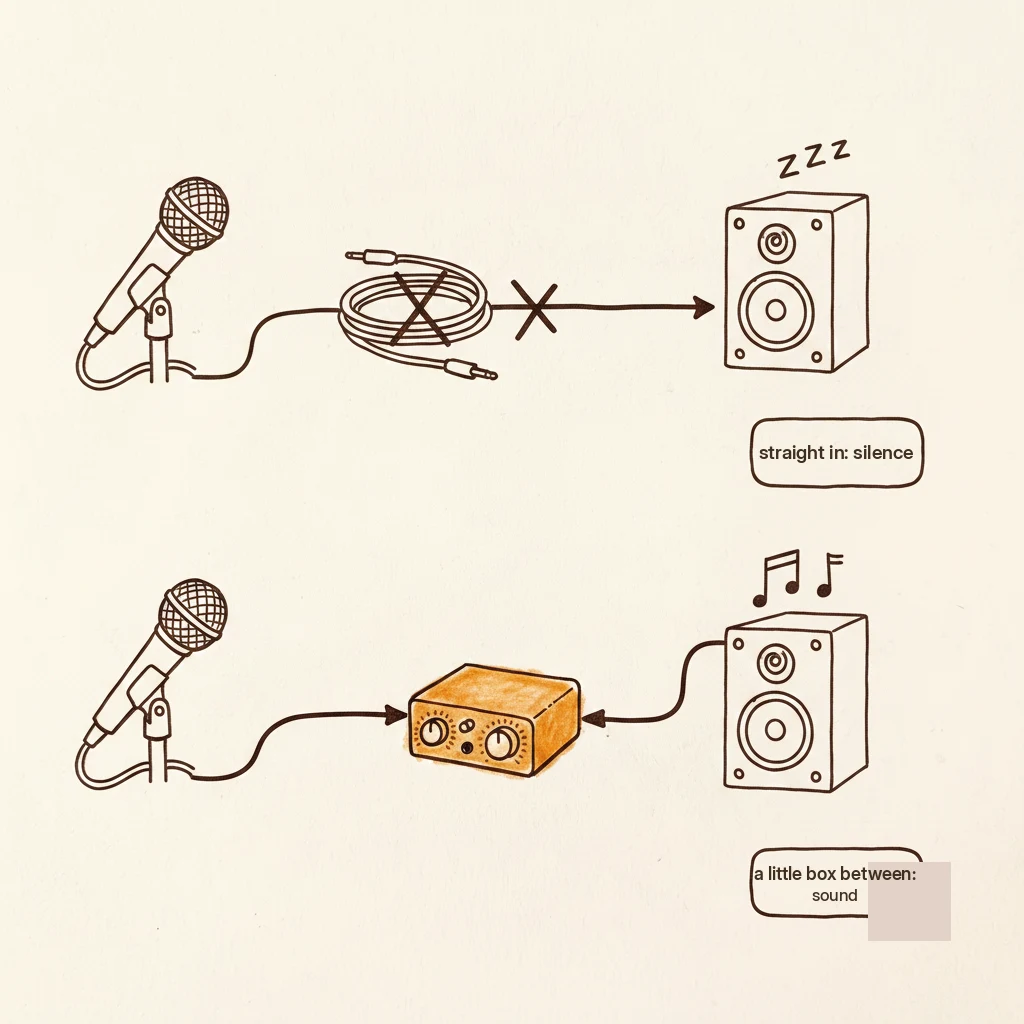
You did the obvious thing
Your kid wants to practice singing. You have a Bluetooth speaker that’s loud and good. The mic came, it has a little plug on the end, the speaker has a little hole on the side. Plug goes in hole.
And then: nothing. Or almost nothing, a faint far-away version of a voice, and you have to yell to hear anything at all.
I’ve watched this exact thing happen at a hundred soundchecks. Everybody hits it. Nothing got broken.
Why the Bluetooth speaker stays silent
Microphones whisper. Speakers only listen for shouting.
That’s the whole thing. The electrical signal coming out of a microphone is tiny. The signal a speaker’s aux jack expects (the one that comes out of a phone) is roughly a thousand times stronger.
Your speaker isn’t ignoring the mic to be difficult. It genuinely can barely hear it.
So a microphone needs something in between that takes its whisper and shouts it. That’s all a mixer is. That’s all an amp is. That’s the thing the internet was trying to tell you with words like preamp and impedance and line level.
The $65 fix, if you want the real setup
Put a small mixer between them. The mic plugs into the mixer, the mixer plugs into your speaker’s aux jack, and now the speaker hears a signal at the strength it wants.
A small mixer, about $65. The Rockville RockMix5 is the one that keeps coming up. Mic in one side, speaker out the other. There's a knob for how loud the voice is and a knob for a little reverb.
Flaws, said plainly: it's another box, another two cables, and it needs an outlet.
Turn that reverb knob about a quarter of the way up and leave it.
Here’s why that matters more than it sounds: when a singer can’t hear themselves properly they sing louder and louder trying to find their own voice, and it wrecks the practice. Getting your own voice back in your ears, with a bit of bloom on it, stops the spiral cold.
Pair it with a Shure SM58 (about $110) and you’ve built the setup that a thousand bars and churches use, for about $175 total. It’ll outlive the kid’s interest and probably you.
If you buy through my links the site earns a little coffee money. Doesn’t change the price, doesn’t change my answer.
The $30 fix, if it’s for a kid
Or don’t fix it. Route around it.
An all-in-one karaoke mic has the speaker built into the handle. There’s nothing to plug into anything. It connects to your phone for the backing music and plays the voice through itself. About $30.
An all-in-one karaoke mic, about $20 to $35. Turn it on and sing. No mixer, no cables, no aux jack, no research.
Flaws, said plainly: it sounds like $30 and the built-in speaker is small.
Real audio people sneer at these. I’ll say the unpopular thing plainly: for a seven-year-old in a living room, the $30 all-in-one is the correct purchase and the $300 setup is the wrong one.
My niece is eleven and sings into anything with a switch on it. I handed her one of these. It survived.
If you're figuring this out, you're probably also wondering:
Gus Harmon
Gus spent three decades running sound wherever somebody needed it: bar bands, weddings, school shows, and twelve years of Sunday mornings. He can't sing a note. He can make sure you're heard. Now he writes so normal people can buy the right thing the first time.