
← a microphone for singing, at home or on stage
Microphone for Singing at Home
Singing at home doesn't need a studio: about $30 for an all-in-one mic that's its own speaker, or about $65 for a little mixer between a real mic and the speaker you already own.
 Gus Harmon · Updated July 8, 2026 · how I decide
If you buy through my links the site earns a little. It's never why I pick things.
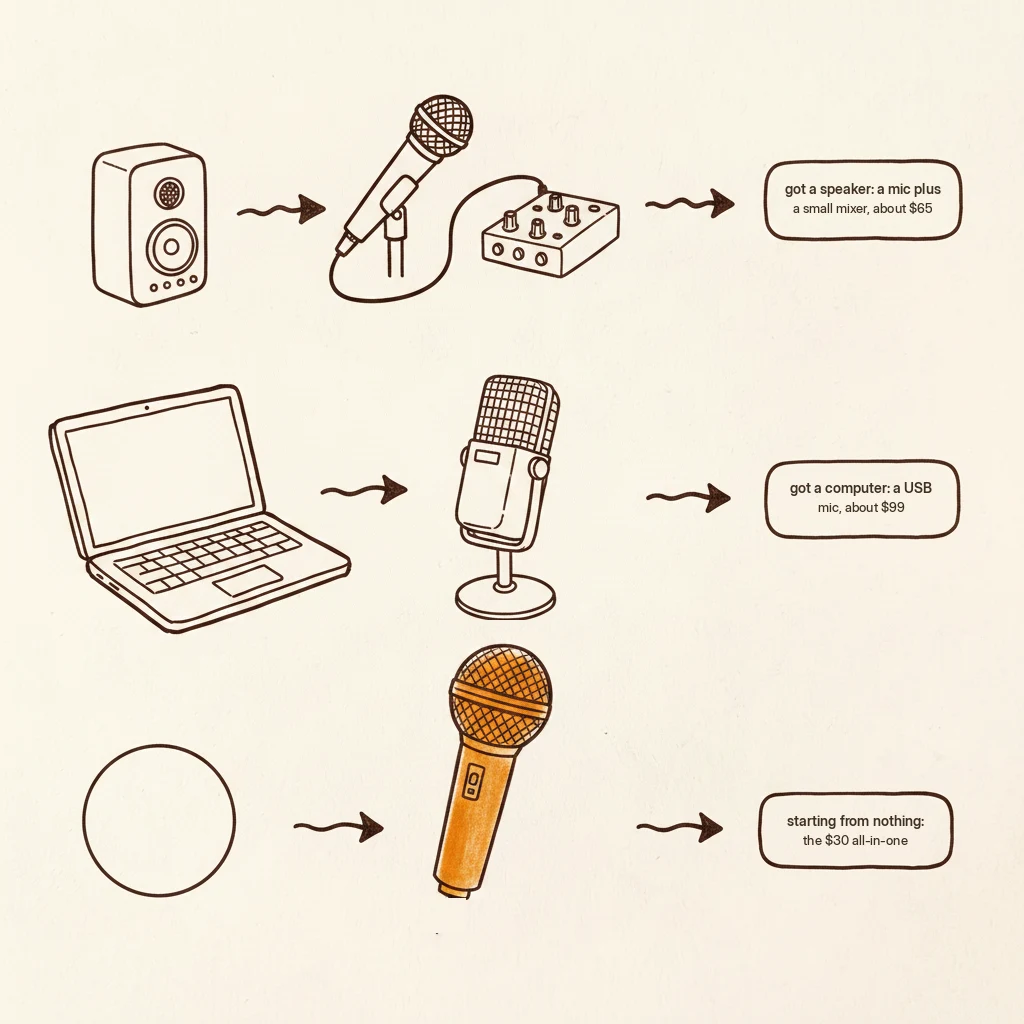
Start with what’s already in the room
You have a speaker. Maybe it’s a Bluetooth speaker on the shelf, maybe it’s a soundbar under the TV. Your daughter sings along to it, or you do, and now somebody wants a microphone in the mix.
That speaker is the whole answer. The mic you buy is decided by what that speaker will and won’t let you connect to it.
So before you shop: walk over, turn it around, and look at the back. Any little round hole labeled MIC, or AUX, or a big quarter-inch hole? Write down what you see. That’s your shopping list.
Plug a $40 mic straight into it and you get silence, or a whisper. Nothing is broken. It’s just the wrong hole, and nobody tells you that at the store.
That silence problem has its own page, because so many people hit it: mic plugged into speaker, no sound.
The $30 way: a mic that is its own speaker
If this is for fun, or for a kid, skip the whole connection question. Buy an all-in-one karaoke mic. The speaker is built into the handle. You turn it on and it works, in the kitchen, in the car, in the backyard.
An all-in-one karaoke mic, about $20 to $35. Two large pizzas. No wires, no plugging, no setup night. It connects to your phone for the music and plays the singing through itself.
Flaws, said plainly: it sounds like $30, and the little speaker will not fill a party. For a living room, that's fine.
The $65 way: hear yourself properly
Nobody explains this to the person practicing at home. The reason singing along at home feels awful isn’t the mic. It’s that you can’t hear yourself over the music. Every singer on every stage says the same sentence to the sound guy: “more me.”
A small mixer fixes it. A mixer is a little box with knobs: the music goes in, your mic goes in, and it sends both out to your speaker with your voice on top, where you can hear it.
Put a whisper of reverb on your voice and suddenly practicing is a pleasure instead of a chore.
A small mixer, about $65 (the Rockville RockMix5 is the one that keeps coming up), plus a real mic. The mic goes in the mixer, the mixer goes to the speaker you already own. Now you're louder than the backing track, with a little reverb, and you can hear every note you're missing.
Flaws, said plainly: it's one more box and two more cables. Fifteen minutes of setup, once.
For the real mic, get a Shure SM58, about $110, from Sweetwater or anywhere that sells them. Add a plain stand for $20 to $30 so nobody’s arm gets tired. If you buy through my links the site earns a little coffee money. Doesn’t change the price, doesn’t change my answer.
You do not need to soundproof anything
Somebody online told you to “treat your room,” hang foam, sing in a closet, buy panels. Put that down.
Your normal living room is fine. What actually cleans up the sound is where you hold the mic: bring it up under your chin, an inch or two away, and sing across the top of it instead of straight into it. That one move does more than a wall of foam.
A living room is bigger, so the reflections come back later and quieter, and your furniture is doing the soaking. Big and soft beats small and soft.
What about recording it, not just hearing it?
Different goal, different gear. If the point is a file you can play back, you want the sound going into a computer or a phone, not out of a speaker. That’s a USB mic (about $99), or honestly, your phone to start.
I keep two pages for that: recording yourself singing at home and recording singing on an iPhone.
If you're figuring this out, you're probably also wondering:
Gus Harmon
Gus spent three decades running sound wherever somebody needed it: bar bands, weddings, school shows, and twelve years of Sunday mornings. He can't sing a note. He can make sure you're heard. Now he writes so normal people can buy the right thing the first time.