
← a microphone for singing, at home or on stage
USB Microphone for Singing
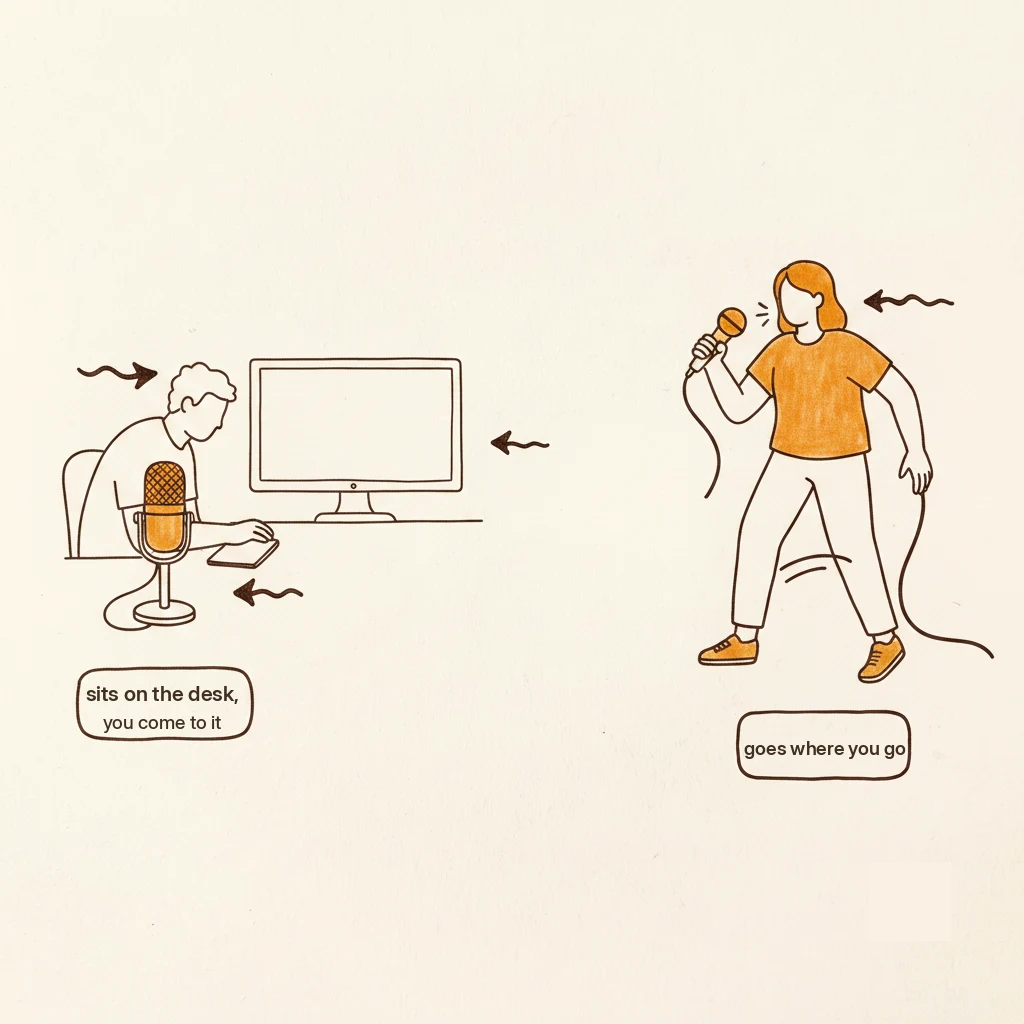
A USB mic plugs straight into the computer and just works, which is right if you record sitting at a desk (about $100 to $170), but if you want to hold a microphone and move, get a handheld USB mic instead (about $70).
 Gus Harmon · Updated July 8, 2026 · how I decide
If you buy through my links the site earns a little. It's never why I pick things.
What USB actually means
You’ve seen people say you need “an interface,” and then somebody else says you need “phantom power,” and now you’re annoyed. Fair.
Here’s the translation. A normal studio microphone can’t talk to a computer by itself. It needs a box in between that powers the mic and turns its sound into computer language.
A USB mic is a mic with that box built into it. That’s all. One cable, into the computer, done.
That’s the entire appeal, and it’s a real one. It’s the shortest distance between you and hearing yourself back.
The argument happening in your house
I read this one over and over. He wants plug-and-play, so he’s looking at USB. Her singing teacher said get a Shure SM58. And she takes one look at a fat mic sitting on a desk stand and says: that won’t feel like a real microphone.
And here’s the part nobody on the first page of Google leads with: you don’t have to choose. Handheld USB mics exist.
The mic that solves it
Samson Q2u, about $80. It looks and feels like a stage mic because it is one, and it has both plugs on the bottom: USB for the computer today, the regular cable for a PA speaker later. The Audio-Technica ATR2100x is the same idea for about $79.
Flaws, said plainly: it's not the prettiest thing on a desk, and it isn't the mic a podcast reviewer would hand you. It is the one that fits somebody who sings standing up.
Both are USB and XLR, which is the fat three-pin cable that live sound gear uses. So the mic survives the upgrade. That’s rare and it’s worth $70.
If you buy through my links the site earns a little coffee money. Doesn’t change the price, doesn’t change my answer.
If you really do just sit at a desk
Recording covers into a laptop, in a chair, not moving. Then a desk-style USB mic is the correct tool and here are the names that show up on every list, which is worth something even before you get to the details.
Audio-Technica AT2020USB-X, about $169, or the Rode NT-USB, about $170. The Blue Yeti (about $100 to $140, often on sale for less) is the one everybody's heard of and it's fine, with one catch below.
Flaws, said plainly: the Yeti is big, it lives on a desk, and it hears the whole room. The NT-USB costs about ten pizzas.
The room rule (why the cheap fancy mic disappointed you)
This is the most useful thing on this page, so I’ll say it slowly.
Microphones come in two temperaments. The sensitive kind (a condenser) hears everything: your voice, the refrigerator, the road, and your voice again a half-second later as it bounces off the wall. The tough kind (a dynamic, like the SM58 or the Q2u) mostly hears whatever is two inches in front of it.
Studios use the sensitive kind, because studios are quiet, padded rooms. You do not live in a studio. You live in a house.
So when a beginner buys a well-reviewed condenser mic and thinks it sounds thin and echoey and cheap, the mic did nothing wrong. It heard the house, exactly as designed. The tough mic would have heard you.
Building them into the mic is what makes USB cheap and simple. It’s also why a USB mic can’t be upgraded piece by piece: you bought the whole chain at once.
What people will argue with you about
Two honest disagreements, reported straight, because I’d rather you hear them from me.
Some people say USB mics are unreliable. I’ve seen it said plainly, more than once, by people who own several: technical problems with every USB mic they’ve had, and a feeling that USB mics are really built for streaming and chatting. USB is the easiest path. It’s not automatically the most durable one.
And the cheapest real setup that isn’t USB at all: a Behringer XM8500 (an SM58-style mic, about $20) into a Behringer UM2 interface (about $45). A Focusrite Scarlett is the interface everybody names when they have more to spend.
Also, an sE V7, about $100, gets called an SM58 killer by people who like it.
If you're figuring this out, you're probably also wondering:
Gus Harmon
Gus spent three decades running sound wherever somebody needed it: bar bands, weddings, school shows, and twelve years of Sunday mornings. He can't sing a note. He can make sure you're heard. Now he writes so normal people can buy the right thing the first time.