
← a microphone for singing, at home or on stage
Best Wireless Mic for Singing (Without the Scary Parts)
A wireless singing mic is the mic plus a receiver box that plugs into your speaker: a decent home pair runs about $67, real stage systems start around $300, and if you aren't walking around while you sing, a $109 wired mic beats any wireless at the same price.
 Gus Harmon · Updated July 8, 2026 · how I decide
If you buy through my links the site earns a little. It's never why I pick things.
Some people say cordless
Cordless microphone, wireless microphone, same thing. If cordless is your word, it’s a fine word, and it’s the one I’d use standing in your kitchen.
What you want is to sing without a cable on the floor, or to hand the mic to your brother-in-law across the room. Fair. Let’s do it right.
The part the box doesn’t tell you
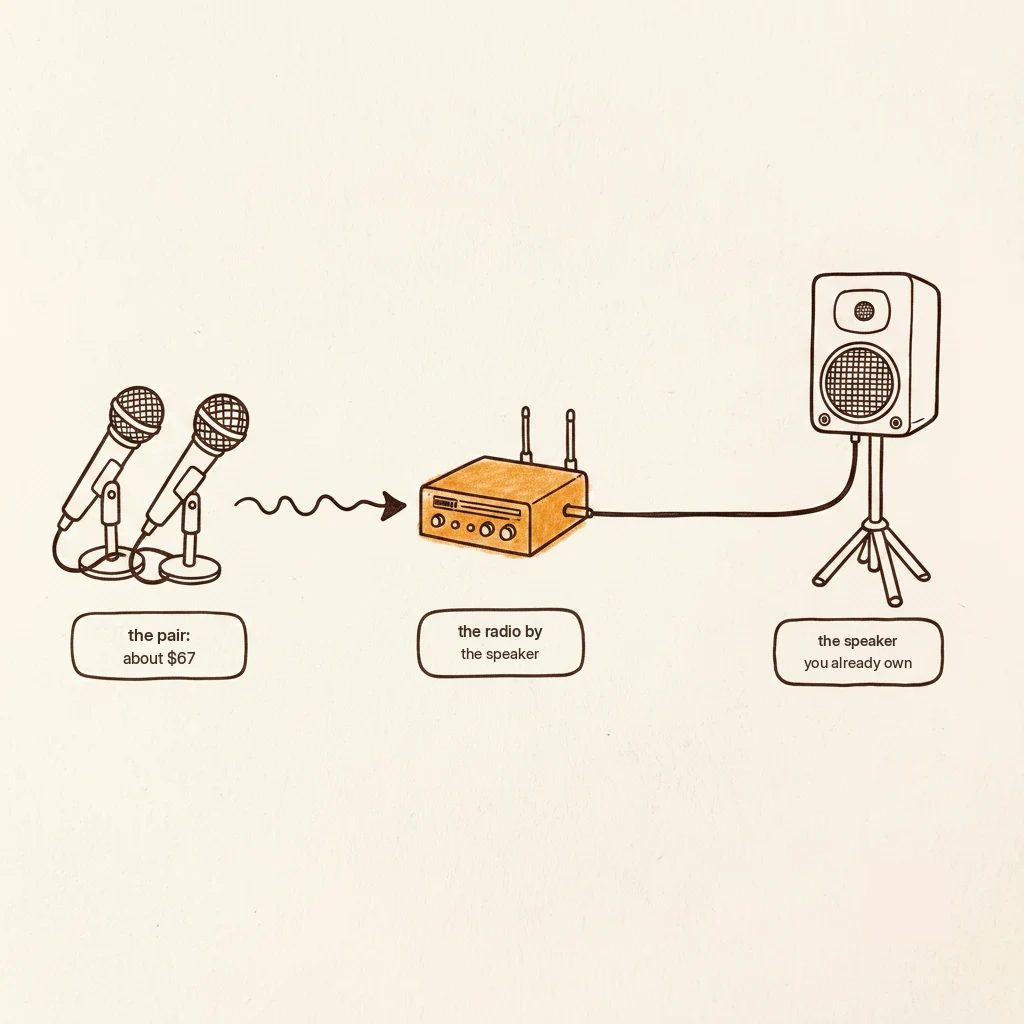
There’s still a cable. It just moved.
The mic broadcasts by radio to a receiver, which is a small box that sits next to your speaker and plugs into it. So you’re buying a radio pair, not a microphone.
That’s why a $60 wireless mic and a $60 wired mic are not comparable objects. The wired one spent all sixty dollars on sound. The wireless one spent it on two radios and a battery, and whatever was left over on sound.
The honest home answer, about $67
For passing a mic around a living room, one system keeps getting named by the people who actually do karaoke every weekend.
Fifine K036 dual wireless, about $67 for the pair. The karaoke crowd's own veteran calls it not great but good enough for home: cheap plastic, decent feel in the hand, no dropouts at ten feet, adequate echo.
Flaws, said plainly: it distorts a little when somebody really lets loose, and the plastic is plastic.
Phenyx Pro four-channel system, about $200. Four things at once: handhelds, a headset, a lapel mic. This is where "system" starts meaning something.
Flaws, said plainly: it's real gear with real settings, and $200 is a lot to spend for a mic you pass around at parties.
If you buy through my links the site earns a little coffee money. Doesn’t change the price, doesn’t change my answer.
And the counter-argument, which I believe
For $109 you can buy a Shure SM58, plug it into a cable, and have a microphone that sounds better than anything wireless near that price, works for fifty years, and cannot run out of batteries in the middle of your song.
If your singing happens in one spot, in front of one speaker, that’s the buy. I wrote the whole SM58 case here.
Batteries are the real reliability spec
Nobody wants to hear this because it isn’t a brand.
A $250 system with dying batteries sounds worse than a $67 system with fresh ones. As the battery fades, the mic broadcasts weaker, and the receiver compensates by amplifying the radio noise along with your voice. That’s the hiss that shows up in the second hour.
Buy batteries in bulk. Change them before the party, not when you notice.
If you're figuring this out, you're probably also wondering:
Gus Harmon
Gus spent three decades running sound wherever somebody needed it: bar bands, weddings, school shows, and twelve years of Sunday mornings. He can't sing a note. He can make sure you're heard. Now he writes so normal people can buy the right thing the first time.