
← a microphone for singing, at home or on stage
Wireless Headset Microphone for Singing
A wireless headset mic is really three parts (the headset, a transmitter you wear, and a receiver that plugs into your speaker), real systems start around $250, and the $40 versions mostly disappoint.
 Gus Harmon · Updated July 8, 2026 · how I decide
If you buy through my links the site earns a little. It's never why I pick things.
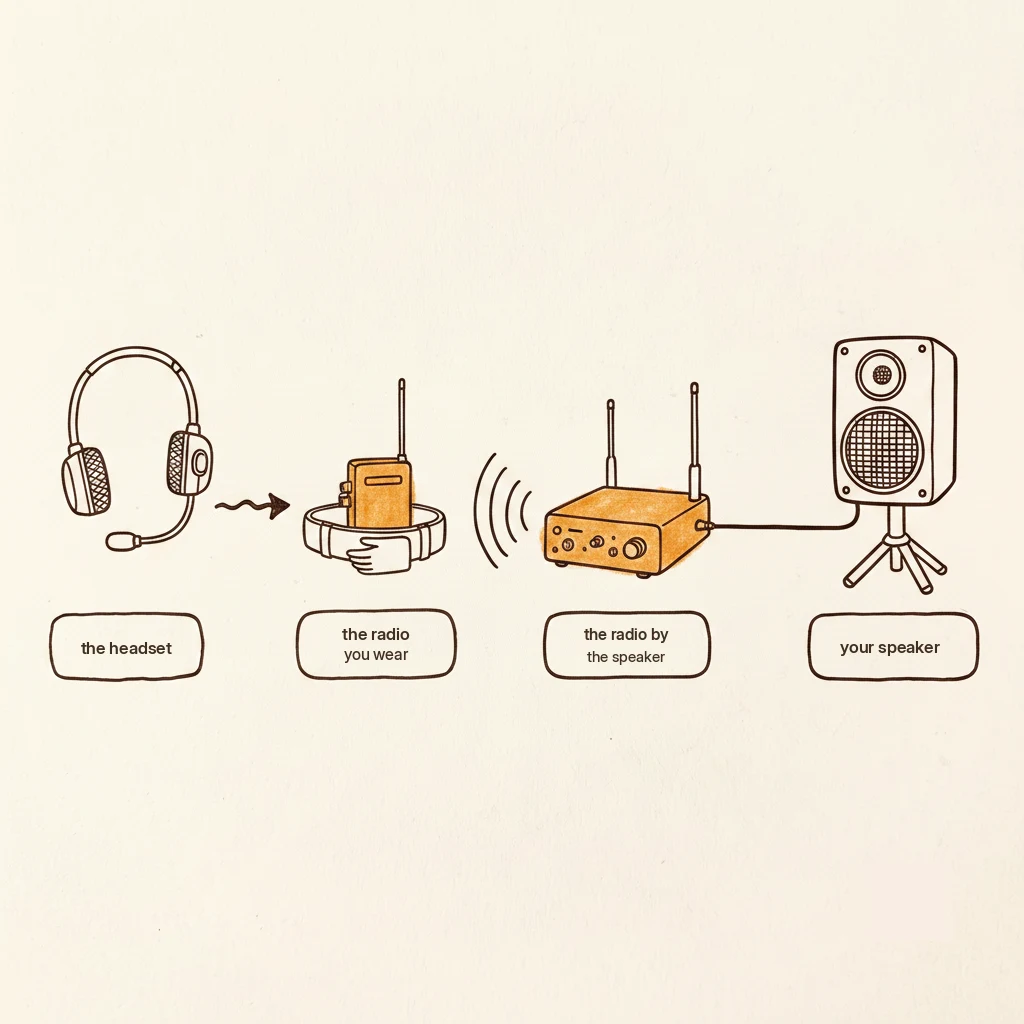
Why there’s a box, and then another box
You went looking for a wireless microphone and the product page showed you three objects. Reasonable question: why do I need all this?
Because “wireless” means radio, and radio takes two ends.
The headset picks up your voice and sends it down a short wire to a small box clipped to your belt. That box is the transmitter, and it’s the thing doing the actual broadcasting. Across the room, a receiver sits by your speaker, catches the broadcast, and hands the voice to the speaker through a cable.
There’s still a cable. It just moved to the other end of the room, which is exactly the trade you wanted.
The honest wall
I’ll say the number out loud, because nobody else on this shelf will.
Real wireless headset systems for singing start around $250 and run to about $400. That’s the floor. Below it is a graveyard of bundles that hiss, drop out mid-chorus, and come with a receiver you can’t plug into anything you own.
Samson Concert 88x headset system, about $250 to $300. The one that gets named for singers, worship leaders, and fitness instructors. Headset, beltpack, receiver, all matched.
Flaws, said plainly: it eats batteries, and it's a system to learn, not a thing to plug in.
Sennheiser XS Wireless 1 headmic set, about $300 to $400, or Audio-Technica System 10, about $300. The Sennheiser is sold as an all-in-one for singers and presenters. The Audio-Technica has a reputation for easy setup and clear sound.
Flaws, said plainly: same story, more money.
If you buy through my links the site earns a little coffee money. Doesn’t change the price, doesn’t change my answer.
The one rule about two microphones
If two wireless mics are running in the same room, they cannot be on the same channel. Same as walkie-talkies: two people on channel 3 hear each other.
That’s the entire meaning of the “frequency selection” language on the box. If you own one mic, you’ll never think about it. If somebody brings a second one, both go silent or squeal until you move one over.
Do you actually need wireless?
I’ve stood behind a board at school shows and church stages watching borrowed wireless die mid-song, in front of everybody, and there is nothing you can do about it from the back of the room.
Cables are annoying. Dropouts are worse.
If you’re standing still, or standing behind a stand, or moving six feet either way, wireless is a $250 solution to a problem you don’t have. Buy the wired headset, or buy an SM58, and keep the money.
If you're figuring this out, you're probably also wondering:
Gus Harmon
Gus spent three decades running sound wherever somebody needed it: bar bands, weddings, school shows, and twelve years of Sunday mornings. He can't sing a note. He can make sure you're heard. Now he writes so normal people can buy the right thing the first time.