
← how singers and sound actually work
Why Don't Singers Use Headset Mics?
Plenty of singers do, whenever they dance: a headset trades a little sound quality and the microphone-as-prop for two free hands, which is why you see them on Janet Jackson and every kpop stage and almost never on a ballad singer.
 Gus Harmon · Updated July 8, 2026 · how I decide
If you buy through my links the site earns a little. It's never why I pick things.
You noticed the wire hooked over her ear
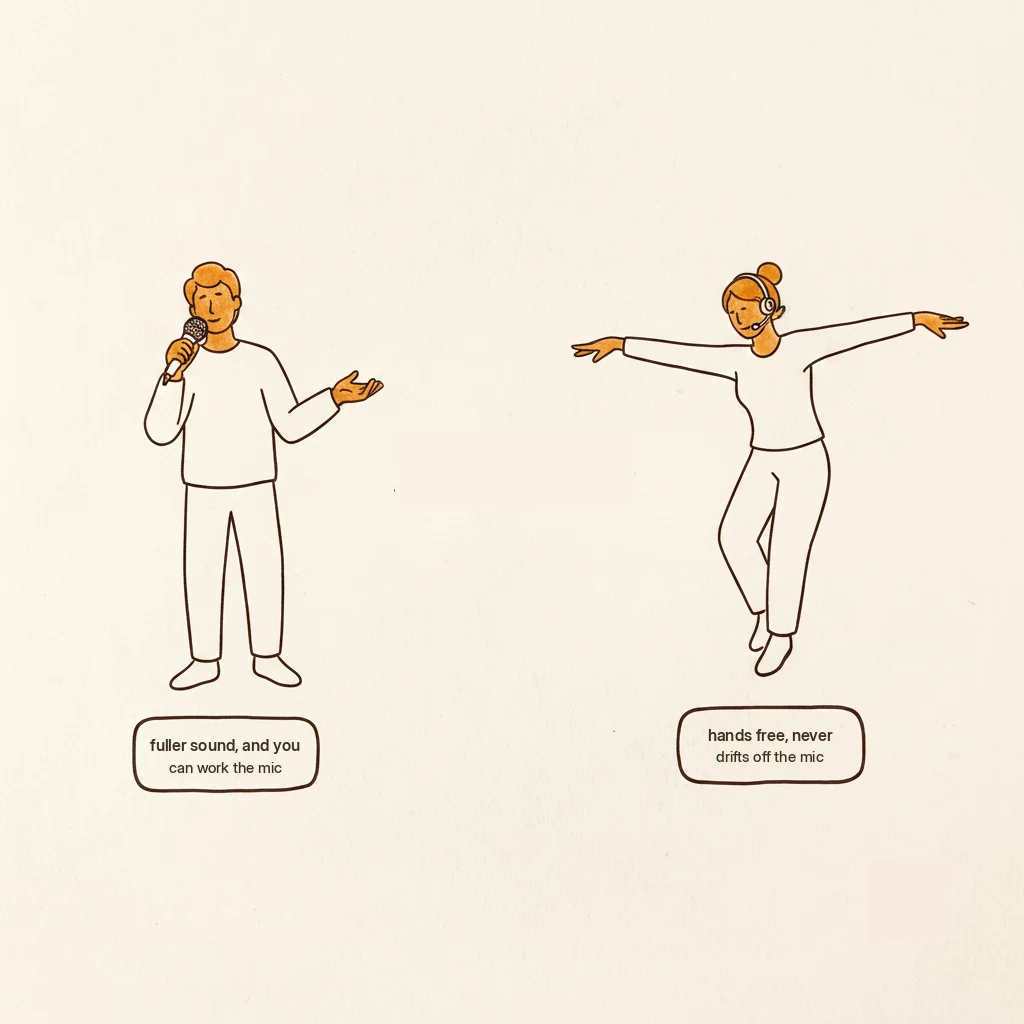
Somebody’s dancing across a stage, singing, and there’s a thin arm curving down her cheek. Then the next act comes out, stands at a stand, and holds a microphone like it’s a small animal.
Both of those people are making the same choice. They just have different jobs that night.
What the handheld gives you
A microphone in your hand is a volume knob you can move.
Singers pull the mic back on the big note and let it fly. They pull it in close on the quiet line so it gets intimate and thick. Sound people call that working the mic, and it’s a real skill, and a headset takes it away from you completely.
That’s the trade. Not sound quality in some abstract way. Expression.
What the headset gives you
Two hands, and a distance that never changes.
If you’re dancing, you can’t be nursing a microphone. You need to hit choreography, and you need the mic to be exactly where it was three seconds ago, before that spin. So the headset goes on and the mic stops moving, forever.
The picture in your head is from the 80s
That’s on purpose. Janet Jackson’s headset became a piece of pop culture furniture. Britney’s did too, to the point that people just call it “the Britney mic.” Nobody had to explain to an audience what it meant: this person is going to move.
The kpop stages you see today are the same idea, grown up. A modern headset feeds a little radio box clipped to the performer’s belt, which sends the voice across the room to a receiver. Same object, same reason, better parts.
So which one is “better”?
Neither. That’s the answer, and it took me about ten years behind a mixing board to actually believe it.
I’ve watched a singer with great hand technique rescue a room that sounded like a gymnasium. I’ve also watched a dance number fall apart because somebody insisted on holding a microphone through it. The gear didn’t decide either night. The job did.
If you're figuring this out, you're probably also wondering:
Gus Harmon
Gus spent three decades running sound wherever somebody needed it: bar bands, weddings, school shows, and twelve years of Sunday mornings. He can't sing a note. He can make sure you're heard. Now he writes so normal people can buy the right thing the first time.