
← hear yourself back, without a studio
Best Microphone for Recording Singing
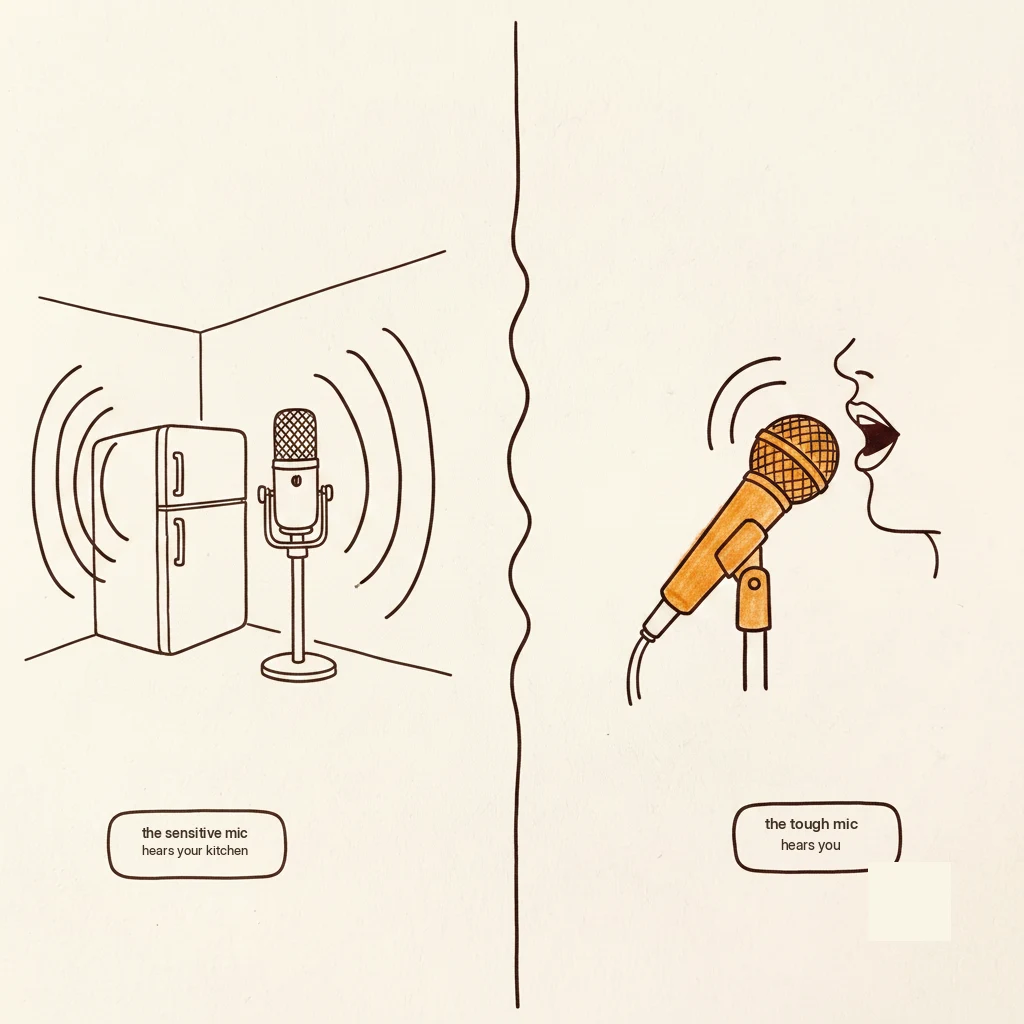
For recording singing at home the room matters more than the mic, so buy the tough $100 dynamic mic that forgives a normal house rather than the sensitive studio mic that records your kitchen along with your voice.
 Gus Harmon · Updated July 8, 2026 · how I decide
If you buy through my links the site earns a little. It's never why I pick things.
Recording is where the money gets wasted
Somebody records at home for the first time, hates how it sounds, and concludes they need a better microphone. So they buy a $200 one. It sounds worse.
That happened because of one thing nobody explains, and once you know it, you’ll save yourself years.
The room is in the recording
Your voice reaches the microphone twice. Once directly, from your mouth. Then again, a fraction of a second later, bounced off the wall, the window, the countertop, the ceiling.
You don’t hear that second copy in real life because your brain edits it out. The microphone doesn’t have a brain. It records both.
So buy the tough mic
An sE V7, about $100, or a Shure SM58, about $110 (about $40 to $60 used). Both are tough dynamic mics. They hear you and mostly ignore the house. People who like the V7 call it an SM58 killer.
Flaws, said plainly: they need a small box to reach the computer, and they won't capture the last ten percent of airy detail a good condenser gets in a good room.
A Behringer XM8500, about $20, into a Behringer UM2 interface, about $45. Sixty-five dollars, total, and it will not embarrass you. An interface is the box that turns a microphone into something a computer understands. The Focusrite Scarlett Solo (about $170) is the one you'll see recommended everywhere.
Flaws, said plainly: it's plastic, and nobody will compliment your gear.
If you buy through my links the site earns a little coffee money. Doesn’t change the price, doesn’t change my answer.
When a condenser earns its keep
I’m not against them. I own them. They are extraordinary in a quiet, soft room.
If you have a small carpeted room with a lot of soft stuff in it, and no fridge or furnace within earshot, then an AT2020 (about $119) or an AT2035 (about $159) will give you detail the dynamic mic can’t. I compared those two here.
The rule is: the room first, then the mic. Not the other way around, ever.
The SM58 argument, out loud
Studio people say never record with an SM58. Stage people say it’s the industry standard. Both camps are certain, and they’re describing different rooms.
In a quiet treated studio, the SM58 leaves detail on the table, and the studio people are right. In your kitchen at nine at night with a refrigerator, the SM58 gives you a usable vocal and the $400 condenser gives you a beautiful recording of a refrigerator.
Pick for the room you actually have.
The coat closet
If the recording still sounds like a room, get closer to the mic. Under your chin, a couple inches out, singing across the top rather than into it. Close beats fancy.
You might not need to buy anything
A voice teacher said something I keep repeating: a beginner might not need to buy anything at all, because a phone voice memo is enough to start hearing yourself.
That’s the honest first step, it costs nothing, and it teaches you more than gear does. The free path is here.
What about the famous singers’ mics
People ask what Billie Eilish or Taylor Swift record with. The honest answer is that whatever microphone is on that stand, it’s in a room built and tuned to be silent, going into an engineer’s hands.
The mic is the least of it. That’s not gatekeeping, that’s the good news: the room is the part you can improve for free, tonight, with a closet full of coats.
If you're figuring this out, you're probably also wondering:
Gus Harmon
Gus spent three decades running sound wherever somebody needed it: bar bands, weddings, school shows, and twelve years of Sunday mornings. He can't sing a note. He can make sure you're heard. Now he writes so normal people can buy the right thing the first time.