
Sound System for a Small Church, in Plain English
A small church needs four things (a mixer, one or two powered speakers, microphones, and cables) which run about $800 to $1,500 all in, but the order matters more than the brands: fix the room and the speaker placement before you buy anything.
 Gus Harmon · Updated July 8, 2026 · how I decide
If you buy through my links the site earns a little. It's never why I pick things.
What's on this page
Nobody trained you for this
Somebody handed you the sound board, or you volunteered in a weak moment, and now Sunday arrives every seven days whether you’re ready or not.
The quotes you got were terrifying. The internet answers in a language you don’t speak. And $100 is not chump change in a church budget, whatever the audio forums seem to think.
Sit down. This is simpler and cheaper than anyone told you. Twelve years behind a little board on Sunday mornings taught me that most of what gets sold to churches is solving a problem the church doesn’t have.
Do these things first, they cost nothing
Before a dollar leaves the account.
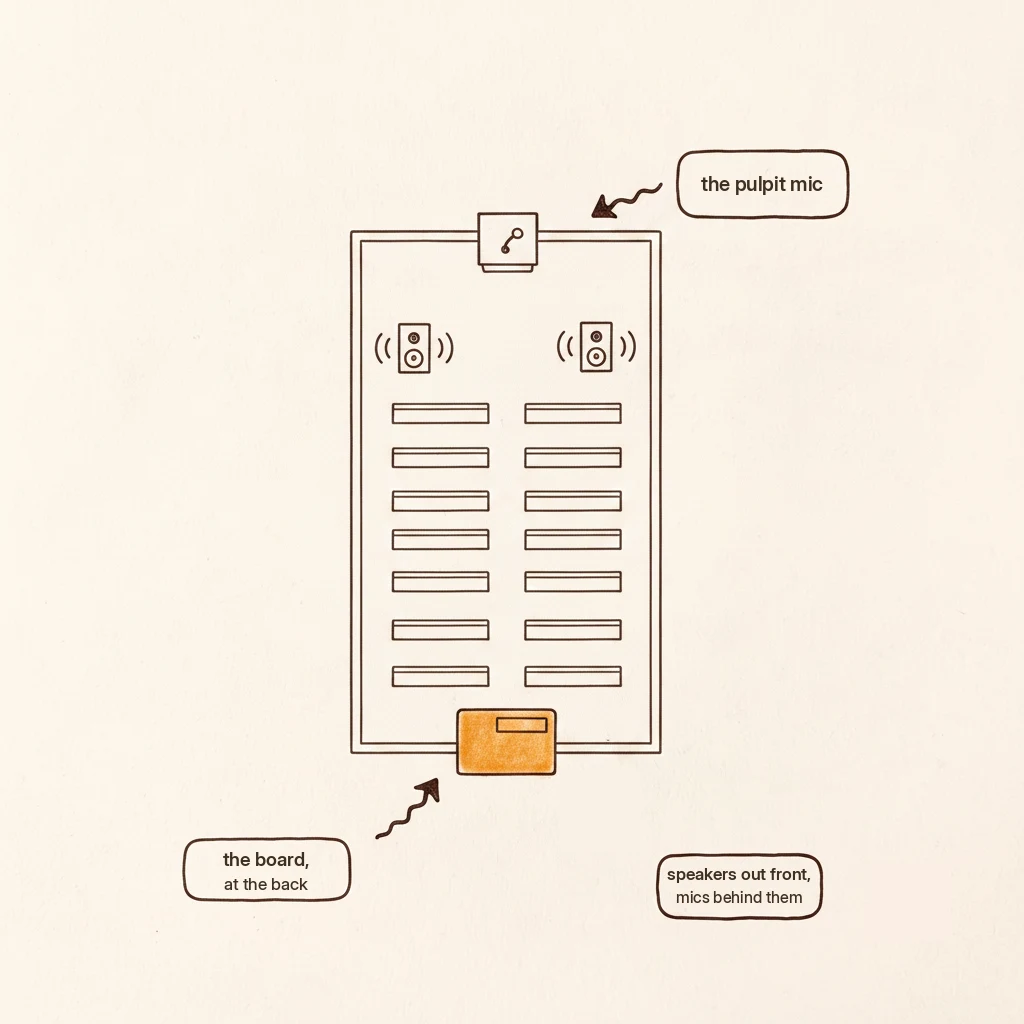
Move the speakers so they’re in front of the microphones. Not behind, not level with. If a speaker can see a microphone’s face, you’ll get a squeal, and no amount of money fixes that geometry.
Point the speakers at people, not at walls. Sound bounces off hard surfaces and comes back as mush. Every soft thing in that room (carpet, cushions, bodies) is on your side.
Then turn on the low-cut switch, sometimes labeled with a little slope symbol, on every channel except the bass and the kick drum. It throws away rumble nobody can hear anyway, and the mud clears up like a window got washed.
The headphone test
Here’s the trick that makes an untrained volunteer sound like they know what they’re doing. I’ve now seen two different working professionals give it, independently, in exactly the same words.
Pick a song you know very well. Listen to it on decent headphones until you have the sound of it in your head.
Then, in the room, tune until the room sounds like that. Not like a spec. Not like a meter. Like the song you know. Your ears already contain the reference; you just needed permission to trust them.
The four things you actually buy
| The thing | What it does | Rough cost |
|---|---|---|
| The mixer (the board) | Takes every microphone, sets how loud each one is, sends them out | About $250 to $350 |
| Powered speakers, a pair | Makes it loud. "Powered" means the amplifier is inside, so there's no extra box | About $300 to $600 |
| Microphones | Two SM58s covers most small churches | About $220 new, about $120 used |
| Cables | The boring part that fails first. Buy decent ones | Whatever's left |
Buy used without shame. A used SM58 is unkillable and costs about $60. I’ve written more about that microphone here, and used powered speakers from a church that upgraded are often perfect.
If you buy through my links the site earns a little coffee money. Doesn’t change the price, doesn’t change my answer.
What to spend, honestly
Eight hundred dollars, done thoughtfully, beats several times that spent in the wrong order.
Money goes to speakers first, because that’s what the congregation hears. Then microphones. Then the board, which matters least, because a cheap modern board is remarkably good and nobody in the pews can hear the difference.
The volunteer problem
The person running sound next year isn’t you. That fact should shape the purchase more than any spec.
Buy a board with physical knobs. A volunteer who touches this once a month can find a knob. Nobody finds a menu, three screens deep, at 9:55 on a Sunday.
And check the warranty length before you buy. Ten years on a board is worth real money to a church that will still own it in ten years.
Free training exists. Shure runs an audio institute with free courses, and it’s aimed squarely at people in your exact chair. Nobody tells volunteers this, and somebody should have told you a year ago.
If you're figuring this out, you're probably also wondering:
Gus Harmon
Gus spent three decades running sound wherever somebody needed it: bar bands, weddings, school shows, and twelve years of Sunday mornings. He can't sing a note. He can make sure you're heard. Now he writes so normal people can buy the right thing the first time.