
← first chords, first songs, at any age
How Much Do Piano Movers Cost? (And Why Not the Couch Guys)
Professional piano movers charge about $150 to $400 for a local upright move and $700 to $2,000-plus for long distance, and it's worth it because a piano can hurt people.
 Gus Harmon · Updated July 8, 2026 · how I decide
If you buy through my links the site earns a little. It's never why I pick things.
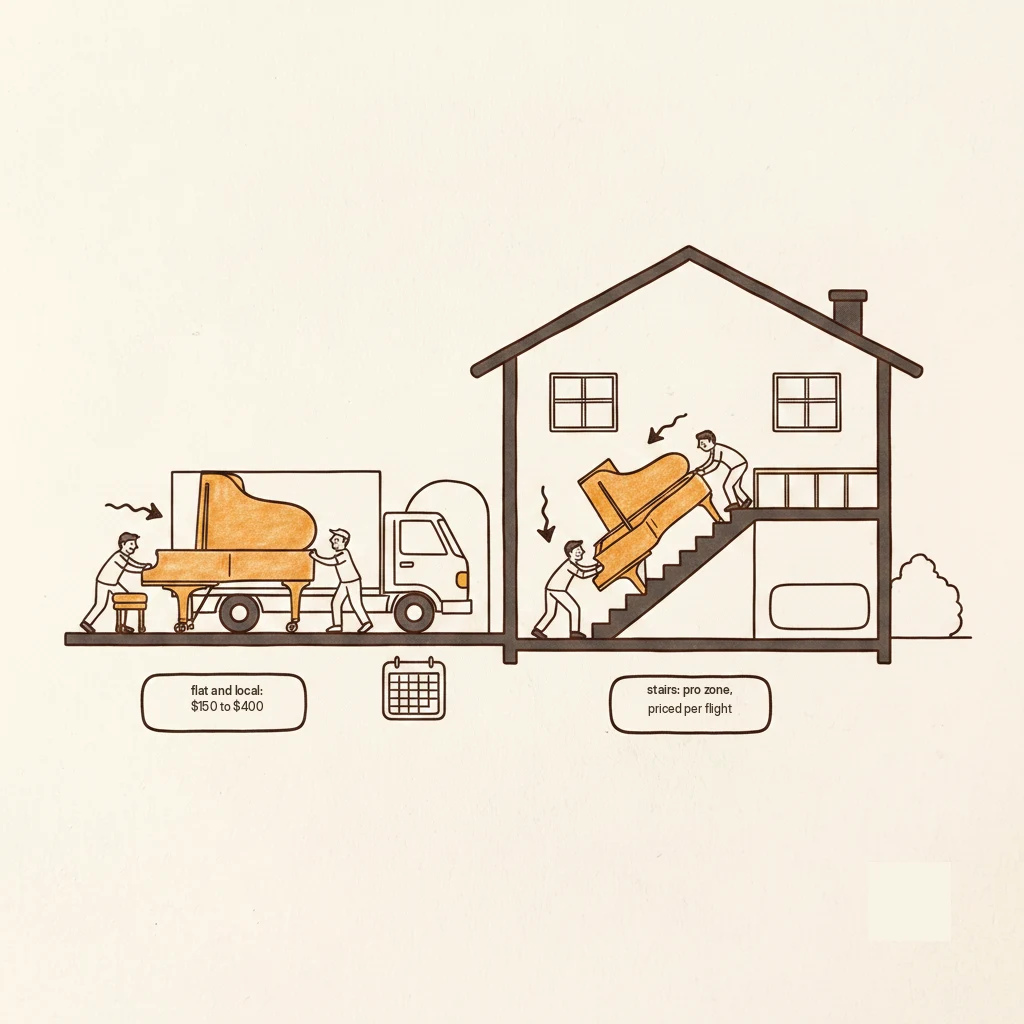
Professional piano movers charge about $150 to $400 for a local upright move, with stairs adding a fee per flight, and $700 to $2,000-plus for long distance. A grand piano costs more because it gets partially taken apart. It’s worth it for two reasons people underrate: a piano can seriously hurt people (300 to 900 pounds, and awkward), and a dropped piano is usually totaled.
You just bought the used upright, or you accepted the free one, or you’re relocating and the piano is the boss battle of the whole move. And you’ve probably already got three friends and a truck mentally on standby. Let me tell you when that’s fine and when it’s a trip to the emergency room.
Here’s the thing. A piano isn’t heavy the way a couch is heavy. It’s three hundred to nine hundred pounds of awkward, top-heavy weight that wants to tip, and it can crush a hand, a foot, or a back in a blink. So the price of piano movers isn’t really about the piano. It’s partly about not maiming your brother-in-law.
The anchor numbers
A local upright move runs a hundred fifty to four hundred dollars. Stairs are a separate line item, charged per flight, so get every flight into the quote up front. Long distance is seven hundred to two thousand and up. A grand costs more because they partially disassemble it, legs and the pedal assembly off, laid on its side on a padded board.
One critical warning: regular household movers often flat-out refuse pianos, or they’ll move it but exclude it from their insurance. So if a piano’s in your move, ask before you assume the moving company’s got it. A specialist is a specialist for a reason.
The honest “can I do it cheaply” answer
Because you asked, and it’s fair. A small digital piano or a little spinet, on one floor, with four adults and a real furniture dolly, is genuinely DIY-able. Those have handles and they’re manageable.
A full upright, plus any stairs at all, is the injury tier. That’s where backs go, fingers get pinched, walls get gouged, and the piano itself gets dropped and destroyed. Not worth it.
The smart middle path if money’s tight: hire the piano movers for just the hard leg, getting it out of the house and onto the truck, and let your friends handle the easy flat stretches. You pay for the danger, not the whole job.
And here’s a bit of quiet wisdom: schools, churches, and concert halls don’t move their own pianos either. That’s not them being precious. That’s them having done the math on injuries and dropped instruments and deciding the movers are cheaper. Follow the institutions on this one.
Why are pianos and moving such enemies, beyond the weight? Because a piano is around 200-plus strings under something like eighteen tons of tension, all balanced against a wooden frame that’s spent years settling into one spot and one climate. Haul it across town, tip it, bump it up stairs, and drop it into a room with different humidity, and all that tension and wood has to re-acclimate to the new home. That’s why the piano will sound off after a move even if nothing broke. It needs to resettle. Which leads to the one tip that makes movers and tuners both happy: book the tuning for about three weeks AFTER the move, not three days. Give it time to breathe in its new spot before you tune it.
For the free-piano folks: this move is the real price of that “free” piano. Three to six hundred dollars before it plays a single note. Factor it in before you say yes.
A couple of traps. Movers who quote low over the phone, then “discover” the stairs on arrival, so get flights in writing. Hourly quotes for what should be a flat rate. And long-distance brokers who subcontract, versus the actual carrier who shows up, so ask who’s really doing the lifting.
Upright, with any stairs anywhere: pay the piano movers the $300 and tip them. Ground-floor digital: you and a friend, it has handles. And book the tuner for three weeks after the truck leaves, not three days.
If you’re figuring this out, you’re probably also wondering:
Gus Harmon
Gus spent three decades running sound wherever somebody needed it: bar bands, weddings, school shows, and twelve years of Sunday mornings. He can't sing a note. He can make sure you're heard. Now he writes so normal people can buy the right thing the first time.