
← first chords, first songs, at any age
How Much Does a Piano Cost? (And Whether You Even Need One)
A real upright piano runs about $3,000 to $8,000 new or $500 to $2,500 used plus moving and yearly tuning, while a weighted digital at $450 to $700 needs none of that.
 Gus Harmon · Updated July 8, 2026 · how I decide
If you buy through my links the site earns a little. It's never why I pick things.
A real acoustic upright piano runs about $3,000 to $8,000 new, or $500 to $2,500 used from a dealer, plus roughly $300 to $600 to move it and $200 or more a year in tuning. A weighted-key digital piano, about $450 to $700 new and less used, needs none of that and is the honest starting point for most beginners. The “free” Craigslist piano usually costs $1,000-plus in moving and repair to become playable.
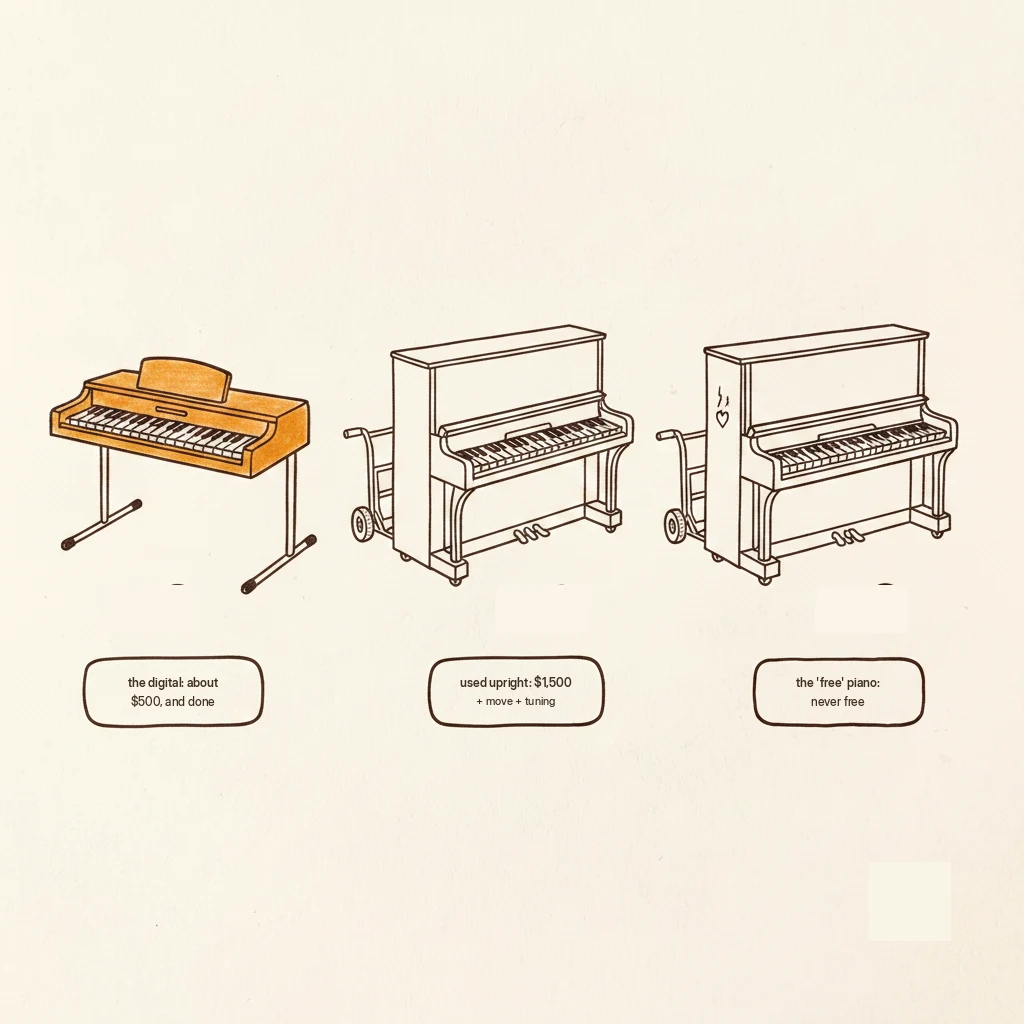
A piano is a different kind of purchase than a keyboard, because a piano moves into the house. It’s furniture with a commitment attached. So before you price one, let me show you the fork, because most beginners don’t actually need the four-figure version.
Here’s the thing nobody at the dealership leads with: an acoustic piano isn’t just an instrument, it’s an instrument plus furniture plus an ongoing service relationship. A tuner twice a year. A mover every time it changes rooms or houses. A digital piano is just the instrument, full stop, and for a beginner the weighted digital is the consensus starting point. The weighted keys build real technique and translate smoothly onto a real piano later.
The three ways to buy a piano
The weighted digital. Four fifty to seven hundred new, less used. No tuning, no movers, no drama, and it’s genuinely what most beginners should start on. There’s a whole page on picking one.
The used acoustic upright. Five hundred to twenty-five hundred from a dealer, refurbished. This is the real entrance to acoustic pianos. But a private-sale piano needs a technician’s eyes first, because a couple of hidden parts, the pinblock and the soundboard, cost more to fix than the whole piano is worth. Get it inspected.
The new acoustic upright. Three to eight thousand, Yamaha or Kawai class. Beautiful, and more piano than a first-year student needs.
There’s a grand-piano rung above all this, from about eight thousand used up into six figures, but that’s the deep end of a serious hobby, not the door into it. It’s the same machine as the five-hundred-dollar upright, just taken much further. Nice to know, not something to buy now.
The free-piano trap
This one saves people real money, so hear me out. Free pianos on Craigslist are usually free because they’re worn out. By the time you pay to move it, three to six hundred dollars, then pay for a pitch raise and repairs to make it playable, you’re a thousand dollars in, on a piano somebody gave away for a reason.
Sometimes, though, the free piano really is a good one somebody just needs gone. So the rule that protects you either way: pay a technician a hundred fifty bucks to inspect it BEFORE you pay anyone to move it. Cheapest insurance there is. Move it first and you might be paying to haul a very heavy piece of firewood up your stairs.
Why does a piano need tuning at all, when a guitar holds for weeks? Because inside a piano are around 200-plus strings, and together they pull with something like eighteen tons of tension against a big wooden frame. That wood breathes with the seasons, swelling in humid summers and shrinking in dry winters, and as it moves, the tension on all those strings shifts and the tuning drifts. So a piano isn’t fragile, it’s just a giant wooden thing under enormous strain, reacting to the weather in your house. That’s the ongoing cost you’re signing up for with acoustic, and it’s exactly the cost a digital doesn’t have.
The real fear under all this is being the family with a piano nobody plays, a very expensive, very heavy reminder. Which is exactly why you start cheap and prove the habit first.
A couple of traps. The free-piano moving-cost ambush, covered above. And spinet pianos dressed up as “compact uprights,” a tier that technicians tend to groan at, so ask what it actually is.
Start on the weighted digital. If the piano habit survives two years, buy the used dealer upright and pay the movers like your back depends on it, because it does. And never accept a free piano without a $150 inspection first.
If you buy through my links the site earns a little coffee money. Doesn’t change the price, doesn’t change my answer.
If you’re figuring this out, you’re probably also wondering:
Gus Harmon
Gus spent three decades running sound wherever somebody needed it: bar bands, weddings, school shows, and twelve years of Sunday mornings. He can't sing a note. He can make sure you're heard. Now he writes so normal people can buy the right thing the first time.