← first chords, first songs, at any age
A Keyboard for a Beginner (61 or 88 Keys? The Real Answer)
For a beginner, how the keys feel matters more than how many, so 61 keys are fine for year one but a used 88-key weighted digital at $300 to $500 is the better buy.
 Gus Harmon · Updated July 8, 2026 · how I decide
If you buy through my links the site earns a little. It's never why I pick things.
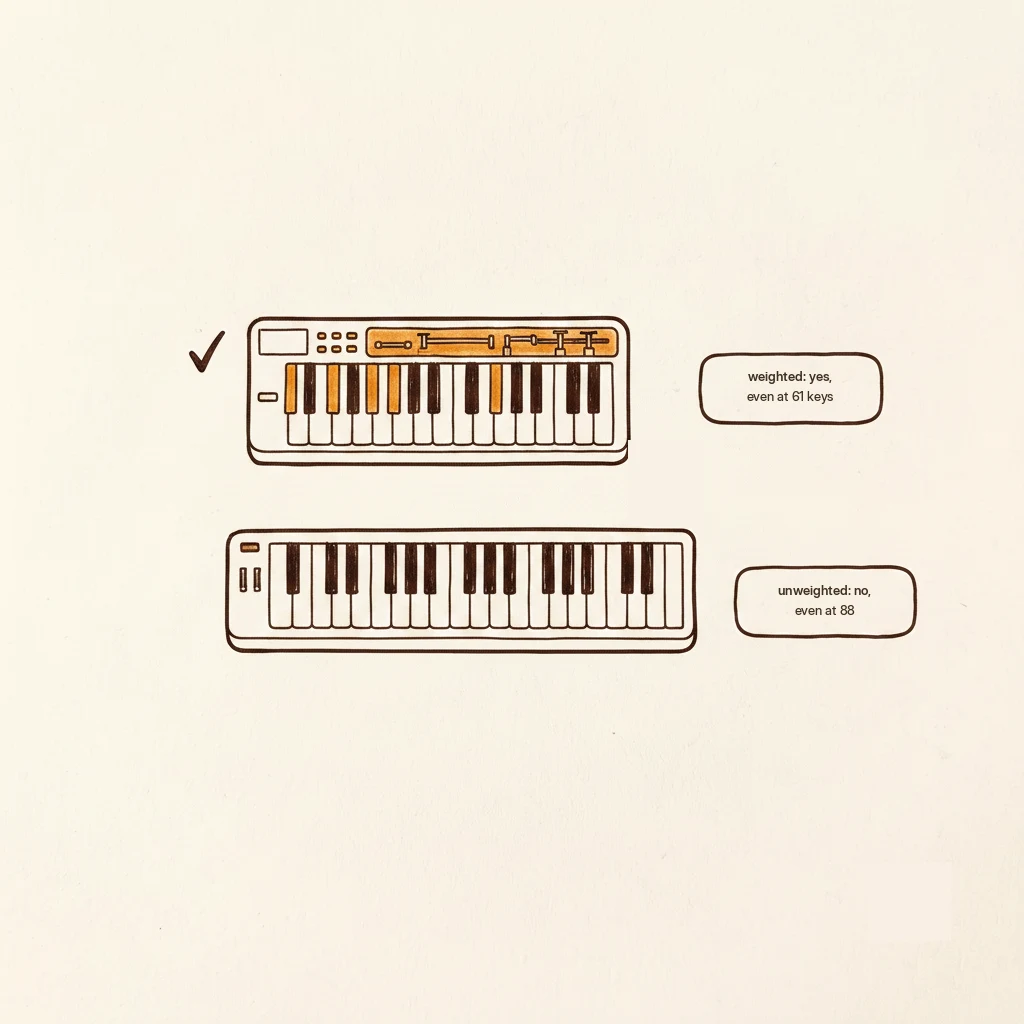
For a beginner, how the keys FEEL matters more than how many there are. 61 unweighted keys are fine for the first year of chords and songs, but weighted keys, the piano-like resistance, are what build real technique. The honest budget order: a used 88-key weighted digital piano, about $300 to $500 and often less secondhand, beats a new 61-key toy at the same price.
The question you’re really asking, the one that’s live on every search, is “should a beginner get 61 keys or 88?” Good question, and the answer surprises most parents. It’s not really about the count at all.
Here’s the thing, and this is the single most useful sentence I can give you: the number of keys is less limiting than whether the keys are weighted. Weighted beats wide. A player learns far more on 61 good, weighted keys than on 88 flimsy plastic ones.
Keys aren’t my instrument, I’ll be honest. But I spent thirty-five years miking pianos and keyboards, and my church board bought two, so I’ve watched a lot of people learn on a lot of boards, and the ones who progressed all had the same thing under their fingers: real resistance.
First, if you already bought the 61-key gift
Breathe. It’s plenty. One kid wrote that he was overjoyed with his 61-key Christmas keyboard, “couldn’t be more thankful, BUT,” worried he’d bought wrong. He hadn’t, not for now. Scales, chords, and most songs all live inside 61 keys. Plenty of players learned every scale and chord they know on exactly that. Play it with joy for a year. The upgrade moment announces itself, you’ll know when you reach for a key that isn’t there, and that’s usually when classical pieces come into the picture, because that’s the repertoire that really wants all 88.
What “weighted” means and why it’s the whole game
On a real piano, each key is connected to a little wooden hammer that swings up and strikes a string, and lifting that hammer is what gives a piano key its satisfying weight and springback under your finger. A cheap keyboard has no hammers, just a plastic key over a rubber contact, so it feels mushy and springy, like a computer keyboard. A “weighted” digital piano puts tiny weighted hammers back inside, purely to imitate that real resistance. Why care? Because your hands build strength and control against that resistance, and hands trained on it transfer straight to a real piano. Hands trained on mush have to relearn everything. That feel is what you’re actually buying.
Beware the word “semi-weighted.” It’s a marketing compromise that doesn’t give you real piano feel. And know that the trouble with the cheap new keyboards isn’t the key count, it’s the quality. The under-two-hundred-dollars-new tier fails on how it’s built, not on how wide it is.
The money move: buy used and weighted
Here’s the secret that gets you the most instrument for the least money. Secondhand weighted digital pianos are everywhere. A used Casio Privia or Yamaha P-series turns up on the marketplace for fifty to a hundred fifty dollars regularly, and a teacher will tell you those translate smoothly onto a real piano later. That’s the smart buy: a used 88-key weighted board for the same money a new 61-key toy would cost.
If used shopping isn’t your thing, the entry point new is the Yamaha P-45 or P-145, fully weighted 88 keys, around four fifty to five hundred. The Roland FP-30X and Kawai ES120 are the step up around seven hundred.
Can it be self-taught? Honestly, yes for year one, with apps and YouTube. A teacher’s real value is fixing your hands before bad habits set, which is a lessons-cost conversation for another page.
A few traps. “88 keys!” splashed on a box that’s unweighted. “Semi-weighted” as a comfort word. Wobbly bundle stands. And “built-in lessons” with lights on the keys, which is the toy lane, not the learning lane.
Got the 61-key gift? Play it with joy for a year, it’s plenty. Buying fresh: a used weighted 88 off the marketplace for the same money as a new toy, and the Yamaha P-45 new if used shopping isn’t your thing.
If you buy through my links the site earns a little coffee money. Doesn’t change the price, doesn’t change my answer.
If you’re figuring this out, you’re probably also wondering:
Gus Harmon
Gus spent three decades running sound wherever somebody needed it: bar bands, weddings, school shows, and twelve years of Sunday mornings. He can't sing a note. He can make sure you're heard. Now he writes so normal people can buy the right thing the first time.