← first chords, first songs, at any age
How Much Do Music Lessons Cost? (The Honest Rate Card)
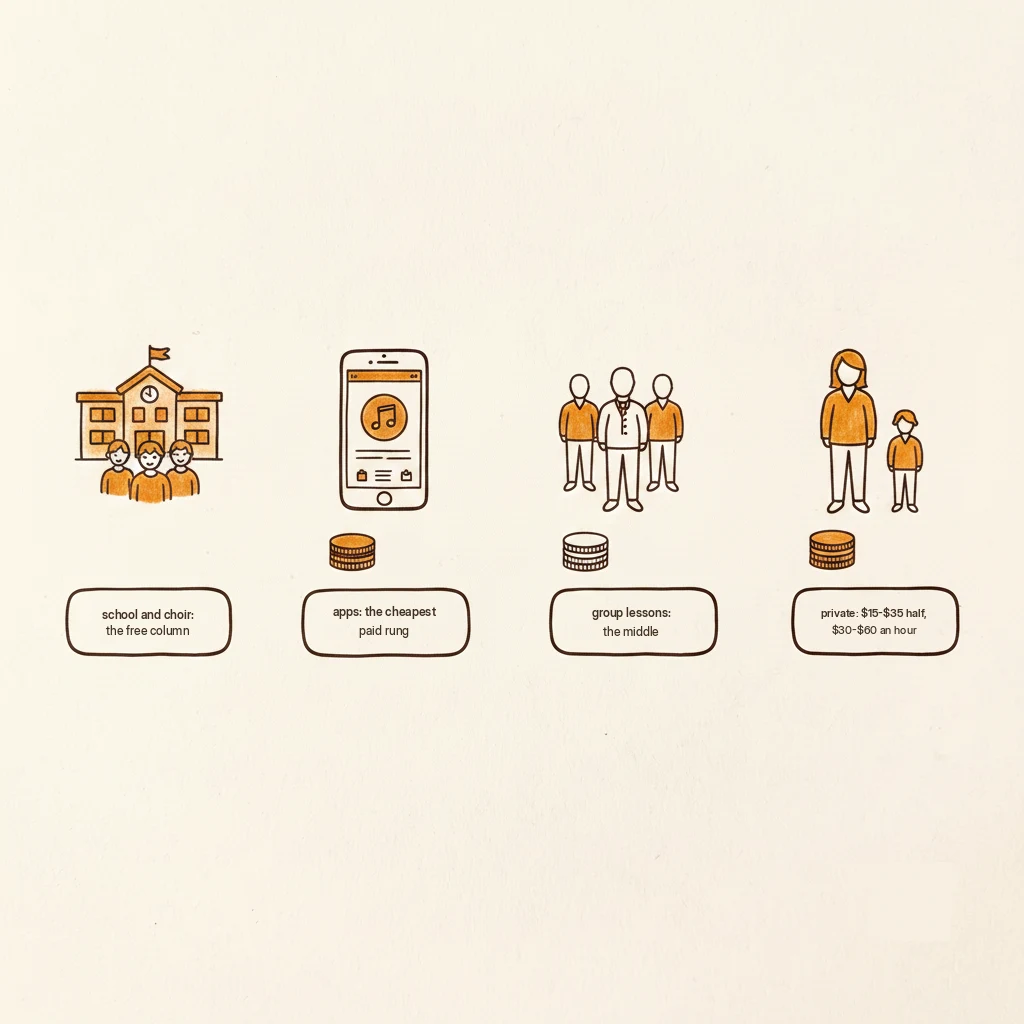
Private music lessons run about $40 to $80 an hour, $30 to $50 for a kid's half-hour, and school and choir programs are the free column most people forget.
 Gus Harmon · Updated July 8, 2026 · how I decide
If you buy through my links the site earns a little. It's never why I pick things.
Private music lessons run about $40 to $80 an hour most places (big cities push $100), or $30 to $50 for the common kids’ half-hour slot. Student teachers run around $20, big cities cost more, and apps sit at $10 to $30 a month. The free column is real too: school band, community choir, library programs.
You’ve probably already done the scary math. Thirty dollars a week is about fifteen hundred dollars a year, and you’re being asked to sign up for that on behalf of a kid who might quit by Halloween. That’s the real question under “how much do lessons cost.” It’s not the hourly rate. It’s whether the whole thing is worth it.
Let me give you the rate card first, then the part nobody helps you judge.
The rate card
Guitar, piano, voice, it’s roughly the same money. Teaching is teaching.
- Private, one hour: about $40 to $80. This is the standard adult lesson.
- Private, half hour (the common kids’ slot): about $15 to $35.
- Student teachers: around $20 an hour. Someone finishing a music degree, fine for a beginner.
- Group classes: cheaper than private, often $10 to $20 a session.
- Apps: roughly $10 to $30 a month across instruments.
- The $0 column: school band and orchestra (that’s real instruction, don’t skip it), community choirs, some library programs.
Big cities run higher across the board. That’s rent, not a scam.
Is the half-hour lesson a rip-off?
No, and this trips up a lot of parents. For a kid under about ten, thirty minutes is the lesson. It’s the length of their focus, not a shortchange. Push a seven-year-old to a full hour and you’re paying for twenty minutes of learning and forty minutes of wandering. The half hour is the right size. You’re not being shorted.
Adults usually do want the full hour, because they can hold focus that long and they’re often in a hurry to get somewhere.
The part that actually decides worth-it
The lesson buys direction and accountability. The practice between lessons buys progress. Those are two different things, and the second one is where your money either converts or evaporates.
Here’s the test I’d use: is the kid practicing between lessons, unprompted, at least sometimes? If yes, fifteen hundred dollars a year is cheap for a skill that stays with them. If no, there is no hourly rate low enough to make it worth it, because they’re not learning between the sessions and each lesson just resets to the last one.
So don’t judge the price in a vacuum. Judge it against the practicing.
How young is too young?
For four-to-six-year-olds, the answer is general-music or group classes, the kind where they clap and sing and bang on things. Private instrument lessons usually work once a kid can focus for thirty minutes and read a little. Piano and violin tend to start earliest. Band instruments wait a bit longer, because they need some lung and some size behind them.
App or teacher?
Both, in an order. An app builds habits and consistency at $10 to $30 a month. A teacher fixes your hands before a bad habit sets like concrete. For an adult, app first, then a teacher when you plateau. For a kid, teacher first, because kids build habits fast and you want the good ones forming, not the wrong ones.
A private teacher can’t actually teach eight hours a day. Lessons cluster after school and on weekends, which are a small slice of the week, and every no-show or cancellation is an hour that can’t be resold. A working teacher realistically fills far fewer teaching hours a week than a full-time job holds, and out of that hourly rate comes the room, the instruments, the driving, the self-employment taxes, the prep time you never see. Run that math and the “expensive” hourly rate is a modest actual living. It’s not a markup. It’s a full-time wage squeezed into a part-time-shaped week.
Pay for single lessons until you’ve watched the kid practice on their own, unprompted, twice in one week. Then buy the semester with confidence. And take the half-hour slot for a young beginner without guilt. It’s the right length, and it’s the cheaper way to find out if this is going to stick.
If you’re figuring this out, you’re probably also wondering:
Gus Harmon
Gus spent three decades running sound wherever somebody needed it: bar bands, weddings, school shows, and twelve years of Sunday mornings. He can't sing a note. He can make sure you're heard. Now he writes so normal people can buy the right thing the first time.