
← first chords, first songs, at any age
How Much Does a Piano Tuner Cost? (Grandma's Old Upright)
A standard piano tuning costs about $150 to $200 and takes an hour or two, and a piano left for years needs a pitch raise first, roughly double, but it can almost always be saved.
 Gus Harmon · Updated July 8, 2026 · how I decide
If you buy through my links the site earns a little. It's never why I pick things.
A standard piano tuning costs about $150 to $200 and takes one to two hours. A piano that hasn’t been tuned in years usually needs a “pitch raise” first, which roughly doubles it into two visits. Pianos get tuned once or twice a year in normal use. And yes, a piano that’s sat untuned for 20 years can almost always be brought back. Budget two visits, not one.
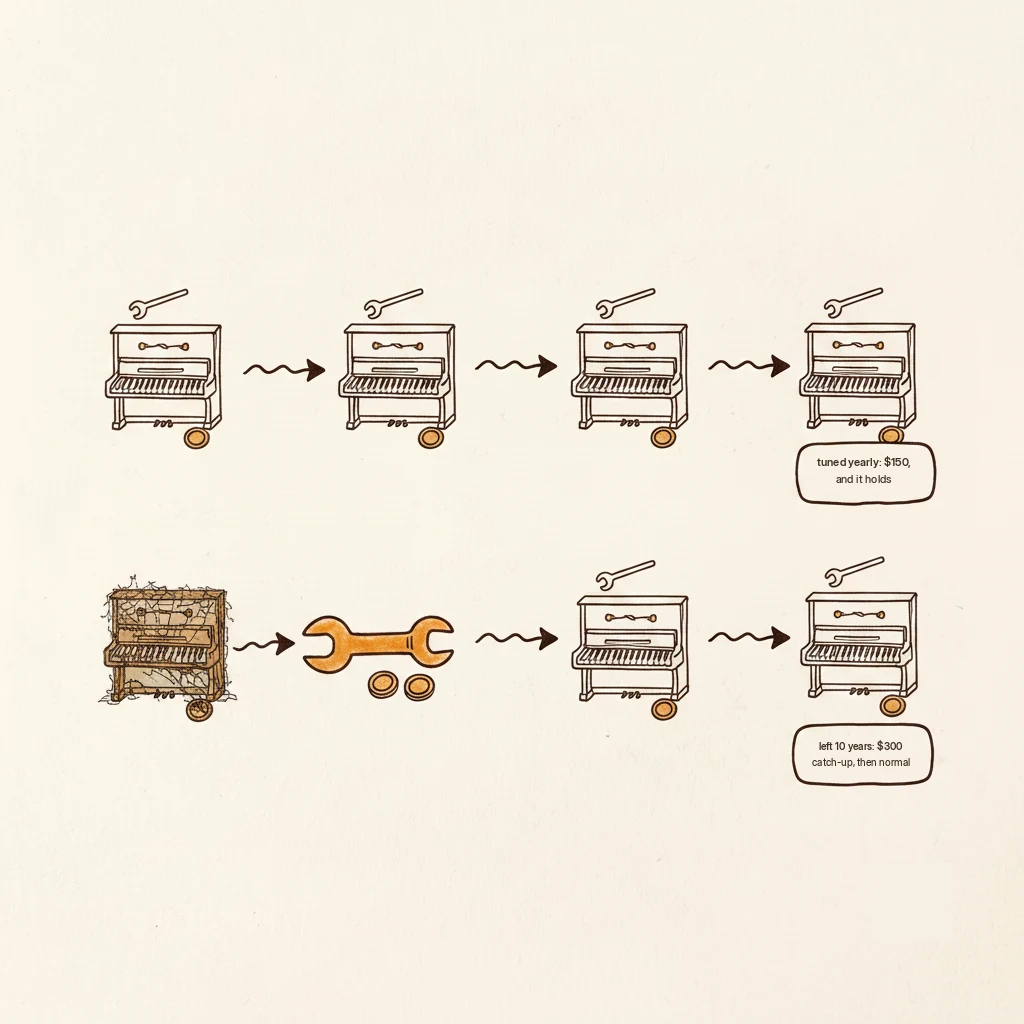
Grandma’s upright just landed in your living room, or the kid restarted lessons on the piano that’s been silent for a decade, and now a stranger is coming to the house to do something you can’t price. Let me give you the anchor so nobody can spook you on it.
Here’s the thing. Tuning is a well-defined service with normal prices, not a mystery. A standard tuning is a hundred fifty to two hundred dollars, an hour or two in your home. That’s the number. Anything wildly under it is bait, and anything wildly over it needs explaining.
The 10-years-silent question, answered kindly
This is the one everybody with an inherited piano is really asking. When a piano sits untuned for years, it doesn’t just go a little out of tune. The whole thing sags flat, all the strings drifting down together. So a single tuning won’t hold, because you’re asking it to jump a long way and stay there, and it won’t.
The fix is a two-step called a pitch raise, then a tune. The tuner brings the whole piano roughly back up in one visit, lets it settle, and fine-tunes it in a second. That two-visit approach is completely normal for a neglected piano. It is not an upsell. It’s physics. Anyone who tells you the twenty-year-silent piano needs only one cheap visit is the one to be suspicious of, not the one quoting you two.
What actually happens in a pitch raise? Remember a piano has around 200-plus strings pulling with something like eighteen tons of total tension. When you crank all of them back up to pitch at once, the added strain flexes the frame and the strings immediately start sagging again, so the tuning you just did falls apart within hours. So the tuner does it in stages, overshooting slightly, letting the whole structure re-settle under the new load, then coming back to set it properly. It’s less like tuning a guitar and more like slowly re-tensioning a bridge. That’s why it takes two visits and why it costs about double. You’re not being milked. You’re paying for the piano to hold.
Tuner or technician? A quick vocabulary gift
These get mixed up. Tuning is the routine service call, the hundred-fifty-to-two-hundred visit. But if the piano has sticking keys, buzzes, or worn parts, that’s technician work, repairs and adjustment, billed by the hour at roughly seventy to a hundred twenty-five. A good tuner will tell you honestly which one your piano actually needs, so ask.
Is it worth it? On an eight-hundred-dollar used upright, a couple hundred a year in tuning is just the cost of owning the thing, same as oil changes. If that ongoing cost bothers you, that’s the honest argument for a digital piano, which never needs tuning at all.
Two small human answers
Do you tip the tuner? Not expected. The kindness that actually helps: offer them water, and clear the framed photos and clutter off the top of the piano before they arrive.
And don’t fall for the “$49 tuning special.” That’s bait for a pitch-raise upsell on arrival. The honest tuner quotes you the real range up front. One more: this is not the DIY hobby to try with a phone app. There are around a hundred tuning pins and it genuinely takes a trained ear and hands. Leave this one to the pro.
Call a tuner, say honestly how long it’s been, and ask for the two-visit price if it’s been years. A hundred fifty or so for a normal visit is standard, and the pitch raise on a long-silent piano isn’t an upsell, it’s just what physics costs.
If you’re figuring this out, you’re probably also wondering:
Gus Harmon
Gus spent three decades running sound wherever somebody needed it: bar bands, weddings, school shows, and twelve years of Sunday mornings. He can't sing a note. He can make sure you're heard. Now he writes so normal people can buy the right thing the first time.