← your kid's instrument: costs, rentals, sticking with it
How Much Does a Saxophone Cost?
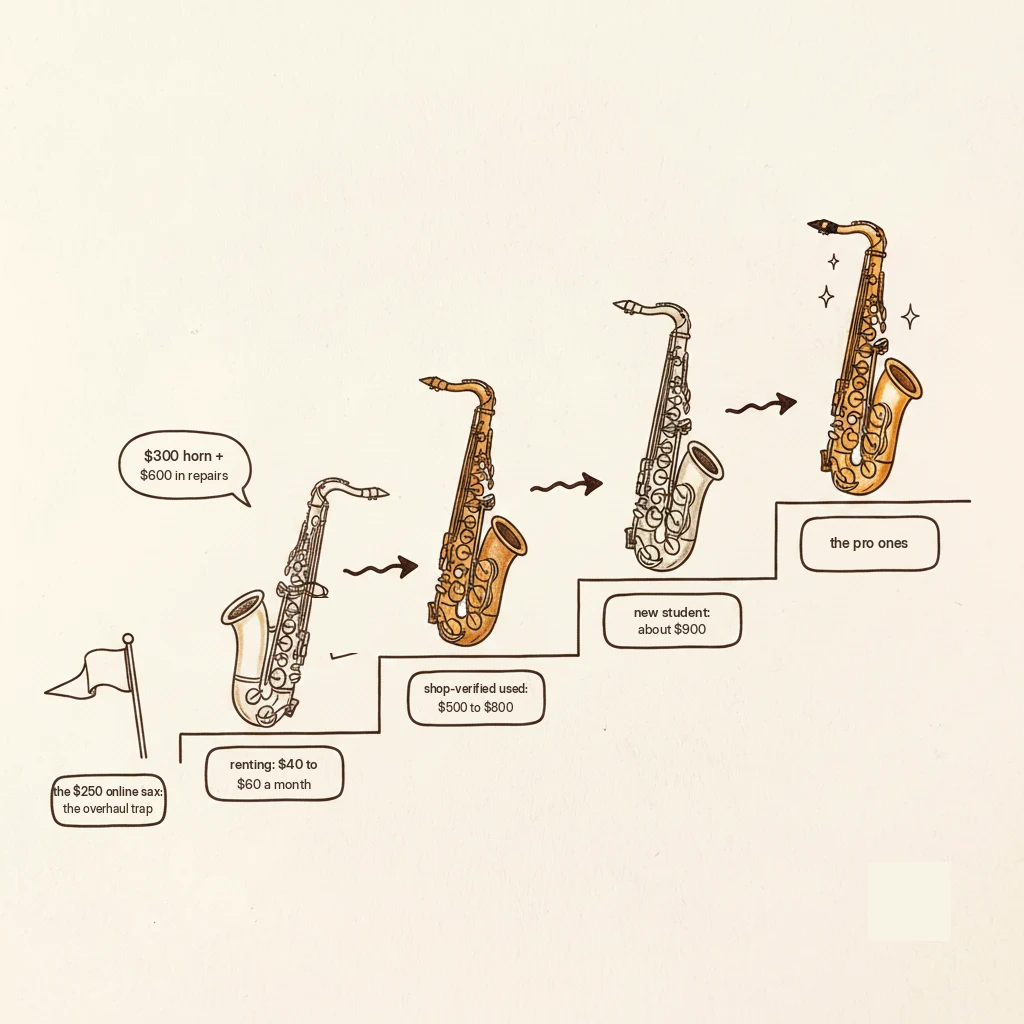
A new beginner alto sax runs about $1,100, a shop-verified used one is $400 to $800, and renting costs about $40 to $60 a month with maintenance included, while the $250 online sax usually needs more than its price in repairs.
 Gus Harmon · Updated July 8, 2026 · how I decide
If you buy through my links the site earns a little. It's never why I pick things.
Sax is the expensive one, and the letter doesn’t warn you
Your kid came home and said saxophone. It’s the coolest instrument in the band room, and it’s the most expensive of the common band picks.
Nobody told you that in advance. So let’s get it on the table before you go shopping, because the sticker is the first shock and the repair bill is the second one.
Start on alto
If you take one thing from this page besides the money, take this. A beginner starts on the alto saxophone.
It’s the right size for a kid’s hands and lungs, it’s what the band parts are written for, and it’s what every teacher will tell you. Tenor is bigger, heavier, and more expensive, and it comes later if it comes at all.
The numbers
| What it is | What it costs | What you should know |
|---|---|---|
| Rental, alto | $40 to $60 a month | More than trumpet rentals. That's normal, not a rip-off |
| Used, ready to play | $400 to $600 | A Yamaha YAS-23 that a shop has gone through |
| Used, shop-verified step up | About $800 | A YAS-275. The no-brainer against a $300 gamble |
| New student horn | About $1,100 | The Yamaha YAS-280, named more times than I can count |
| Budget-new clone | About $600 | Plays. Resells for nearly nothing |
If you buy through my links the site earns a little coffee money. Doesn’t change the price, doesn’t change my answer.
The $300 Facebook saxophone
Here’s the lesson that people learn the expensive way, over and over.
Used Yamahas look cheap online. Somebody’s selling a YAS-23 for $300 and it’s the same model a shop wants $600 for, and you feel like you found the deal.
The words that matter are “ready to play.” A saxophone that has sat in a closet for fifteen years needs an overhaul, and a shop’s overhaul on a student horn can run up to $600. Your $300 bargain is a $900 saxophone with extra steps and a month of waiting.
If you do buy online, use a marketplace with a real return window, and take the horn straight to a repair tech the day it lands. That’s what the people who buy successfully actually do.
Buy the Yamaha, not the clone
A budget-new sax for $600 plays. Nobody’s lying about that.
But when your kid quits, or upgrades, the Yamaha sells for real money and the clone sells for almost nothing. Over the life of the thing, the resale asymmetry usually eats the $300 you saved.
That’s the rare case where I’d steer you to the more expensive object, and I want you to notice how much it costs me to say so, given how much of this site is me telling people to buy the cheap one.
The costs that never stop
Reeds. Beginners chew through them, they crack, they get left in the case wet. Figure $3 to $5 a reed, size 2 or 2.5 to start.
Then a mouthpiece eventually, a stand, and the method book the director assigns. None of these are big. All of them are real.
Is it easy to learn?
Easier than most band instruments to get a first honk out of, harder than it looks to make a nice sound with.
A former private teacher said the thing I’d say: sound production takes real practice, which is exactly why renting first makes sense for any woodwind. Let the kid discover whether they love the sound they’re making before anybody buys the horn that makes it.
If you're figuring this out, you're probably also wondering:
Gus Harmon
Gus spent three decades running sound wherever somebody needed it: bar bands, weddings, school shows, and twelve years of Sunday mornings. He can't sing a note. He can make sure you're heard. Now he writes so normal people can buy the right thing the first time.