← first chords, first songs, at any age
Piano Sheet Music for Beginners (and How to Start Reading It)
Free beginner piano sheet music is everywhere online, and the real skill (reading it) is a four-week trick, not a childhood window you missed: middle C is your anchor and a first real piece is weeks away.
 Gus Harmon · Updated July 8, 2026 · how I decide
If you buy through my links the site earns a little. It's never why I pick things.
Free beginner piano sheet music is all over the internet: 8notes has a graded beginner tier, MuseScore has over a million pieces (quality varies, so sort by rating), MakingMusicFun is great for kids, and IMSLP holds the classical vault. The real question is reading it, and that's not the mountain you fear. Middle C is your home base, your right hand reads the top staff, and you'll be playing a real first piece (Jingle Bells level) within weeks, not years.
First, the thing somebody made you feel bad about
Here’s the thing I’ve watched play out at a music counter a thousand times: a grown adult, quietly convinced that reading music is a childhood-window skill they missed forever, half-braced to be laughed at for even asking.
Nobody should be shamed for being eager to learn. Plenty of self-taught players pick up reading later in life and read just fine. There are adults out there who started from zero and were reading real pieces inside a year. You did not miss the window. There is no window. Let’s just start.
Where the free sheet music actually is
The good stuff is free, and there’s a lot of it. Here’s the honest map so you’re not drowning.
- 8notes has a beginner tier that’s graded by difficulty, which means somebody sorted it so you don’t have to. Trustworthy starting point.
- MuseScore is enormous, over a million pieces, but it’s uploaded by users, so quality is a lottery. Sort by rating and you’ll find gems.
- MakingMusicFun is aimed at kids and elementary players, big friendly notes.
- IMSLP is the classical vault, public-domain scores of basically everything ever written. More than a beginner needs, but it’s there forever and free.
- Hoffman has clean printables to get you going.
Reading it, demystified
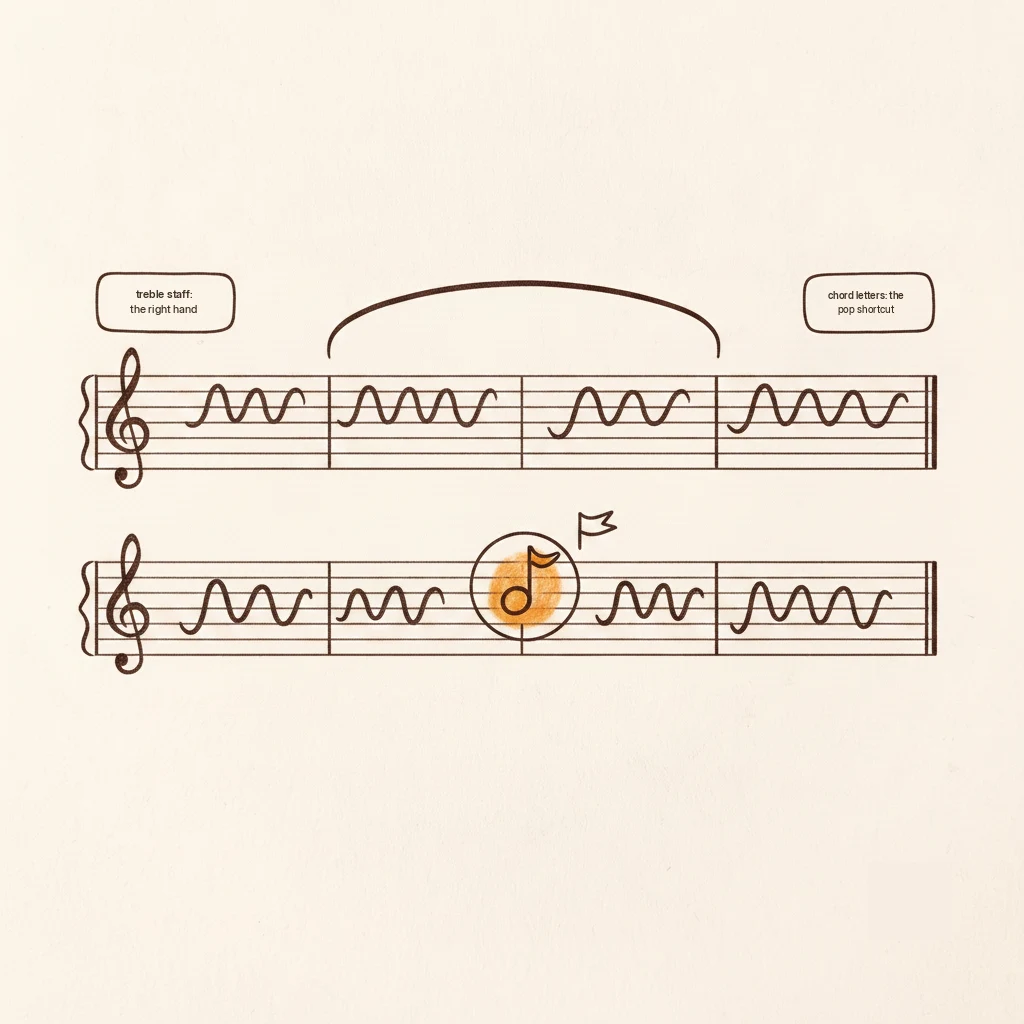
Reading music feels like a secret code until somebody shows you the one anchor, so here it is. Middle C sits in the middle of the piano, and it’s your home base for everything. Your right hand reads the top staff (the higher notes), your left hand reads the bottom staff (the lower ones). Most first-month pieces keep your hand in one spot, five fingers over five keys, so you’re not leaping around.
From there, a piece at the Jingle Bells or Ode to Joy level is just weeks of honest practice away. That’s not a stunt song. It’s the real proof-of-concept piece, and playing it is the moment the code turns into music.
The other route: chords instead of dots
Here's the part the "you must read sheet music" crowd leaves out. Pop and rock pianists often don't read all those dots at all. They read chord symbols (C, Am, F) written above the melody and build the sound from those. It's the fake-book, lead-sheet tradition, and it's completely legitimate. The Heart and Soul left hand you already know is basically the gateway to it.
Both routes are real, and they end up meeting anyway. If you want songs on the piano fast, chords are a shorter road. If you want to play written music exactly as composed, reading is the road. Neither one is the “right” one. Pick the door that matches what you actually want to play.
If you want structure, the Alfred’s Adult All-in-One book (about $17 to $20) is the classic page-by-page path, and the Faber books (about $12 to $18) are the standard for younger players. Both hold your hand through the reading.
One hard no
Those falling-note videos, the ones where colored bars rain down onto the keys, feel like learning and aren’t. They can genuinely set back your reading if you ever want to read for real, because they train your eyes on the wrong thing. Use them for fun if you like, but don’t mistake them for learning to read music.
Paper or tablet?
Either works. A tablet means no printing and no reprinting, but you’ll fight page turns mid-song. Paper’s superpower is that you can write on it, and you should. Teachers mark up music constantly: fingerings, reminders, little arrows. Grab a pencil and scribble on your sheets. That’s not defacing them, that’s using them.
Skip this unless you like the nerdy part. Piano is the easiest instrument to read on, and there's a clean reason. On piano, every note on the page maps to exactly one key, and what you read is what sounds. A trumpet or clarinet player has to mentally transpose, because their written C comes out as a different actual pitch, so they're doing a translation step you never have to do. On piano the page and the keyboard speak the same language. That's a real head start.
Print Jingle Bells from 8notes tonight, stick a little label on middle C, and give yourself two honest weeks. Reading music is a four-week trick that feels like a superpower for the rest of your life.
Questions people actually ask
Where can I get free beginner piano sheet music?
8notes for graded beginner pieces, MuseScore for sheer variety (sort by rating since quality varies), MakingMusicFun for kids, and IMSLP for classical. All free. Start with 8notes because someone has already sorted it by difficulty, so you won’t accidentally print something two years above your level.
Can I teach myself to read music as an adult?
Yes, easily, and anyone who says otherwise is wrong. Middle C is your anchor, one hand per staff, and most first pieces keep your hand in one position. Plenty of adults go from zero to reading real pieces within a year. It’s a four-week skill to get comfortable, not a childhood-only ability.
Should I learn piano by chords or by reading sheet music?
Depends what you want to play. For pop and singing along, chord symbols get you there faster and are completely legitimate. For playing written pieces exactly as composed, reading the notes is the road. Both are valid and they converge over time, so pick the one that matches your goal and start.
If you buy through my links the site earns a little coffee money. Doesn’t change the price, doesn’t change my answer.
Getting your music together, you're probably also wondering:
Gus Harmon
Gus spent three decades running sound wherever somebody needed it: bar bands, weddings, school shows, and twelve years of Sunday mornings. He can't sing a note. He can make sure you're heard. Now he writes so normal people can buy the right thing the first time.