← your kid's instrument: costs, rentals, sticking with it
Easy Trumpet Songs for Beginners (Honest About the Face)
A beginner's first trumpet songs live on about five notes, Hot Cross Buns up to Ode to Joy, and the real gate isn't the list, it's building the lip muscles that make a clear tone.
 Gus Harmon · Updated July 8, 2026 · how I decide
If you buy through my links the site earns a little. It's never why I pick things.
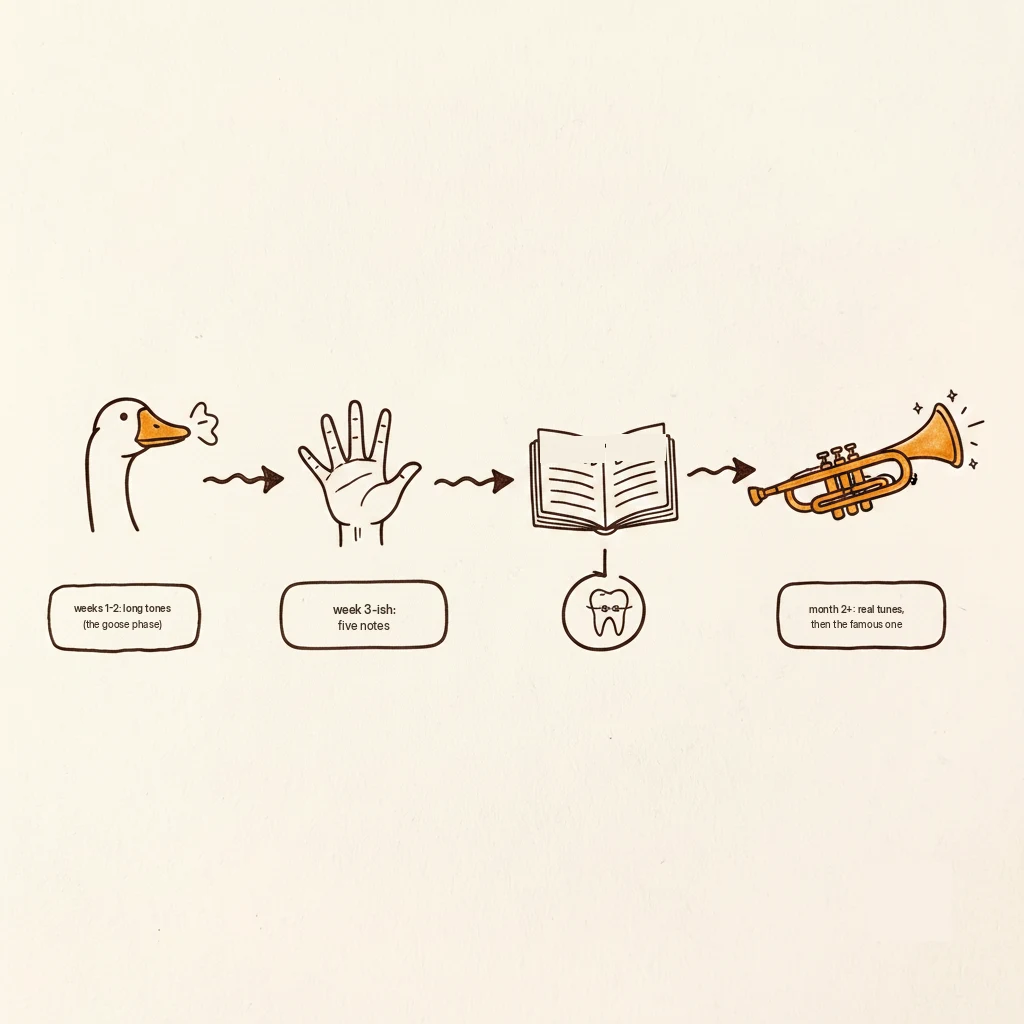
A beginner’s first trumpet songs live on about five notes: Hot Cross Buns, Mary Had a Little Lamb, then the method book’s melody pages. The real gate isn’t the song list, it’s the face. The lip muscles that make a clear note take weeks to build, and no song is easy until a clean tone is.
I read a thread once from a guy who wanted to learn trumpet to play La Vie En Rose at his own wedding. The room was warm about it and completely honest: getting a good sound on a trumpet takes months, sometimes years, and one player half-joked he’d hide behind the altar and play while the groom faked it.
That’s the thing about trumpet nobody puts on the song lists. So let me tell you the truth first, kindly, and then give you the songs.
The face comes before the songs
The word for it is embouchure, which just means the way you set your lips against the mouthpiece to make a note. It’s a muscle skill, and like any muscle it takes weeks to months to build. Early on the trumpet sounds like a dying goose. That is completely normal. Every trumpet player alive made that sound for a while.
So if you’re a parent and week two sounds rough, nothing’s broken. That’s the goose phase, and it passes with a little time on long, steady notes.
Real songs really do live on five notes
Here’s the good news under the hard truth: you don’t need a big range to play real music. A beginner’s first songs sit inside about five notes, and they still count.
- Hot Cross Buns. Three notes. The universal first tune, and no shame in it.
- Mary Had a Little Lamb. A step up, still tiny range.
- Ode to Joy, the version that stays inside the staff. Now you’re playing something people recognize.
These are the melody pages in any method book, and pretending they’re beneath a beginner is exactly how a kid ends up faking instead of playing. Play the five-note songs like they’re Carnegie Hall. That’s how the face gets strong enough for the big ones.
If braces are coming, read this
When braces go on, a trumpet player’s tone and range will drop, sometimes a lot, because the lips are now pressing against metal. It’s temporary, usually about two weeks to adjust. Dental wax helps some kids, a brace guard helps others, and it happens again (faster) when the braces come off. If a band director ever suggests your kid switch instruments over braces, that’s the wrong call. Kids play trumpet through braces every single year.
A brace guard. About $10 to $15 (worth verifying). It sits between the braces and the inside of the lip so the pressure doesn’t cut, which shortens the miserable adjustment. Buy it the same day you know braces are coming, not after two weeks of a kid hating the horn.
Flaws, said plainly: it’s a small comfort aid, not a fix, and some kids do fine with plain dental wax. Cheap enough to try either way.
About that famous-song dream
The La Vie En Rose, the Rocky theme, the song that made you want a trumpet in the first place. That’s a real goal, and it’s roughly a month-six goal with some steady practice, not a week-one one. Put it on the calendar and it becomes a plan instead of a disappointment.
And if there’s a hard deadline, like an actual wedding, the loving answer is the one that thread landed on: about $500 hires a good professional to play it beautifully on the day. That’s not giving up. That’s making sure the moment sounds right while you keep learning for you.
Free sheet music for the beginner tunes is easy to find. The by-difficulty sheet libraries (the 8notes-style sites) carry the whole starter list at no cost. Point yourself there before buying anything.
One more shelf, mostly for the grown-ups: if what pulled you to the trumpet was jazz, you don’t have to wait years for it. Players point beginners at the Real Book (the big jazz songbook, downloadable free) and name the standards that sit almost inside a starter range: All of Me stays at or under E, Bessie’s Blues under D, and Blue Bossa works played down an octave. Real jazz, month-three range. That’s a better carrot than any exercise book.
A trumpet only has three valves, so how does it play a whole scale, let alone five clean notes, with so few buttons? The answer is your lips. For any one valve combination, the trumpet can sound several different notes depending on how fast your lips buzz, a series of pitches called the harmonic series that the tube naturally allows. Beginners start on the notes that come easiest in that series, then learn to jump between them by changing the lips, not the fingers. So “five notes” isn’t a baby range. It’s you learning to steer the horn with your face, which is the actual core skill of the entire instrument. Master those five and the rest is more of the same trick.
Two weeks of long, steady notes before anybody worries about songs. Then Hot Cross Buns like it matters, and up the five-note ladder from there. If braces are on the way, buy the guard the same day. The famous song goes on the fridge with a date about six months out.
If you buy through my links the site earns a little coffee money. Doesn’t change the price, doesn’t change my answer.
If you’re figuring this out, you’re probably also wondering:
Gus Harmon
Gus spent three decades running sound wherever somebody needed it: bar bands, weddings, school shows, and twelve years of Sunday mornings. He can't sing a note. He can make sure you're heard. Now he writes so normal people can buy the right thing the first time.