
← a microphone for singing, at home or on stage
Is the Audio-Technica AT2035 Good for Vocals? (An Honest Review)
The AT2035 is a $159 condenser that sounds genuinely pro on vocals, but only if you have an audio interface and a quiet room, so the real all-in cost is about $300.
 Gus Harmon · Updated July 8, 2026 · how I decide
If you buy through my links the site earns a little. It's never why I pick things.
The AT2035 is a large-diaphragm condenser around $159 that answers “is it good for vocals” with a yes, if you have two things: an audio interface (it’s XLR, not USB) and a quiet room, because condensers hear everything. Its edge over the cheaper AT2020 is a high-pass switch and a 10dB pad. Budget about $300 all-in.
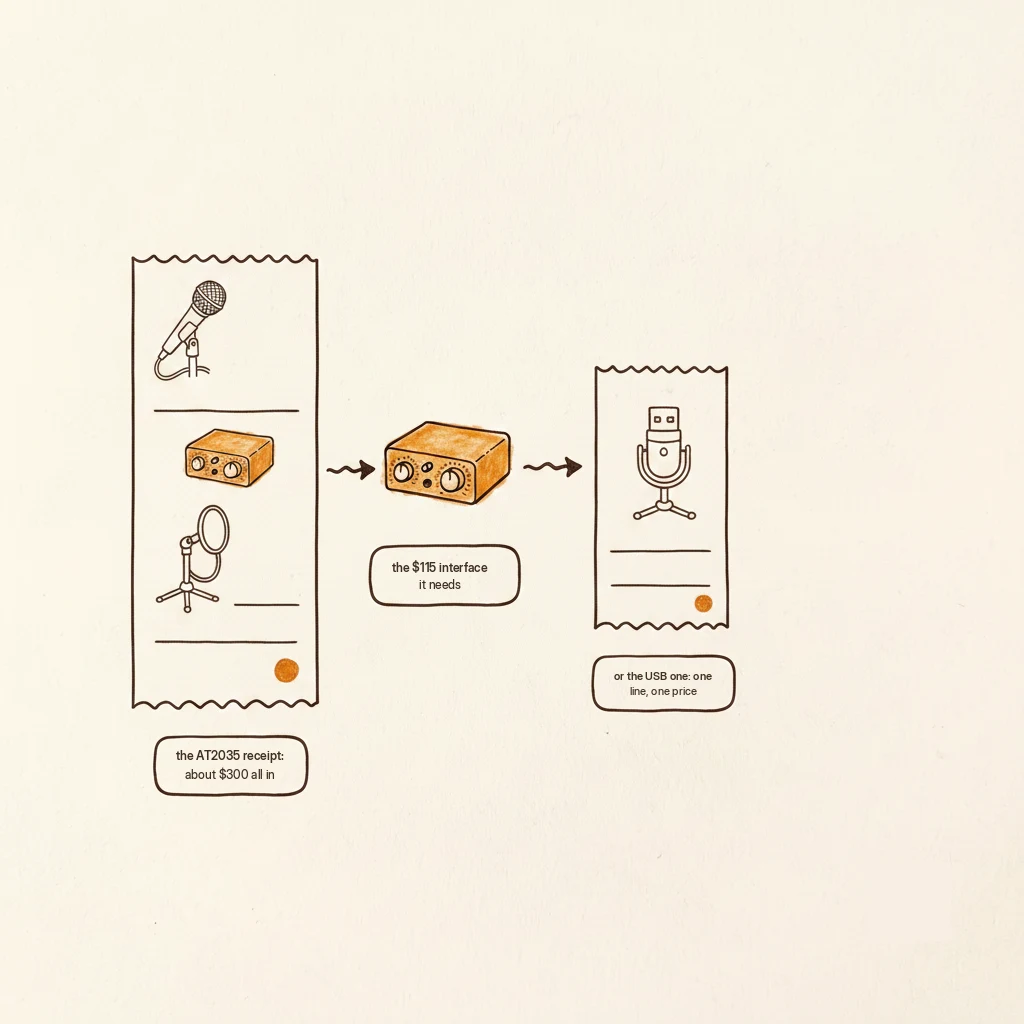
Let me save you the worst surprise in home recording before you click buy. The AT2035 is a genuinely good microphone. It’s also XLR, not USB, which means if you plug it straight into your computer, nothing happens. It needs a box in between. Nobody on the shelf leads with that, and it’s the exact thing that turns a happy $159 purchase into a $159 paperweight. So we lead with it.
The gate: what it actually costs to use
The AT2035 has an XLR plug, the three-pin professional connector, and your computer has no place to put it. To use it you need an audio interface, a small box (a Focusrite Scarlett is the usual one, about $170, though sturdy budget interfaces start near $60) that the mic plugs into and that then connects to your computer by USB. It also supplies the power the condenser needs to work.
So the real receipt looks like this:
- AT2035 microphone: about $159
- Audio interface: about $60 (budget box) to $170 (the usual Scarlett)
- A stand and a pop filter: about $30
That’s roughly $300 all-in, give or take the box, not $159. If that’s more than you wanted, there’s a plug-and-play cousin: the AT2020USB+ is the USB version of this family, one cable straight to the computer, no interface. Less flexible, far simpler. Know which world you’re buying into before you order.
The room rule (the part that decides if you’ll love it)
A condenser this sensitive hears everything: your voice, yes, and also the refrigerator, the street, the furnace, and the dog two rooms over. In a quiet or treated room, the AT2035 makes home vocals sound genuinely professional for $160. In a normal, live-in living room, it will faithfully record all the noise you didn’t know you had, and you’ll sound worse than you would on a cheap rugged mic. Before you buy any condenser, stand in your recording spot at night and just listen for ten seconds. If you can hear the house, get a dynamic mic instead.
What you get for the extra fifty over the AT2020
The AT2035 is the grown-up sibling of the $119 AT2020. For the extra money you get a bigger diaphragm, plus two switches the 2020 doesn’t have:
- A high-pass switch, which is a fancy way of saying it can ignore low rumble (footsteps, traffic, HVAC hum).
- A 10dB pad, insider-speak for “it won’t distort on loud sources.” Think of it as sunglasses for the mic when things get loud.
It also comes with a shock mount (the little cradle that isolates it from desk bumps), which the 2020 doesn’t include, a real bit of value. It’s the condenser that tends to stay in a home studio even as the collection grows, sitting right alongside the workhorse Shure dynamics.
Audio-Technica AT2035. About $159. If you already own an interface and a quiet corner, this is a lot of professional-sounding microphone for the money. Add a $12 pop filter and stop shopping.
Flaws, said plainly: useless without an interface, and merciless in a noisy room. Both are about your setup, not the mic.
Questions people actually ask
Is the Audio-Technica AT2035 good?
Yes, for vocals and acoustic instruments in a quiet room, with an interface. It’s a well-regarded budget condenser that stays useful for years. It’s the wrong tool for a noisy room or a plug-straight-into-USB setup.
Is the AT2035 good for vocals?
It is, and it’s a common choice for exactly that. The catch is the room: in a quiet space it sounds pro, in a noisy one it records the noise too. Pair it with a quiet corner and a pop filter.
What is the AT2035 used for?
Home vocal recording mostly, plus acoustic guitar, podcasting, and voice work. Anywhere you want detailed sound and can control the room noise and provide phantom power through an interface.
What’s the difference between the AT2035 and AT2020?
The AT2035 adds a 10dB pad, a high-pass switch, a larger diaphragm, and an included shock mount, for about $40 more. The AT2020 at $119 is the same family’s entry door and a fine mic in its own right.
Think of the microphone as having a fixed “loudest thing it can cleanly handle” before the sound distorts. Belt a big note or mic a loud amp and you can blow past that ceiling, and the recording clips into ugliness. The pad is just a switch that quietly turns the incoming signal down by a set amount (10 decibels) right at the mic, before anything can overload, giving you more headroom under that ceiling. It’s genuinely the sunglasses analogy: your eyes work fine in a room, but step into blinding sun and you need something to knock the intensity down so you can still see detail. The pad knocks the loud down so the mic can still hear detail instead of just distorting.
If you already own an interface and a quiet corner: buy it, buy the pop filter, and stop shopping. If you own neither, the $99 USB cousin or a $30 dynamic mic will make you happier this month, and you can grow into the XLR world later.
If you buy through my links the site earns a little coffee money. Doesn’t change the price, doesn’t change my answer.
If you’re figuring this out, you’re probably also wondering:
Gus Harmon
Gus spent three decades running sound wherever somebody needed it: bar bands, weddings, school shows, and twelve years of Sunday mornings. He can't sing a note. He can make sure you're heard. Now he writes so normal people can buy the right thing the first time.