
← a microphone for singing, at home or on stage
Is a Condenser Microphone Good for Singing? (The Room Decides)
A condenser hears beautiful detail and every noise in your house, so a $100 to $150 condenser wins in a quiet room, but a $30 to $100 dynamic flatters you in a normal living room.
 Gus Harmon · Updated July 8, 2026 · how I decide
If you buy through my links the site earns a little. It's never why I pick things.
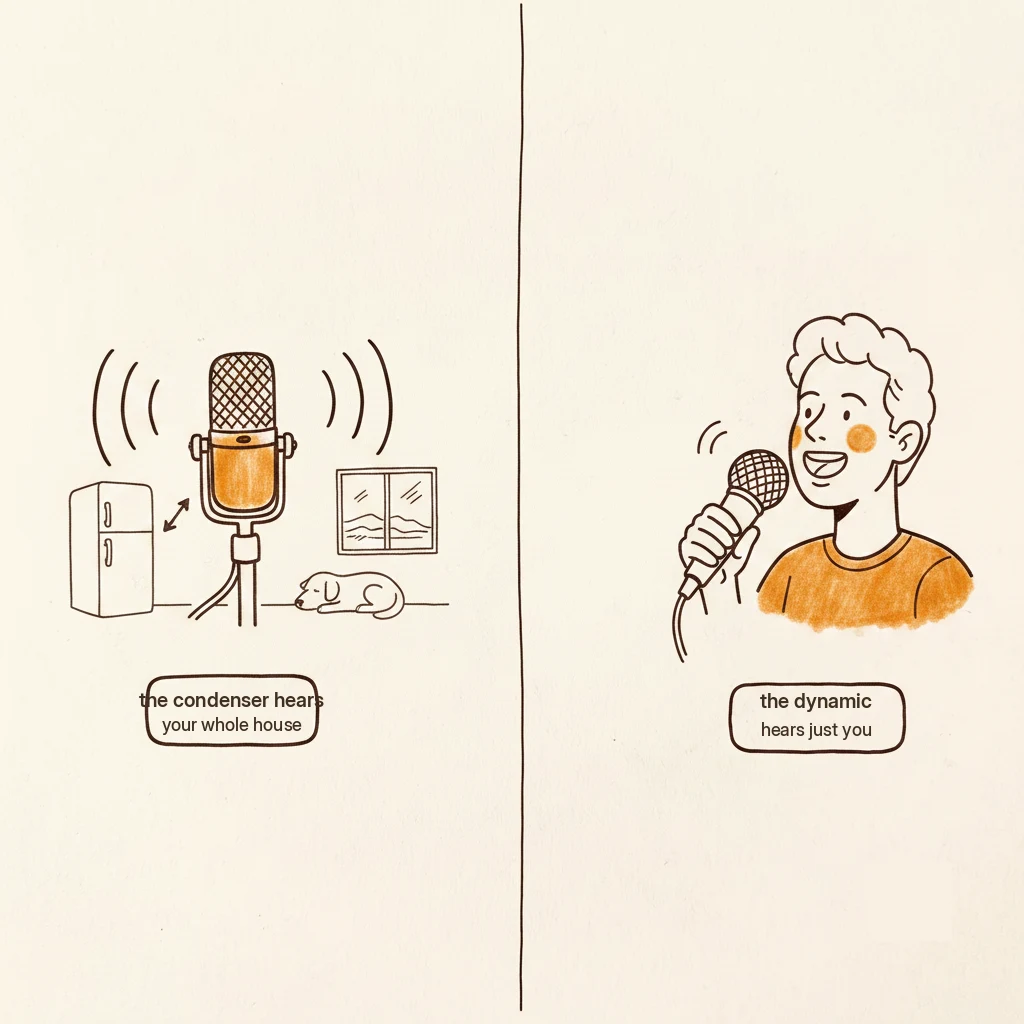
A condenser microphone is the sensitive kind. It hears gorgeous detail, and it hears your kitchen, your fan, and the dog just as clearly. In a quiet or treated room, a $120 to $160 condenser (AT2020, AT2035) makes home vocals sound pro. In a normal living room, a $20 to $110 dynamic (XM8500, SM58) will flatter you more. The mic question is really a room question.
You learned the word “condenser” somewhere, a YouTuber’s mic, a “best mics” list, and now you’re asking the right question exactly one room too early. Because here’s the thing nobody in those roundups tells you: the “better” microphone will make you sound worse in the wrong room. Let me keep you from that.
What the two words actually mean
Forget the spec sheets. In plain terms:
- A condenser works off a lightweight charged plate that flutters at the faintest sound. That’s why it hears every detail, and why it hears everything else in the room too. It’s the sensitive one.
- A dynamic works off a little coil and magnet that needs real sound pressure to move, so it mostly only hears what’s right up close to it. It’s the tough one, and it ignores the room.
That difference is the whole ballgame.
The room rule
The sensitive mic hears your kitchen. The tough mic hears you. That’s the law this entire page hangs on. A condenser needs a quiet or treated room to shine. A dynamic forgives a normal, live-in room. Decide your room first, and the mic chooses itself.
Here’s the ten-second test. Stand where you’d sing, tonight, around seven o’clock, and just listen. Fridge hum? Street noise? Furnace, HVAC, a TV down the hall? If you can hear the house, buy the dynamic and thank me later. Actual silence? The AT2020 will treat you beautifully.
The picks, short and honest
- Condenser lane (quiet room): AT2020 at about $119, or the AT2035 at about $159 with its extra switches. Remember these are XLR, so they need an audio interface (about $115), or you can get the USB versions to skip that box.
- Dynamic lane (normal room): the Behringer XM8500 at about $20, or the Shure SM58 at about $110. Rugged, forgiving, plug-and-go with an interface, and near impossible to kill.
Fix your room before you upgrade your mic
Before you spend $200 chasing a better mic, spend $0 on your room. Sing into a closet full of hanging clothes, or drape blankets over the hard surfaces around you, or just record in the softest corner of the house. Soft stuff absorbs the echo and noise that make home recordings sound cheap. A modest mic in a treated closet beats an expensive mic in a bare, echoey room every time. Room first, microphone second.
And yes, before any of that, the free rung: sing into your phone’s voice memo and listen back. A lot of people discover they didn’t have a mic problem at all.
You’ve probably heard that a famous debut album was recorded in a bedroom on a modest microphone. It’s true in spirit, and the lesson is exactly this page’s point: the room was quiet and the singer was close. The gear was ordinary. The conditions were right.
Don’t fall for the insider sneer
Somewhere online, someone will tell you “USB mics are toys.” Translated out of insider contempt, that just means “past hobby use you’ll eventually want an interface and an XLR mic.” That’s useful. The sneer isn’t. For hearing your kid sing, for singing for fun, for YouTube, a good USB condenser or a $30 dynamic is not a toy. It’s the right tool.
Why can’t you just turn a condenser’s sensitivity off and use it in a noisy room? Because the sensitivity isn’t a setting, it’s the whole design. A condenser senses sound with an ultra-light charged membrane that a charged plate sits behind, and the tiniest air-pressure changes (any sound at all) move that membrane and register. It physically cannot distinguish “your voice” from “the fridge,” it just reports every vibration that reaches it. A dynamic is built the opposite way: its heavier coil needs a real shove of sound pressure to move, so distant, quiet noises literally don’t have the muscle to register, while your voice six inches away does. The dynamic’s “blinders” aren’t a filter you switch on. They’re baked into how heavy the moving part is.
Stand in your room at 7pm and listen for ten seconds. If you can hear the house, buy the dynamic (XM8500 or SM58) and be happy. If it’s genuinely quiet, the AT2020 will treat you right. Either way, fix the room with blankets or a closet before you spend a dollar more on the mic.
If you buy through my links the site earns a little coffee money. Doesn’t change the price, doesn’t change my answer.
If you’re figuring this out, you’re probably also wondering:
Gus Harmon
Gus spent three decades running sound wherever somebody needed it: bar bands, weddings, school shows, and twelve years of Sunday mornings. He can't sing a note. He can make sure you're heard. Now he writes so normal people can buy the right thing the first time.