
← how singers and sound actually work
Why Does My Recording Sound Muffled? (Three Free Fixes)
A muffled voice recording almost always comes from being too close to the mic, an echoey room, or a blocked mic, and all three fixes are free before you touch any settings.
 Gus Harmon · Updated July 8, 2026 · how I decide
If you buy through my links the site earns a little. It's never why I pick things.
A muffled voice recording almost always has one of three causes, in this order: you’re too close to the mic, so bass piles up (back off to 6 to 12 inches); the room is echoing back at the mic, smearing the words (record facing a closet full of clothes); or the mic itself is blocked (dust, or the wrong side, since many mics have a front). Fix placement and the room before touching a single setting.
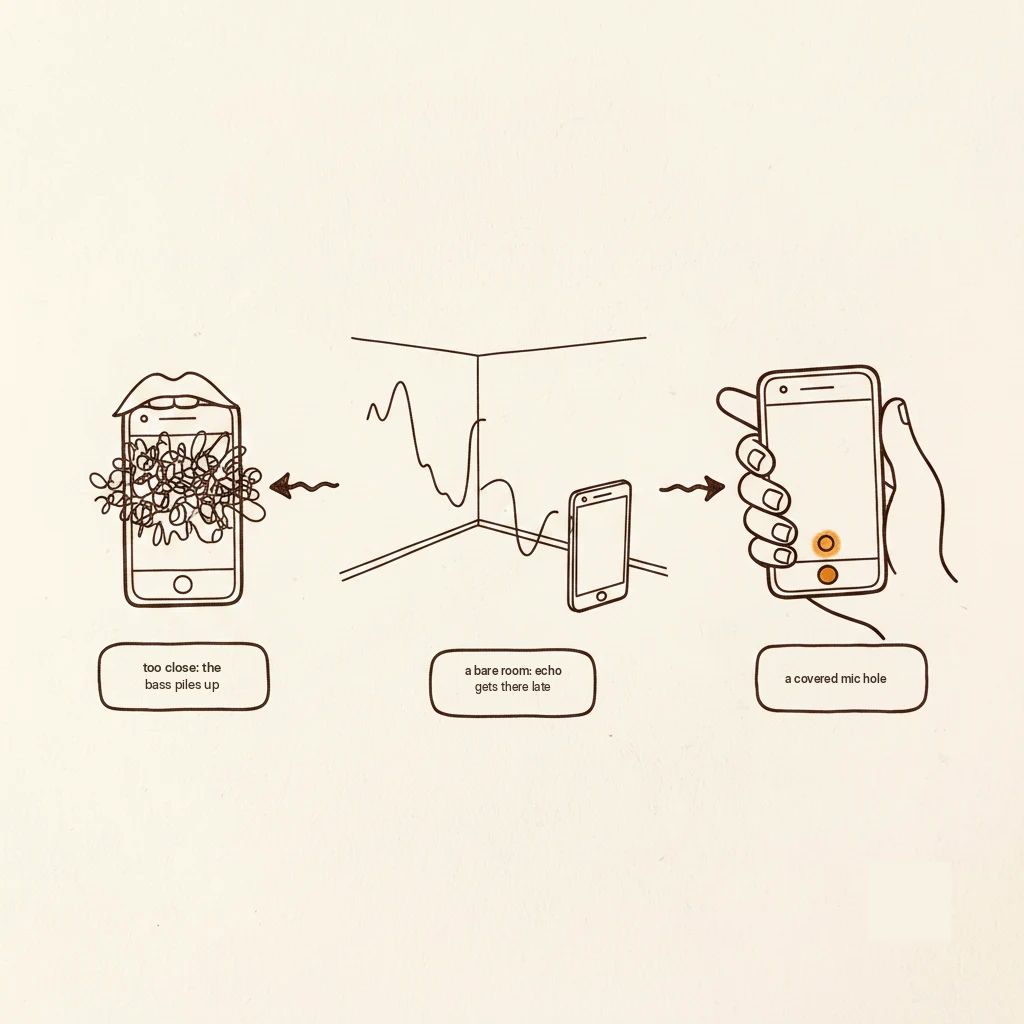
You just recorded something, hit play, and your voice sounds muffled, far away, like you were in a bathroom. Disappointing. And I’ll bet your first instinct is that you bought the wrong microphone. Hold off on that. Almost always it’s free to fix, and you already own everything you need.
Here’s the thing. Muffled almost always comes from one of three places, and they go in a specific order, cheapest first. Work through them one at a time, one test recording each, and you’ll find it. Don’t skip to buying gear. That’s the whole reason this page exists.
Cause one: you’re too close
If you’re right up on the mic, practically eating it, the low end piles up and turns your voice thick and boomy. It’s a real effect and it’s the first thing to check. The fix costs nothing: back off to about six to twelve inches, a hand’s width or so.
Even better, the singer’s trick: put the mic down at your chin and talk or sing ACROSS the top of it, not straight into it. That evens out the boominess and kills those popping “p” sounds at the same time. Free, and it fixes two problems at once.
Cause two: the room
This is the big one, and it’s the one people never suspect. If you’re recording in a bare room, hard walls, a floor, not much furniture, your voice leaves your mouth, bounces off the walls, and arrives back at the mic a hair late. That echo smears the words together and steals the crispness. That’s the “sounds like a bathroom” sound exactly.
The fix, by price: turn and face an open closet full of hanging clothes, which soak up the bounce, for zero dollars. Hang a couple of blankets on the walls beside and behind the mic, still zero dollars. Or the classic hack, actually stand inside the coat closet and record there. Clothes are the cheapest sound treatment ever invented.
What actually makes words sound like words lives in a band up around 2 to 5 kilohertz, the high-mid range where consonants live, the “t” and “s” and “k” sounds that let you tell “cat” from “cash.” When a bare room bounces your voice back late, it muddies up exactly that band, so the vowels survive but the consonants blur, and blurred consonants are what your ear reads as “muffled.” That’s why treating the room, not buying a mic, is the real fix: you’re protecting the frequencies where speech becomes understandable.
Cause three: the mic itself
Save this for last, but check it. If a mic that used to sound fine suddenly sounds muffled, look for debris: a dust sock over the grille, or a foam windscreen that’s rotted and packed with years of gunk. Clean or replace it.
And the gentlest one, because it happens to everybody: a lot of microphones have a front and a back, and it’s easy to sing into the wrong side. If yours is the kind that takes sound from the side, make sure you’re on the correct face. No shame in it, it’s one of the most common mistakes there is.
One more, if you’re on a phone: your finger or the case is probably covering the tiny mic hole on the bottom edge. Check that before anything else. Zero-dollar fix nobody looks for.
About settings
Only after all that. Once placement and room are handled, a gentle roll-off of the deep lows can help. But settings come last, always. You cannot fix a room problem with a knob. Same law the whole site runs on.
Back up to a hand’s width, face the closet, and check nothing’s over the mic hole, in that order, one test recording each. If all three takes still sound the same, NOW we talk about the microphone. Not before.
If you’re figuring this out, you’re probably also wondering:
Gus Harmon
Gus spent three decades running sound wherever somebody needed it: bar bands, weddings, school shows, and twelve years of Sunday mornings. He can't sing a note. He can make sure you're heard. Now he writes so normal people can buy the right thing the first time.