← first chords, first songs, at any age
Lessons for Band Instruments (Beyond the Band Room)
Your band kid already gets instruction (school band IS lessons), so private trumpet, clarinet, or trombone lessons are a supplement you add when a specific trigger fires, not a requirement.
 Gus Harmon · Updated July 8, 2026 · how I decide
If you buy through my links the site earns a little. It's never why I pick things.
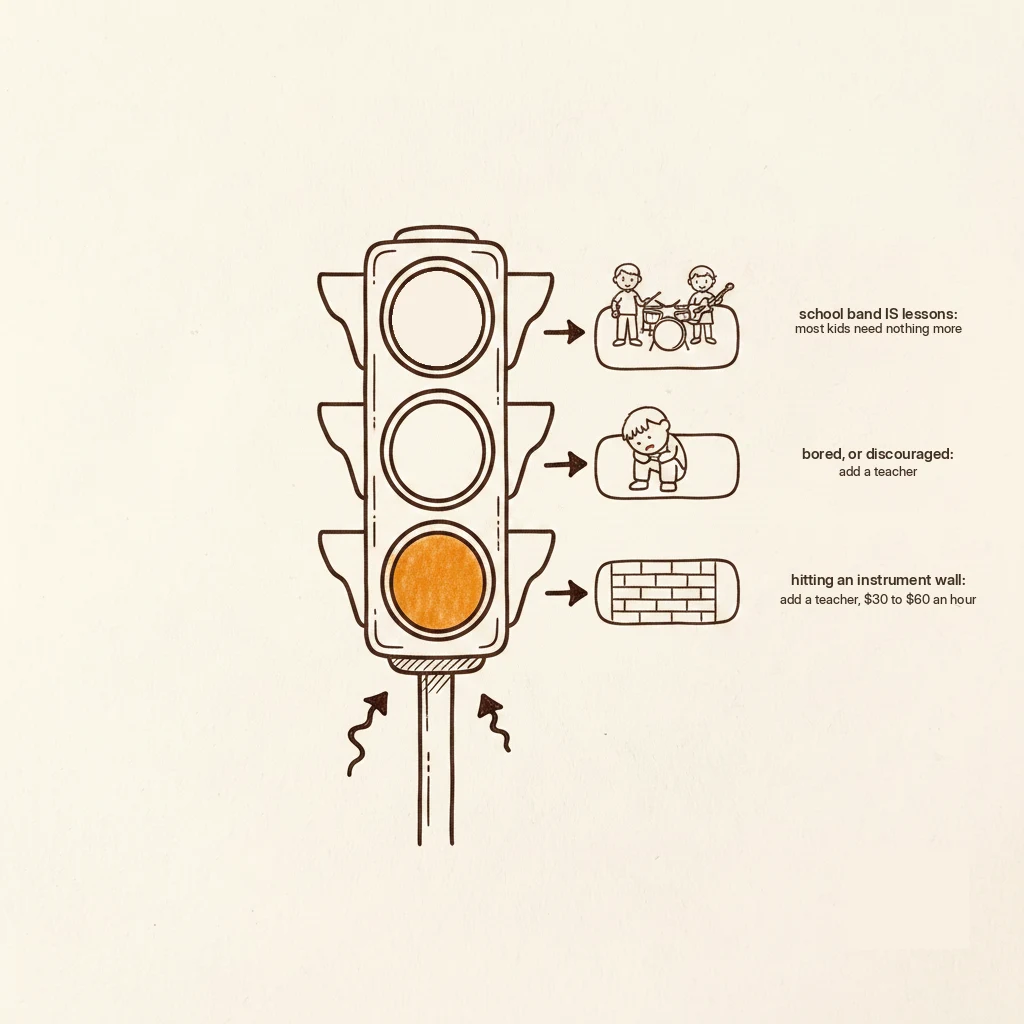
Your kid on trumpet, clarinet, or trombone already gets real instruction, because school band IS lessons. So private lessons are a supplement, not a requirement, and most kids do fine without them. Add private lessons when a specific trigger fires: the kid is ahead and bored, behind and discouraged, or hitting an instrument-specific wall. Rates run the standard $40 to $80 an hour, less for half-hour kid slots. Ask the band director first. They know which local teachers fix which problems, often for free.
Start here: you may already have what you’re shopping for
Here’s the thing that saves a lot of families a lot of money. Your kid is in band class. That is group instruction from a trained music teacher, several times a week, for free. School band IS lessons. Plenty of kids go all the way through it and never need a private teacher at all.
So the question isn’t “do band kids need lessons.” It’s “did a specific thing happen that private lessons would fix.” Most weeks, the answer is no, and that’s fine.
The triggers that actually call for private lessons
There are three honest reasons to add a private teacher, and they’re easy to spot.
Bored and ahead. The 40-kid band room moves at one speed, and your kid is way out in front, coasting. Private lessons feed that appetite: solo pieces, harder music, prep for honor band or auditions. Without it, a talented kid gets bored and drifts.
Discouraged and behind. The room is moving and your kid is stuck, getting quietly miserable. A private teacher catches the ONE mechanical thing holding them back, often something small like reed strength or how they’re forming their mouth, before “I’m bad at this” hardens into quitting. This is the highest-value lesson money there is.
The instrument-specific walls. Each horn has a spot where a specialist earns their fee fast:
- Clarinet: the break, that month-two register crossing where everything falls apart. A teacher walks a kid across it far quicker than solo struggling does.
- Trumpet: embouchure and range. Building the lips safely is genuinely faster and safer with a teacher than with random YouTube, where bad habits creep in.
- Trombone: the slide has no marked positions, so the ear has to find the notes. That’s exactly the kind of thing a teacher’s real-time feedback fixes.
And here's the single highest-return trigger of all: braces. When they go on, a brass kid's tone can crash for weeks as the lips relearn against the metal. Two or three lessons during that stretch alone can save a kid from quitting over something that was never their fault. If you spend on lessons at exactly one moment, that's the moment.
Ask the director before you pay anyone
Before you go hunting, email the band director one line: “would private lessons help my kid, and with what?” They see your child play several times a week. They’ll tell you honestly whether it’s needed, and they usually keep a shortlist of local teachers who specialize in exactly the wall your kid is hitting. That’s a free diagnostic from the person who knows best.
For finding teachers, work in that order: the director’s shortlist first, then the local music store’s teacher board, and the online marketplaces last (they tack on booking fees). Rates are $40 to $80 an hour, or roughly $30 to $50 for a kid’s half-hour slot. Ask up front about any recital or festival fees.
One more free option, said with a smile: a strong kid in the next chair teaches half of this for nothing. A good section-mate is its own kind of lesson.
Skip this unless you like the nerdy part. The reason a 40-kid band room can't teach embouchure, the exact shape of the lips and air, is simply arithmetic. Fixing a mouth means watching one mouth, close up, and adjusting it in real time. A director conducting forty kids physically cannot stand at each face. It's not a failing of the teacher or the program, it's one mouth at a time being the whole job, and forty mouths being the room. That gap is precisely what a private half-hour buys.
Semester one: band class and patience. That's the whole plan. The day the kid comes home either glowing or grinding, email the director one line, "would privates help, and who?", and take whichever name comes back. And book a couple of sessions the month the braces go on, no matter what.
Questions people actually ask
Does my kid need private lessons if they’re already in band?
Usually not. School band is group instruction from a trained teacher, and most kids thrive on it alone. Add private lessons only when a trigger fires: your kid is bored and ahead, discouraged and behind, or stuck on an instrument-specific wall. Ask the band director whether it’s warranted before you spend.
How much do trumpet, clarinet, or trombone lessons cost?
The standard is $40 to $80 an hour, with kid-sized half-hour slots around $30 to $50. Find teachers through the band director’s shortlist first (often the best and cheapest leads), then the local music store, then online marketplaces, which add booking fees. Ask about recital or festival fees up front.
When are private band lessons most worth it?
At three moments: when a talented kid is bored and needs feeding, when a struggling kid needs one mechanical fix before quitting, and, highest return of all, when braces go on and a brass kid’s tone temporarily falls apart. A few targeted lessons at the right moment beat a standing weekly bill.
Weighing lessons for a band kid, you're probably also wondering:
Gus Harmon
Gus spent three decades running sound wherever somebody needed it: bar bands, weddings, school shows, and twelve years of Sunday mornings. He can't sing a note. He can make sure you're heard. Now he writes so normal people can buy the right thing the first time.