← first chords, first songs, at any age
Piano Lessons for Adults (It's Not Too Late)
Adults learn piano just fine: figure on about a year to real pieces with steady practice, an adult method book, a teacher who respects self-taught progress, and twenty enjoyable minutes a day.
 Gus Harmon · Updated July 8, 2026 · how I decide
If you buy through my links the site earns a little. It's never why I pick things.
Adults learn piano just fine, and anybody who told you otherwise is wrong. The honest map: with steady practice, figure about a year to real pieces. You won't become a concert pianist, and that's freedom, not failure, because you never wanted to be one anyway. The path is an adult method book (Alfred's or Faber), a teacher who respects self-taught progress (weekly or even occasional), and twenty minutes a day that you actually enjoy.
First, the thing your family said
Here’s the thing I have to clear off the table before anything else, because it’s the real reason you hesitated: somebody told you you’re too old. A friend, a relative, a voice in your own head. Let me hand you the actual room of adult beginners.
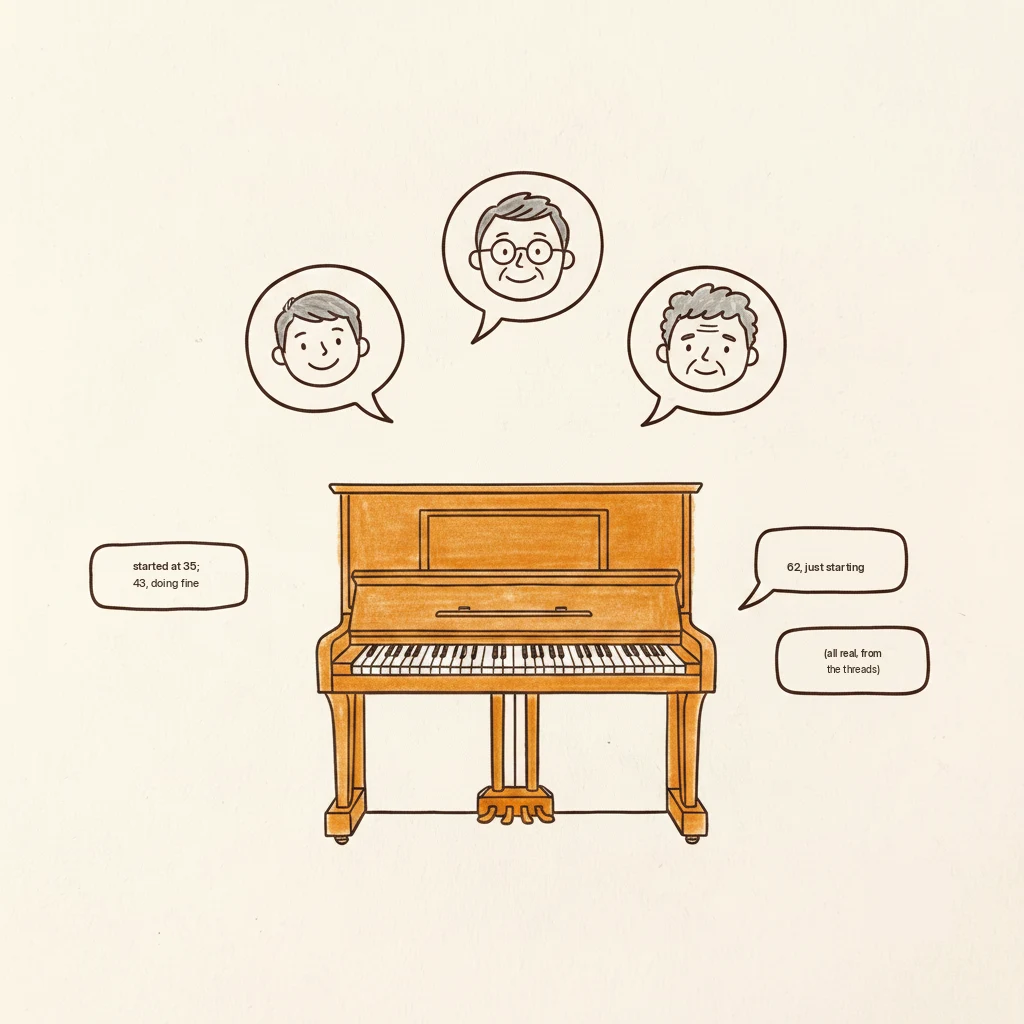
They started at 35. At 40. At 43, doing fine. In their late 50s. One at 62, calling practice one of the most joyous parts of the day. These are real people with real progress. As one of them put it, “too late” comments usually say more about the mindset of the person saying them than about you. You are not too old. You’re right on time.
The honest ceiling (which is actually good news)
Here's the honest ceiling, and I want you to hear it as freedom. It's never too late to learn to play piano. It is almost certainly too late to become a concert pianist. And nobody in that room of happy adult beginners wanted to be one. Somebody who started at 44 was playing Beethoven by 47, for their own joy in their own living room. That's the real bar, and it's a wonderful one. Take the pressure off and the whole thing gets easier.
The path, step by step
You don’t need much. Get an adult method book: Alfred’s Adult All-in-One (about $17 to $20) or Faber Adult Piano Adventures (about $18) are the two standards, both built to move at an adult’s pace instead of a child’s. There are free YouTube walkthroughs that go page by page alongside the Faber book, which many self-teachers lean on.
A teacher helps, but as an adult you get to set the cadence. Weekly is great. So is an occasional check-in every few weeks if you’re the self-directed type. What matters is the fit, and for a grown-up that means one specific thing.
Find a teacher who respects the mile you’ve already walked
A lot of adults arrive at lessons half-braced to be scolded for their self-taught habits. The right teacher does the opposite. Tell a prospective teacher, out loud, “I’m self-taught and proud of it.” The right one grins and builds on what you’ve got. The wrong one bristles. And the same law from every good lesson applies: you should feel good after a lesson. If you don’t, that’s the wrong teacher, not the wrong hobby.
The twenty-minute truth
Adult life runs on minutes, not hours, and that’s fine, because daily beats marathon. Twenty honest minutes a day, most days, will carry you past someone who crams two hours every other Sunday. Consistency is the whole engine. Put the keyboard somewhere you’ll pass it, and play a little every time you do.
If you’re still choosing the instrument, the short version is that weighted keys matter more than the number of keys, and a good weighted digital piano is the usual adult answer. There’s a fuller breakdown on the keyboard-buying page.
Skip this unless you like the nerdy part. Adult brains learn piano differently, not worse. A child soaks skills up by slow osmosis over years. An adult can't do that, but an adult CAN do deliberate practice: understanding what a passage is doing, targeting the exact hard bar, and drilling it on purpose. On month-one skills, that focused approach often moves faster than a kid's, which is the opposite of the story you were told. You trade effortless absorption for strategy, and strategy is powerful.
Buy the Alfred's book today and play ten minutes tonight. Then book one lesson for next month with a teacher you've told, out loud, "I'm self-taught and proud of it." The right one will grin. That's your teacher.
Questions people actually ask
Is it too late to learn piano at 30, 40, or 60?
No. Adults start successfully at every one of those ages and reach real pieces within about a year of steady practice. The only thing off the table is a professional concert career, which isn’t why you’re here. Your brain learns fine; the “too late” idea is a myth, not a fact.
How long does it take an adult to learn piano?
With consistent daily practice, about a year to play real pieces you’d be proud of. Twenty focused minutes most days beats occasional long sessions. Progress is steady rather than instant, and using an adult method book plus the odd lesson to check your technique keeps you moving in the right direction.
Do adults need a teacher or can they self-teach piano?
Plenty of adults self-teach successfully with an adult method book and free video walkthroughs. A teacher speeds things up and catches physical habits, and as an adult you can keep it occasional rather than weekly. The key is finding one who respects self-taught progress and leaves you feeling good after each lesson.
If you buy through my links the site earns a little coffee money. Doesn’t change the price, doesn’t change my answer.
Picking piano back up, you're probably also wondering:
Gus Harmon
Gus spent three decades running sound wherever somebody needed it: bar bands, weddings, school shows, and twelve years of Sunday mornings. He can't sing a note. He can make sure you're heard. Now he writes so normal people can buy the right thing the first time.