← first chords, first songs, at any age
Music Lessons for Preschoolers (What Age, What Kind, What Money)
Before about age five, music lessons means group music play, not private instruction; private lessons hit their sweet spot at five to nine, and a singing four-year-old wants a choir, not a voice teacher.
 Gus Harmon · Updated July 8, 2026 · how I decide
If you buy through my links the site earns a little. It's never why I pick things.
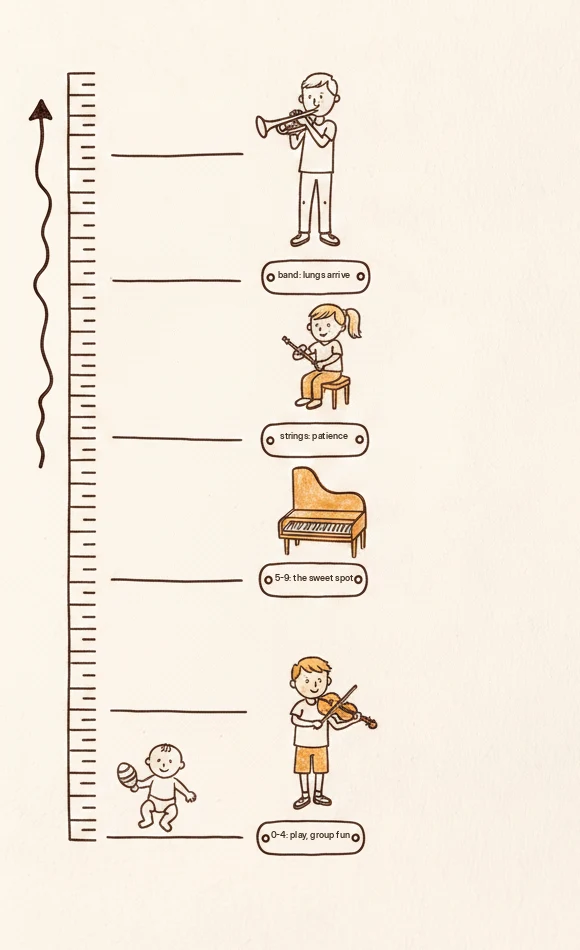
Before about age five, "music lessons" means group music play: singing, rhythm, parent-and-me classes, not sitting a toddler down for private instruction. The private-lesson sweet spot is five to nine. Piano and violin can start earliest (a four-year-old can hold a tiny bow), guitar and drums around seven, band instruments later once the lungs and adult teeth arrive. And a singing four-year-old wants a children's choir, not a voice teacher. Young voices need play, not technique.
First: there is no window, so breathe
Here’s the thing that has parents panicking at a music counter over a three-year-old: the fear of missing “the window.” There is no window. Early exposure is a gift, not a deadline. People start piano at 62 and call practice the best part of their day. Nobody is behind at four. So let’s take the pressure off and just match the child to the right thing for right now.
The age map
- Birth to 3: exposure and parent-and-me classes. Singing in the car, banging on pots, one class where you sit on the floor together. That’s the whole curriculum, and it’s a good one.
- 3 to 4: group general music. A room of little kids singing, shaking eggs, learning to move to a beat.
- 5 to 9: the private-lesson sweet spot. This is when one-on-one instruction starts to click.
Within that sweet spot, instruments start at different ages. Piano and violin can begin earliest, four or five, because both come in child sizes and don’t demand lung power. Guitar and drums tend to work around seven. Band instruments (trumpet, clarinet, and the rest) wait until the lungs are big enough, the hands reach, and the adult front teeth are in.
Readiness beats age every time. The real question isn't "is my kid five yet," it's "can they focus for twenty to thirty minutes, and do they WANT to go?" A focused, eager four-year-old is more ready than a squirmy, dragged-along six-year-old. Watch the child, not the calendar.
The singing question, answered kindly
Those searches for singing lessons for a four or five year old come from a real place: a kid who sings constantly. Here’s the honest answer. Under about age eight, that child wants a children’s choir or group singing, not a private voice teacher. Young voices are still developing, and what they need is play, pitch-matching games, and confidence, not vocal technique. Private voice lessons make sense around ten and up.
And a gift, while we’re here: the shame that grown-ups carry about their singing? Little kids don’t have it yet. Keep it that way. A choir builds joy and a good ear without ever teaching a child to be self-conscious.
The money, both halves
Let’s talk real numbers, because the sales pages won’t. Typical private activity runs around $120 a month. Parent-and-me group classes are about $15 to $25 a class. First private half-hour lessons for a five-year-old run about $15 to $35 each. Some families spend wildly more, and some look at that and say “that’s my whole paycheck,” and both of those are true and both get to be true.
Now the column nobody advertises: the $0 one. Library story-and-song hours. Church and community children's choirs, often free or near it. School music programs. For a preschooler, singing in the kitchen and going to the library's free music hour genuinely IS the lesson. Don't let anyone make you feel that free means lesser at this age. It doesn't.
One activity at a time
A word of hard-won wisdom from parents further down the road: one activity at a time. Let a kid fully sink into one thing rather than getting shuttled between four and burning out by ten. Depth beats a packed calendar, and a burned-out ten-year-old quits everything.
A few traps to sidestep: “conservatory method” markups on toddler classes (a three-year-old does not need a prestigious pedagogy), prepaying a whole semester before you know the fit, and any program that won’t let you sit in and watch.
Skip this unless you like the nerdy part. All that "just playing" at age three or four is quietly building the two skills every instrument later stands on: a steady sense of beat and the ability to match a pitch you hear. Shaking an egg in time and singing back a simple tune are the literal foundations of rhythm and ear. So the giggly floor-sitting class isn't pre-music, it's the most important music a four-year-old can do.
Under five: sing in the kitchen and take the library's free music hour. That IS the lesson. At five, if she still sings to the dog, book the half-hour piano or violin slot. And nobody's behind. People start at 62 and love it.
Questions people actually ask
What age should kids start music lessons?
Group music play suits birth to four; private one-on-one lessons hit their sweet spot at five to nine. Piano and violin can start at four or five, guitar and drums around seven, band instruments later. But readiness beats age: the real test is whether the child can focus for twenty to thirty minutes and wants to be there.
Can a 4-year-old take singing lessons?
Not private voice lessons, but yes to a children’s choir or group singing. At four, a child’s voice needs play, pitch-matching, and confidence-building, not technique. Formal voice training waits until around age ten. A choir gives a singing four-year-old exactly the right thing and keeps it joyful and pressure-free.
How much do preschool music classes cost?
Parent-and-me group classes run about $15 to $25 a class, and structured group music programs land around $60 to $120 a month. First private half-hour lessons are roughly $15 to $35. There’s also a strong free tier: library song hours, community and church choirs, and simply making music at home.
Thinking about a little one's music, you're probably also wondering:
Gus Harmon
Gus spent three decades running sound wherever somebody needed it: bar bands, weddings, school shows, and twelve years of Sunday mornings. He can't sing a note. He can make sure you're heard. Now he writes so normal people can buy the right thing the first time.