← quieter kits and household peace treaties
Easy Drum Songs for Beginners (Hold the Groove Like the Record)
Start with Billie Jean and Seven Nation Army for pure pocket, then Highway to Hell, and know that a month of fundamentals unlocks a thousand songs at once.
 Gus Harmon · Updated July 8, 2026 · how I decide
If you buy through my links the site earns a little. It's never why I pick things.
The classic first drum songs are classics for a reason: Seven Nation Army, Billie Jean, Back in Black, and the drum teacher’s favorite first assignment, Highway to Hell. The job is to hold the groove down like the record, not decorate it. And drums are the one instrument where a month of fundamentals first unlocks a thousand songs at once.
Before a single song, let me kill the thing that makes new drummers quit. A player with twenty years in, marching band, rudiments, good teachers, the whole background, wrote this: “It takes me months to learn a difficult song. I have no natural talent.” Two hundred people upvoted the top reply, which was some version of: thirty-year players feel exactly the same, and the YouTube prodigy kids are the wrong yardstick.
So if you’re measuring yourself against an eleven-year-old shredding a Rush song on your feed, stop. That’s not the comparison. The comparison is the record, and the record just needs you to keep good time.
The one a drum teacher assigns first
Highway to Hell. A working drum teacher explained why perfectly: it’s “a simple rock beat but there is also enough arrangement to the track that makes it an actual piece of music. Focus on the groove and actually hold it down and play it like the record. Don’t get bored and pretend you are above playing simply.” That last part, about getting bored, is the entire discipline of drumming in one sentence.
The starter list, and the job each one teaches
- Billie Jean. The metronome song. Same beat the whole way, zero fills, pure pocket. If you can play Billie Jean and not rush, you can play drums.
- Seven Nation Army. The riff everyone knows, and the drum part is the solid floor under it.
- Back in Black, and honestly any AC/DC song. As one player said, “they’re almost all the same,” and coming from a drummer that’s a compliment, it means they’re all clean, playable grooves.
- Anything by CCR. Great for finding the rhythm and starting to experiment with small fills.
- Boulevard of Broken Dreams and Weezer (Buddy Holly, Say It Ain’t So) when you want a little more going on.
The thing about drums specifically
No other instrument starts by learning a whole song. Drums are different, and a wise player named it: spend a month on fundamentals first, the basic beat and stick control on a practice pad, and “you will be able to play thousands of songs with good fundamentals established.” So hold both at once: groove basics every day, and one real song as the carrot. The fundamentals are what make the songs come easy, not the other way around.
And know that learning a song is its own separate skill. Playing along to a track isn’t the same as playing the song, there are count-offs, sections, and endings to learn. Getting from “I can play the beat” to “I can play the whole thing start to finish” is real work, and it’s normal that it takes a bit.
What is the “money beat”?
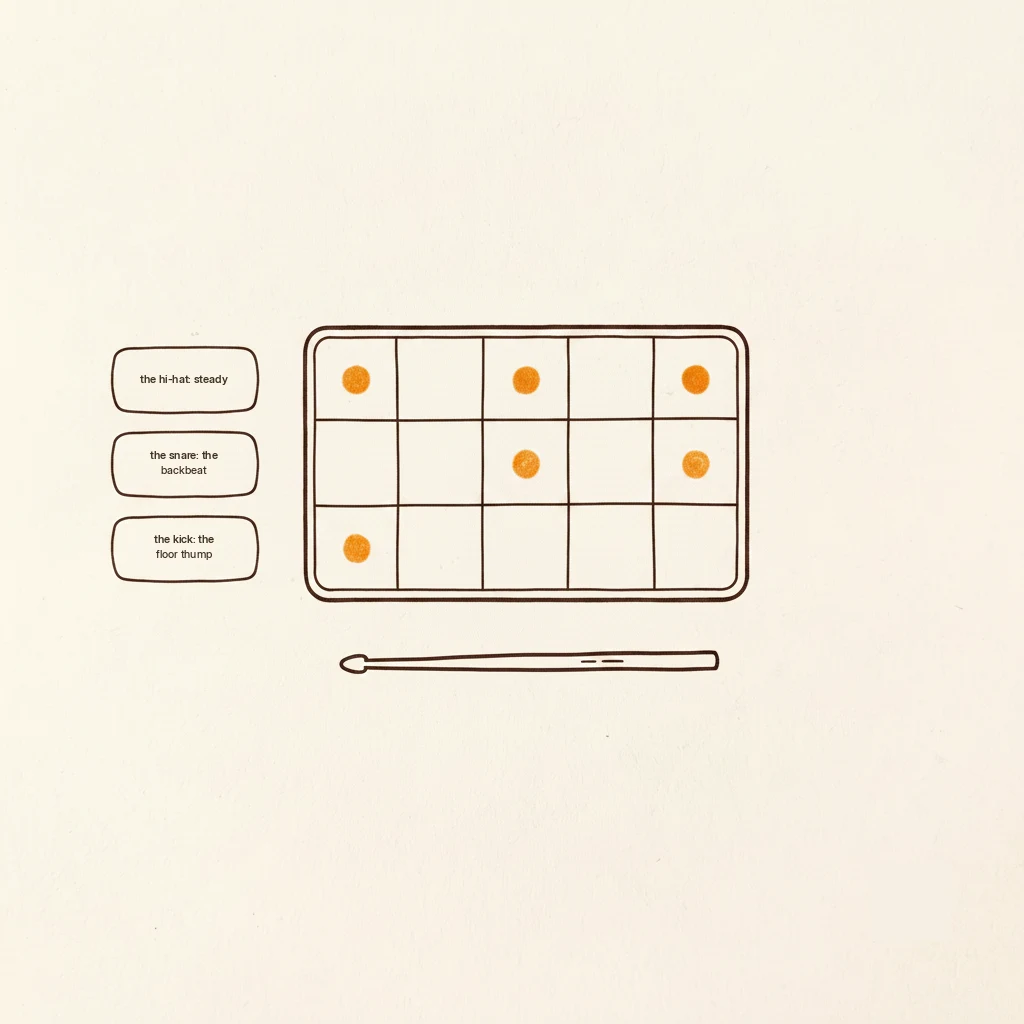
It’s the basic rock beat under most of recorded music: kick drum on beats one and three, snare on two and four, steady eighth notes on the hi-hat. That’s it. That one pattern, sometimes called the 80/20 of drumming because a small handful of grooves cover the vast majority of songs, is most of the radio. Billie Jean is that beat, naked, with nothing else, which is exactly why it’s the perfect first song.
A practice pad and a pair of sticks. About $40 together. This is where the month of fundamentals happens, quietly, on the kitchen table, without waking the house. It builds the stick control that every song on this list rides on.
Flaws, said plainly: a pad is not exciting, and a kid wants to hit the real kit. That’s fine, split the time. Ten minutes of pad, then the fun.
Everything here works at bedroom volume on an electronic kit like the Nitro, with headphones on. The one caveat that survives is the kick-drum thump traveling through the floor to rooms below, which is its own conversation.
Why does that one money beat carry so much of popular music? It comes down to the backbeat, the snare hits on beats two and four. In a lot of the world’s music the strong beats are one and three, where your foot naturally lands. Rock, pop, soul, and funk deliberately slap the snare on the off beats, two and four, which fights that natural pulse just enough to make your body want to move, to fill the gap. That tension is the groove. So when a beginner plays kick on one-and-three and snare on two-and-four, they’re not playing a simple beginner pattern, they’re playing the exact rhythmic engine that makes people dance, the same one under thousands of hit records. Simple to play, deep as the ocean underneath.
Billie Jean with a metronome until it’s boring, then Highway to Hell played like the record, and no fills until the groove doesn’t move. Ten minutes on the practice pad every day for the first month. The drummer’s job is to be trusted, not noticed.
If you buy through my links the site earns a little coffee money. Doesn’t change the price, doesn’t change my answer.
If you’re figuring this out, you’re probably also wondering:
Gus Harmon
Gus spent three decades running sound wherever somebody needed it: bar bands, weddings, school shows, and twelve years of Sunday mornings. He can't sing a note. He can make sure you're heard. Now he writes so normal people can buy the right thing the first time.