
← first chords, first songs, at any age
The Best Acoustic Guitar for Beginners (Should It Be Acoustic?)
The standard first acoustics are the Yamaha FG800 and FS800 at about $250, but steel strings are the hardest on beginner fingers, so match the guitar to the music they want to make.
 Gus Harmon · Updated July 8, 2026 · how I decide
If you buy through my links the site earns a little. It's never why I pick things.
The standard first acoustic guitars are the Yamaha FG800, about $250, and its smaller-bodied sibling the FS800: real instruments teachers recognize. But answer the bigger question first. Acoustic isn’t automatically the “proper” way to start. Steel acoustic strings are the hardest on beginner fingers, so a kid who wants to play electric songs should just start electric.
Before I name a guitar, let me stop you from buying the wrong fork, because that’s the real mistake here, not the wrong model.
Here’s the thing you’ve probably been told: “everyone starts on acoustic, that’s just how it’s done.” That’s folklore, not fact. So the first question isn’t which acoustic. It’s whether acoustic is even right for the person holding it.
The fork, answered straight
Follow the music the learner actually wants to make. That’s the whole rule.
If the dream is a singer-songwriter with a wooden guitar around a campfire, acoustic is exactly right. Buy it with confidence.
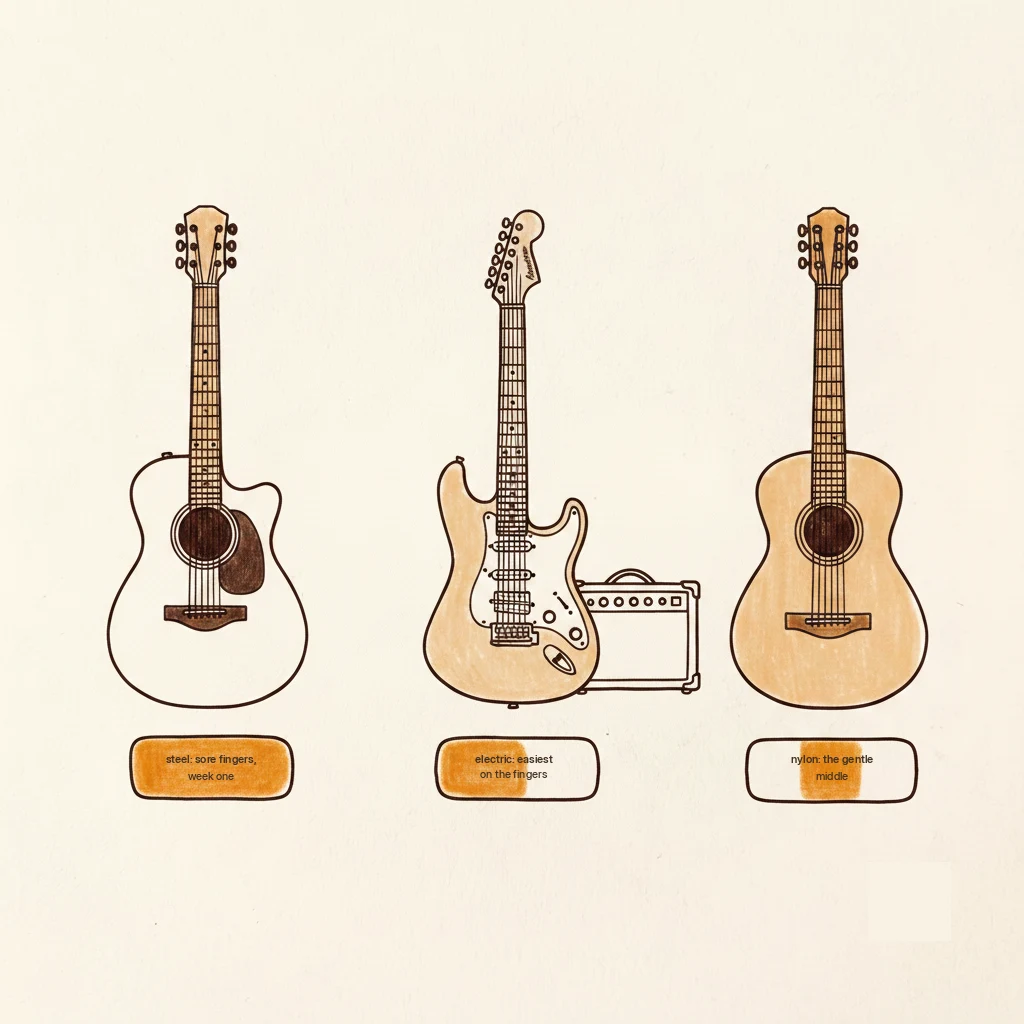
If the dream is loud, the electric songs the kid actually listens to, don’t buy an acoustic out of some sense of duty. Steel-string acoustics have the highest string tension of the bunch, which means the most finger pain in week one, which is exactly when beginners quit. Electric is the gentlest start. There’s a whole page on that if that’s the fork.
And there’s a soft middle: a nylon-string classical guitar. Nylon strings are far easier on the fingers, which is why they’re the standard in school guitar classes and great for small hands.
Why do steel acoustic strings hurt more than electric or nylon? It comes down to tension, how hard the string is pulling. A steel acoustic string is stretched tight to ring out loud with no amplifier helping it, and that high tension means you have to press harder to fret a note, which is what shreds soft fingertips. Electric strings are thinner and under less tension because the amp does the work of getting loud. Nylon strings are softer and looser still. So “acoustic first to toughen up” is really “start on the most painful option for no reason.” Match the strings to the fingers, not to tradition.
If acoustic is the answer, here’s what to buy
The perennial first acoustic is the Yamaha FG800. It’s the Pearl Export of guitars, the one teachers nod at, about two hundred to two thirty. The Fender CD-60S is the co-standard at a similar price. And used versions of both are everywhere around a hundred twenty to a hundred fifty.
Two more things. The setup rule from the electric page applies double to acoustics, because a cheap acoustic with high strings is the number-one finger-killer there is. Budget the eighty-dollar setup, or buy from a shop that includes one. And mind the body size: the FS shape is a smaller, more comfortable body for smaller frames and for adults playing on the couch, while the FG is the bigger dreadnought. A kid under about twelve wants a 3/4-size guitar, or maybe a ukulele, which is its own gentle path.
A word for the adult beginner
If you’re picking this up at fifty, hear me: adults quit from hand pain far more than from boredom. So give yourself three mercies. Light strings. The smaller FS body. And full permission to start on electric if that’s the music you love. None of that is cheating. It’s just not quitting.
A few traps. Skip the seventy-nine-dollar “acoustic packs.” Watch for laminate-top guitars sold at solid-top prices, the tell is the words “solid spruce top” in the spec. And “it was only played once, still on the wall” still needs a setup like any other.
If the dream is wooden and around a campfire: the FG800, set up, done. If the dream is loud: don’t buy an acoustic out of duty, see the electric post. And if the hands are small or fifty-plus: the smaller FS body and light strings are not cheating.
If you buy through my links the site earns a little coffee money. Doesn’t change the price, doesn’t change my answer.
If you’re figuring this out, you’re probably also wondering:
Gus Harmon
Gus spent three decades running sound wherever somebody needed it: bar bands, weddings, school shows, and twelve years of Sunday mornings. He can't sing a note. He can make sure you're heard. Now he writes so normal people can buy the right thing the first time.