
← old cassettes and camcorder tapes, rescued
Cassette Player Repair: It's the Belt (About 90% of the Time)
When an old cassette player won't spin or plays slow and warbly, it's almost always the belt: a $5 to $10 rubber loop and a screwdriver afternoon fix it, or a $30 to $40 new player if you just want to listen.
 Gus Harmon · Updated July 8, 2026 · how I decide
If you buy through my links the site earns a little. It's never why I pick things.
When an old cassette player powers on but the wheels won't turn, or everything plays slow and warbly, it's the belt about 90% of the time: a little rubber loop inside that ages into taffy. Replacement belts cost $5 to $10, are specific to your model, and swapping one is a screwdriver-and-patience afternoon with a per-model YouTube video. If you just want to play a box of tapes and own no player, a $30 to $40 new deck handles casual listening.
Before you grieve the old Walkman, read this
Here’s the thing thirty-five years around gear taught me: half the machines people mourn didn’t die. They need a part that costs less than lunch.
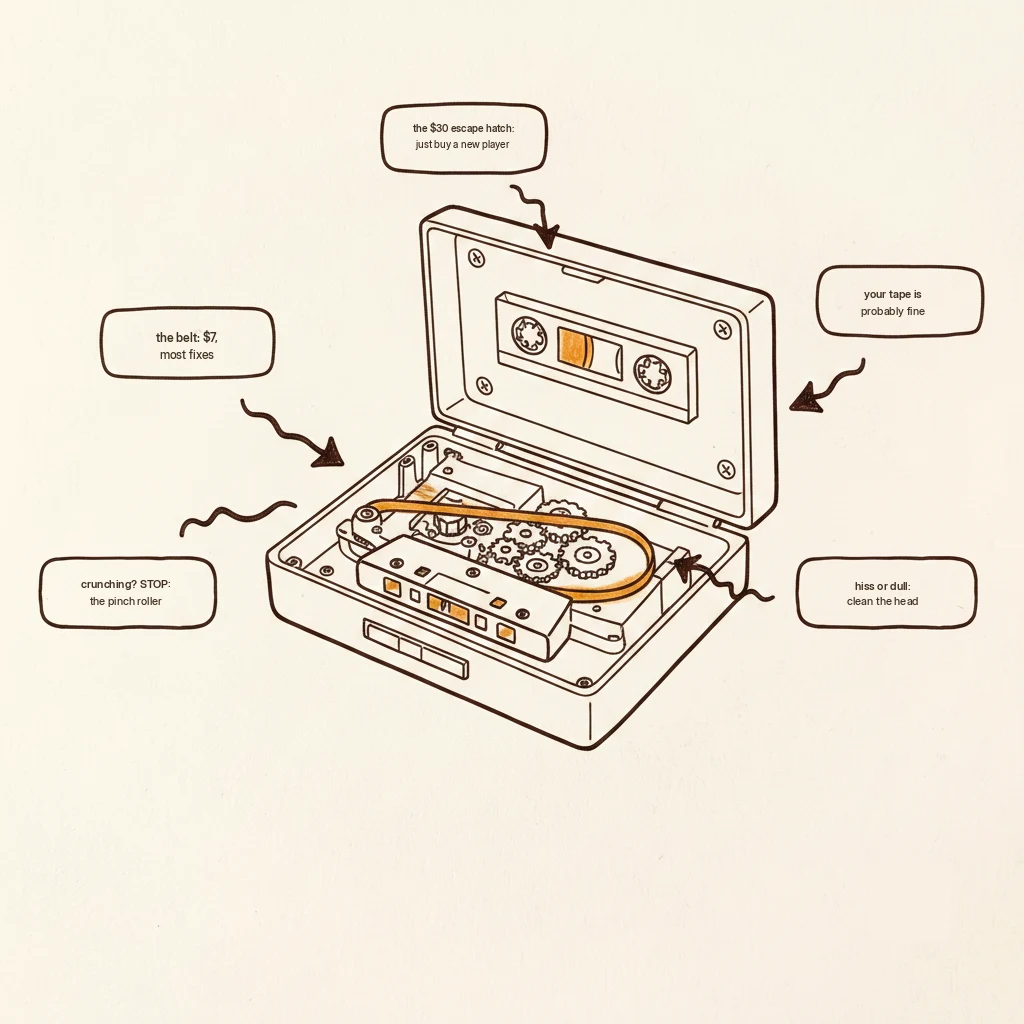
The belt is a rubber loop that spins the wheels. Rubber ages. After enough years it goes soft and stretchy like old taffy, and then the motor turns but the tape doesn’t. That’s your slow, warbly, or dead-wheeled player, nine times out of ten.
Read the symptoms and you’ll know what you’re dealing with:
- Won’t spin, plays slow, or wobbles in pitch: that’s the belt.
- Crunching, or actually chewing a tape: stop the machine. That’s the pinch roller or the mechanism, and it eats tapes. Protect the tapes first.
- Hiss and dull, muffled sound: the playback head needs a cleaning.
The belt job, honestly sized
I won’t pretend it’s zero effort. Take the back cover off and sometimes the belt is sitting right there in plain sight. Sometimes it’s buried under the mechanism and you’re in for more disassembly. It’s a bit of a model lottery, so look up your exact model on YouTube before you start. Somebody has almost certainly filmed it.
There’s no universal belt, either. They come in different thicknesses and diameters, so measure the old stretched one or search your model number to order the right size. While you’re in there, wipe the little pulleys clean with rubbing alcohol before you fit the new belt. Then play a song you know well and check the speed sounds right.
That whole thing, belt plus a head cleaning plus a speed check, is what a shop means when they say “servicing.” Parts run $5 to $10.
The one rule that outranks the machine: never leave a precious tape sitting in a player that's acting up. If it won't eject cleanly, open it and free the tape by hand rather than let a crunchy mechanism keep pulling. The tape is irreplaceable. The player isn't.
If you just want to play the box (no player at all)
Plenty of people find the tapes and own nothing to play them on. You’ve got three roads.
A new basic player runs $30 to $40 and is perfectly fine for casual listening. A thrift-store deck plus a fresh belt is the quiet quality sleeper: old machines often sounded better than new cheap ones, and now you know how to fix them. And if what you really want is to save these tapes as files, a USB converter (about $25 to $40) both plays them AND records them at the same time, so you buy one thing instead of two.
One checkbox for the fancy blank tapes: the metal-formula ones need a deck that can actually handle metal tape, or they’ll sound wrong no matter how good the belt is.
Skip this unless you like the nerdy part. It's almost always the belt and almost never the head, and there's a clean reason why. The belt is rubber, and rubber is a living-ish material that oxidizes and relaxes over decades until it can't grip. The playback head is metal and glass, and metal doesn't age like that. So the part that fails is the cheap rubber band, not the precision bit, which is exactly why a $7 fix brings so many "dead" players back.
Type the model number plus the word "belt" into YouTube before you grieve the Walkman. It's a $7 rubber band and the best screwdriver hour you'll spend this year. And a precious tape never rides in a player that's still crunchy.
Questions people actually ask
Why won’t my old cassette player spin?
Almost always the belt. It’s a rubber loop that’s aged soft, so the motor turns but the wheels don’t. A model-matched replacement belt is $5 to $10, and swapping it is an afternoon job with a per-model YouTube video to follow. If the player is crunching instead, stop, because that damages tapes.
How can I play old cassette tapes if I don’t have a player?
Cheapest path: a new basic player, $30 to $40, fine for listening. Best-sounding cheap path: a thrift-store deck plus a fresh belt. Best path if you also want to save them: a USB cassette converter, $25 to $40, which plays and records at once so you’re not buying two devices.
Is it worth repairing an old cassette deck?
For an heirloom, absolutely. The usual fix is a $5 to $10 belt and an afternoon, which is a lot of sentiment saved for a little money. If it’s just a generic player and you only want to hear the tapes, a cheap new one or a converter may be less fuss than the repair.
If you buy through my links the site earns a little coffee money. Doesn’t change the price, doesn’t change my answer.
Getting the box playing again, you're probably also wondering:
Gus Harmon
Gus spent three decades running sound wherever somebody needed it: bar bands, weddings, school shows, and twelve years of Sunday mornings. He can't sing a note. He can make sure you're heard. Now he writes so normal people can buy the right thing the first time.