
← your kid's instrument: costs, rentals, sticking with it
A Clarinet for a Beginner (the Invincible Plastic Yamaha)
The beginner clarinet answer is a tough plastic student horn like the Yamaha YCL-255 (about $600), and whatever you buy, swap the stock mouthpiece for a $30 one.
 Gus Harmon · Updated July 8, 2026 · how I decide
If you buy through my links the site earns a little. It's never why I pick things.
The beginner clarinet is the invincible plastic student horn: a Yamaha YCL-255 (about $600 new) or a Buffet B12. Tough, in tune, and resellable for about what you paid. The $100 Amazon clarinet is the one wrong answer, repair shops won’t work on it. Renting the school year (about $175) is a fine second path. Whatever arrives, replace the stock mouthpiece.
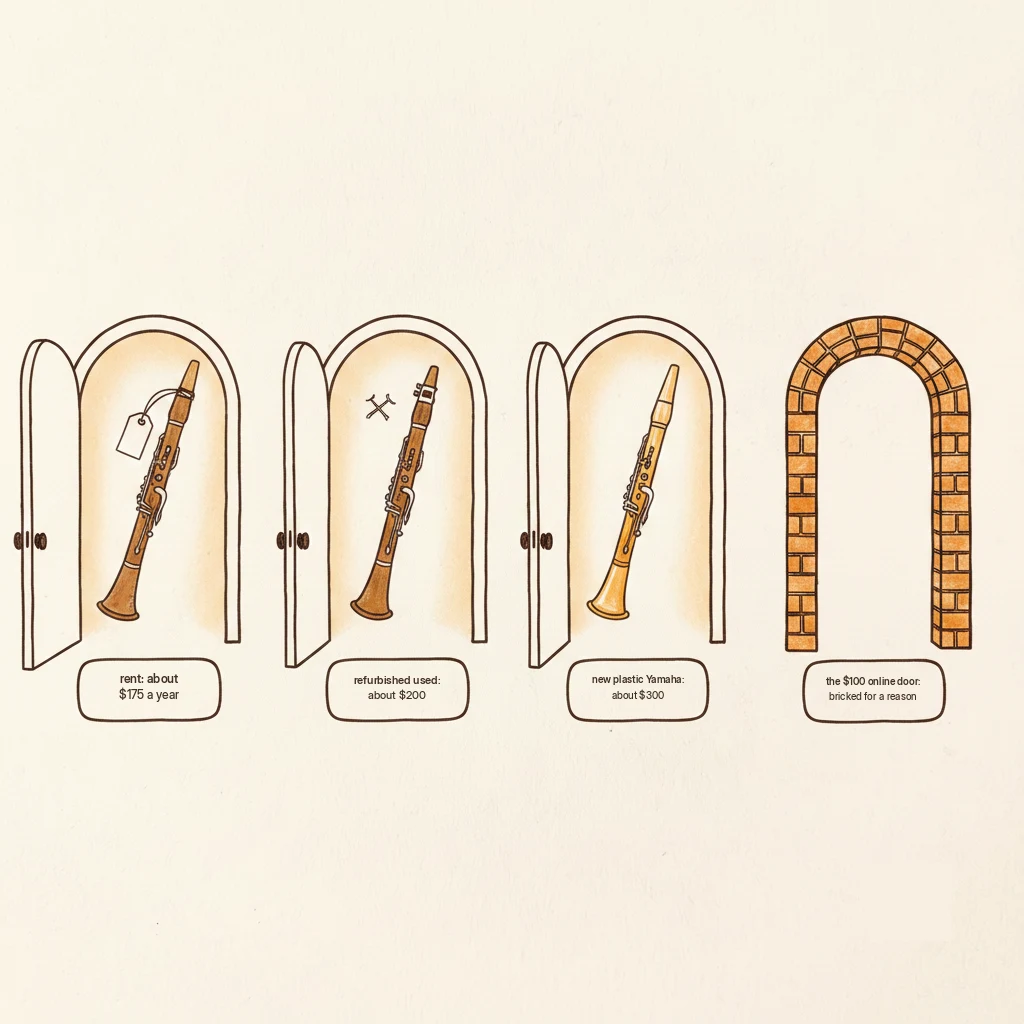
My daughter played clarinet, and unlike her brother and his short-lived trombone, she stuck with it, so I’ve watched this exact purchase from the front row. You’ve probably already anchored on the wrong price, because “clarinet under $200 new” looks like it exists online. It doesn’t, honestly. Let me re-anchor you kindly, and then give you the one genuine argument in this category.
The out-of-the-box answer
A Yamaha YCL-255. About $600 new. The plastic Yamahas (the 250, 255, 200AD) are, in the words of the band world, “invincible.” They play in tune, they shrug off a school bus and a dropped case, and here’s the kicker: “if your kid quits in one or two years you should be able to resell for about the same price.” That resale symmetry is what makes $600 the cheap choice, not the expensive one.
Flaws, said plainly: it’s plastic and plain-looking, not a gleaming wood clarinet. For year one (and years two and three), plastic is the right call, see the nerdy box below.
The Buffet B12 or Prodige is an equally good alternative, and a Backun Alpha makes a great backup horn later if the kid moves up to wood.
The one real argument (and how to settle it)
There’s genuine disagreement among people who know clarinets, and I won’t paper over it:
- Your band director will often say under-$200-new won’t last, so rent, or buy a used Yamaha, Selmer, Vito, or Jupiter.
- A counter-voice says most used instruments don’t actually need an expensive overhaul, and that repair shops overstate it because overhauls are profitable.
- A third person bought the $30 marketplace horn and paid $300 to overhaul it anyway.
Here’s how all three can be true at once: they’re describing different horns. My synthesis: buy a refurbished or play-tested used clarinet, or rent the year, or buy the $600 Yamaha new. Any of those three is a good door. The only truly wrong door is the $100 Amazon clarinet, and the cruel irony is that when you search for a beginner clarinet, that is the first thing the results try to sell you.
The upgrade that beats a new horn
Whatever clarinet you buy, replace the stock mouthpiece. It’s about $30 (a Forbes Debut is a well-liked one), and it does more for a beginner’s sound and comfort than swapping the entire horn would. This is the clarinet world’s best-kept secret: don’t buy an “intermediate” clarinet when the kid improves, upgrade the mouthpiece and the reeds first. Same $30 fix, most of the benefit.
Pair it with a box of 2.5-strength reeds and you’ve got the rig that survives a thousand middle-school band rooms.
The rest of the small stuff
If the band program hasn’t handed you a book, the standard pair is Essential Elements plus a Rubank method (confirm the editions). On squeaks: they’re almost always equipment and mouth setup, not destiny, a too-hard reed is the usual culprit, so they’re fixable. And on teaching yourself: honest yes, with rails. The wall is tonguing (starting notes cleanly), where self-taught habits harden, and a 30-year teacher’s warning applies, once a bad tonguing habit locks in it’s very hard to undo, so get a little guidance right at that stage.
A wood clarinet sounds a touch warmer, which is why advanced players want one, but wood is alive to its environment. It swells and shrinks with humidity and temperature, and a wood clarinet that goes from a cold car into a warm band room, over and over, can literally crack, an expensive, heartbreaking failure. It also demands careful “breaking in” and oiling. Plastic (technically a resin) does not care. It doesn’t crack from the school bus in January, it doesn’t swell in a humid gym, and it survives being dropped and knocked around by a distracted eleven-year-old. So for the years when the instrument lives in a backpack and the player is still deciding if they love it, plastic isn’t the compromise, it’s the smarter material. Wood is the reward for sticking with it.
The plastic Yamaha, a Debut mouthpiece, and a box of 2.5 reeds. That exact rig has survived a thousand band rooms. If money’s tight, the $175 rental buys you a year to find a refurbished one at Christmas.
If you buy through my links the site earns a little coffee money. Doesn’t change the price, doesn’t change my answer.
If you’re figuring this out, you’re probably also wondering:
Gus Harmon
Gus spent three decades running sound wherever somebody needed it: bar bands, weddings, school shows, and twelve years of Sunday mornings. He can't sing a note. He can make sure you're heard. Now he writes so normal people can buy the right thing the first time.