
← your kid's instrument: costs, rentals, sticking with it
A Flute for a Beginner (the Door Where the Trap Runs Backwards)
A beginner flute is a closed-hole, C-foot student model like the Yamaha 222 (about $400 used), and the trap here is overspending: a $1,500 flute is an intermediate one a beginner can't use yet.
 Gus Harmon · Updated July 8, 2026 · how I decide
If you buy through my links the site earns a little. It's never why I pick things.
A beginner flute is a closed-hole, C-foot student model in the $300 to $700 range used or from the entry brands: the Yamaha 222 is the sturdy default (about $400 used; its new price has climbed to about $1,300, one more reason to buy used). Here the trap runs backwards, parents overspend. A $1,500 flute is an intermediate flute a beginner can’t use yet. Rent for the band year, buy at teacher sign-off, and expect more air than sound the first two weeks.
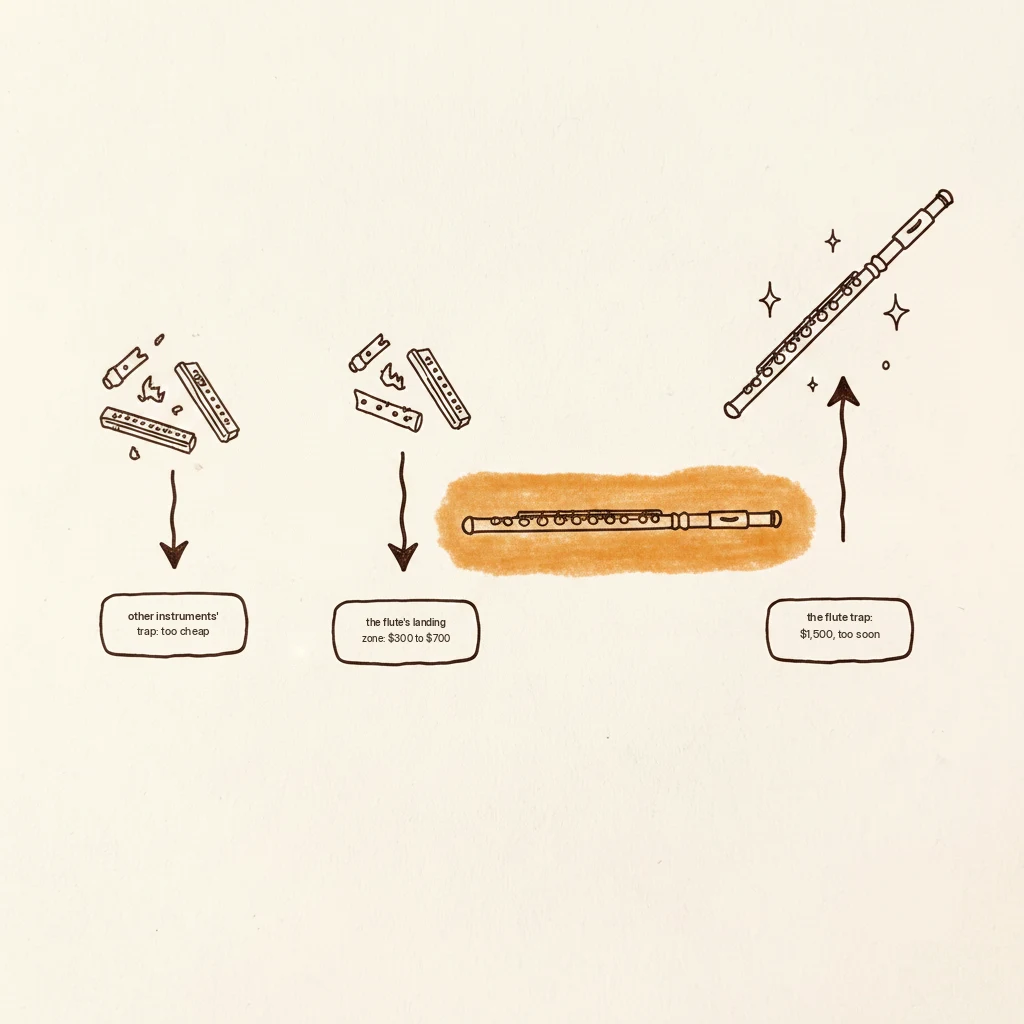
Most instrument pages on this site are trying to keep you from buying too cheap. The flute is the odd one out. Here, well-meaning parents tend to overspend, talked into a beautiful $1,500 flute for a nine-year-old who can’t yet use what makes it beautiful. So let me talk you down, gently, and save you eight hundred bucks.
The backwards trap
A more expensive flute isn’t a “better beginner flute.” It’s a different flute, an intermediate one, built with features (open holes, a fancier foot, a heavier metal) that a beginner’s fingers and breath can’t take advantage of yet, and that can actually make learning harder. Players in one thread said it four different ways: “do not pay $1,500 for a beginning flute.” The beginner zone is a closed-hole, C-foot student model, $300 to $700 used or from the entry brands. Full stop.
The brand you’ll hear over and over
Yamaha YFL-222 (or 221). About $1,300 new these days (the price has climbed hard the last few years), or roughly $350 to $450 used. Players call it “the best beginner flute on the market” and “the sturdiest,” and a used one earns real loyalty (“still my backup”). It plays in tune, it survives a backpack, and it holds resale value. If you buy one flute, buy this one.
Flaws, said plainly: not the prettiest or most exciting flute in the case. It’s the Honda Civic of flutes, which is exactly the compliment a beginner needs.
Other honest options: Jupiter and Pearl student models sit in the middle; Di Zhao student flutes have hand-cut headjoints (unusual at this price, so they sound lovely but are a touch fragile); a Trevor James or Gemeinhardt student line is fine; and the plastic Nuvo Student 2.0 (about $150) is a real answer for a small child. As one player put it, “honestly any flute around $500 is about the same.” That’s your permission to stop agonizing.
You can trust the recommendations here
One thread member said the quiet part out loud, and it made me smile: “Flute companies do not have the capital to be sponsoring redditors, so I think you’re in the clear.” Unlike some corners of gear-buying, the flute world’s consensus is genuinely unsponsored. When the room agrees on the Yamaha 222, it’s because it’s good, not because someone got paid.
The sequence, and a warning about used
The smart path: school rental for the band year, teacher sign-off, then buy a student model, ideally used. But here’s the catch that makes where you buy used matter.
A flute’s real value is in its pads, the little cushions that seal each key over its hole. They’re invisible and they wear out, and a worn pad means the flute leaks and fights the player. A “$200 flute” from a marketplace can become a “$700 flute” after it needs a full re-pad. So buy used from a shop that play-tests the instrument first, not from a stranger’s closet. The price of a used flute is really the price of its pads.
And the honest heads-up for the first two weeks: the flute is the one band instrument that may make almost no sound at first, just a lot of air, because getting a note out means learning to blow across the hole just right. That’s the instrument, not the kid. One lesson to get a proper embouchure (the mouth shape) started beats a month of YouTube frustration.
There’s a real book pairing here, too, if the band program hasn’t handed you one: the standard Essential Elements method plus a Rubank book (worth confirming the exact editions). And if you see “split E mechanism” in a listing, that’s just a small key linkage that makes one particular high note speak more easily, nice to have, not a make-or-break for a beginner.
High E on the flute is a notoriously finicky note, it wants to crack or not speak cleanly, because of how the air splits across two open holes at once up in that register. The split-E mechanism is a tiny bit of extra keywork that closes one of those holes automatically when you finger high E, which stabilizes the note so it comes out reliably. Who cares? A beginner struggling with that one squeaky high note might genuinely benefit, and it’s common on student flutes now. But it adds a hair of weight and complexity, and plenty of great players never use one. So: a nice feature if the flute you like has it, absolutely not worth chasing a pricier flute to get.
A used Yamaha 222 from a shop that play-tested the pads, or the school rental until the teacher says buy. Put the extra $1,000 in a jar labeled “intermediate flute, three years from now.” If it’s still labeled that in three years, buy the good one with joy.
If you buy through my links the site earns a little coffee money. Doesn’t change the price, doesn’t change my answer.
If you’re figuring this out, you’re probably also wondering:
Gus Harmon
Gus spent three decades running sound wherever somebody needed it: bar bands, weddings, school shows, and twelve years of Sunday mornings. He can't sing a note. He can make sure you're heard. Now he writes so normal people can buy the right thing the first time.