← first chords, first songs, at any age
How to Read Guitar Tabs for Beginners (Five Minutes)
Guitar tab is six lines for six strings with numbers for frets, you can learn to read it in five minutes, and no, it isn't cheating; the one catch is that tabs assume you already know how the song goes.
 Gus Harmon · Updated July 8, 2026 · how I decide
If you buy through my links the site earns a little. It's never why I pick things.
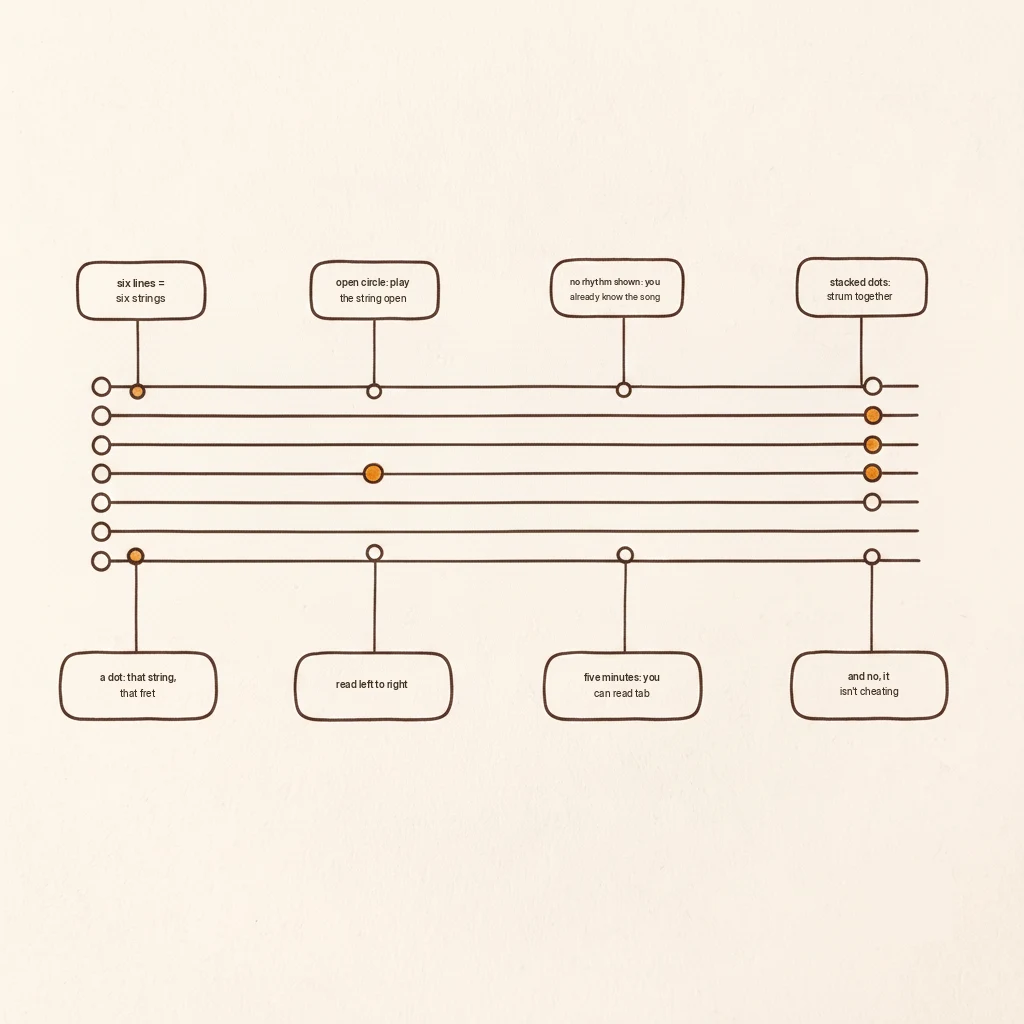
Guitar tab is six lines for six strings, and the top line is your thinnest string. Numbers on a line tell you which fret to press on that string: a 0 means play it open, and stacked numbers mean strum those notes together. You can read it in five minutes, and no, it isn't cheating. Tabs even show bends and slides that regular sheet music can't. The one catch tabs don't advertise: they assume you already know how the song goes, because the recording carries the rhythm.
The whole thing, in five minutes
Here’s the thing: tab looks like code and reads like a map. Six horizontal lines, one for each string on your guitar. The top line is the thinnest, highest string; the bottom line is the fattest, lowest one.
The numbers sitting on those lines tell you where to put a finger. A 3 on the second line means “press the third fret on that string.” A 0 means play the string open, no finger. When numbers are stacked in a column, you strum them all at once, so that’s a chord. Read left to right, play it in order. That’s the entire system.
A few little letters show up too: h for a hammer-on, p for a pull-off, a slash for a slide, b for a bend. Those are moves your fingers make, and here’s the neat part: sheet music literally cannot write a string bend. Tab can. That’s not a lesser format, it’s a guitar-native one.
No, tabs aren’t cheating
Somebody, somewhere, made you feel guilty for using tabs instead of "real" music. Let it go. As players who've done both put it, you're not missing anything with tabs unless you're headed for classical, and tab is just "put your fingers here" in its simplest form. Reading standard notation on guitar is genuinely harder than on piano, for reasons of how the instrument is laid out. The guilt is misplaced. It's physics, not virtue.
The one catch, said plainly
Tabs have a real limitation, and it’s better you hear it now. Tab tells you the pitches, which frets on which strings, but it usually doesn’t tell you the rhythm, how long to hold each note. It quietly assumes you have the recording to listen to.
So the method is simple: listen to the song first until you know how it goes, THEN follow the tab for where your fingers land. The record is your rhythm section. Tab plus your ears equals the whole song. Tab alone, for a song you’ve never heard, leaves you guessing.
One modern fix worth knowing: some tab sites and apps play the tab back for you and scroll in time, which fills in the rhythm the old text tabs left out.
Your first riffs (this is where riffs come from)
The famous guitar lines everybody hums? Those live in tab, and they’re the perfect place to start. Try Seven Nation Army first, because it’s on a single string with one finger and you’ll have it in ten minutes. Then Smoke on the Water, Come As You Are, and Brain Stew. Each one is a “your first tab reads this” trophy.
One gentle warning, because I’ve watched a hundred players fall into it: don’t become a riff collector who knows the first eight seconds of forty songs and can finish none of them. Learn a riff, then learn the rest of that song. Finishing things is the skill that actually grows.
Where to find good tabs
Big community sites (the Ultimate Guitar type) have a tab for nearly everything, but the quality is a lottery, so use the star ratings to filter the junk from the good ones. And the player-style sites (Songsterr is the well-known one) show and play the rhythm, which patches the one thing plain text tab can’t do.
Do I ever need real notation?
Eventually, maybe, and only if a specific door calls. Standard notation writes the rhythm right on the page, lets you communicate with musicians who don’t play guitar, and opens up music written for other instruments (want to play a Bach duet with a flute player someday? that’s the case for it). None of that is homework. It’s a later door you can open if you ever want to, and most players never do.
Skip this unless you like the nerdy part. Anybody who sneers at tab as a shortcut has the history backwards. Tablature, notation that says "put your finger here" instead of naming an abstract pitch, is about five hundred years old. Lute players in the Renaissance read tab, not staff notation, for exactly the reason guitarists love it now: on a fretted, many-strings instrument, showing the hand where to go beats decoding pitches every time. You're using one of the oldest systems there is.
Learn the six-lines-six-strings trick right now. It's five minutes. Then pull up the tab for Seven Nation Army and play it tonight: one string, one finger, a real song. Listen to the record first so you've got the rhythm, then follow the numbers.
Questions people actually ask
Are guitar tabs cheating?
No. Tab is a guitar-native way of writing music that’s been around for centuries, and it can even show bends and slides that standard notation can’t. Unless you’re specifically headed into classical guitar, you’re not missing anything by using tabs. The idea that they’re a shortcut is just misplaced guilt.
Do I need to read sheet music to play guitar?
Not to play songs and riffs, no. Most guitarists play their whole lives on tab and their ears. Standard notation is worth learning later only if you want to read rhythm off the page, play with non-guitar musicians, or tackle classical pieces. It’s an optional door, not a requirement.
What’s an easy first riff to learn?
Seven Nation Army. It’s played on one string with one finger, so you can read the tab and play the whole thing in about ten minutes. After that, Smoke on the Water and Come As You Are are classic next steps. Listen to each song first so you feel the rhythm, then follow the tab.
Getting into tabs, you're probably also wondering:
Gus Harmon
Gus spent three decades running sound wherever somebody needed it: bar bands, weddings, school shows, and twelve years of Sunday mornings. He can't sing a note. He can make sure you're heard. Now he writes so normal people can buy the right thing the first time.