← first chords, first songs, at any age
Easy Guitar Songs for Beginners (That You'll Actually Finish)
Start with a two-chord song like Horse with No Name, learn about ten open chords and one strum, and you can play hundreds of songs.
 Gus Harmon · Updated July 8, 2026 · how I decide
If you buy through my links the site earns a little. It's never why I pick things.
The first guitar songs worth learning are the ones players actually finish. Start with a two-chord song like Horse with No Name, plus the Smoke on the Water and Come As You Are riffs for day-one fun. Learn about ten open chords and one strum and you can play hundreds of songs.
Let me name the thing you’re probably feeling, because it’s the real problem and nobody puts it on these lists. You’ve got five half-learned riffs, zero finished songs, and a quiet feeling that you’re a fraud with a guitar.
A guy in a guitar thread said it better than I can: “Wait, you’re supposed to learn them all the way through?” Yes. And here’s the consolation somebody posted right under him, which happens to be true: “If you can play one song you are better than 90% of guitar players.” Ninety percent of people who start guitar quit inside the first year, and the classic pattern is riffs collected, no song finished, so it never feels like playing. One finished song puts you past almost everybody.
So the trap isn’t hard songs. It’s unfinished ones. This list is built to get you to finished.
The whole method, in one line
Learn these ten open chords: A, Am, B7, C, D, Dm, E, Em, F (or the easier Fmaj7), and G. Add one strum pattern, down-down-up-up-down-up. That’s it. That combination plays hundreds of songs, and every song below is really just a fun way to drill those chords into your hands.
The order that actually works
Think of it as a ladder, one rung at a time.
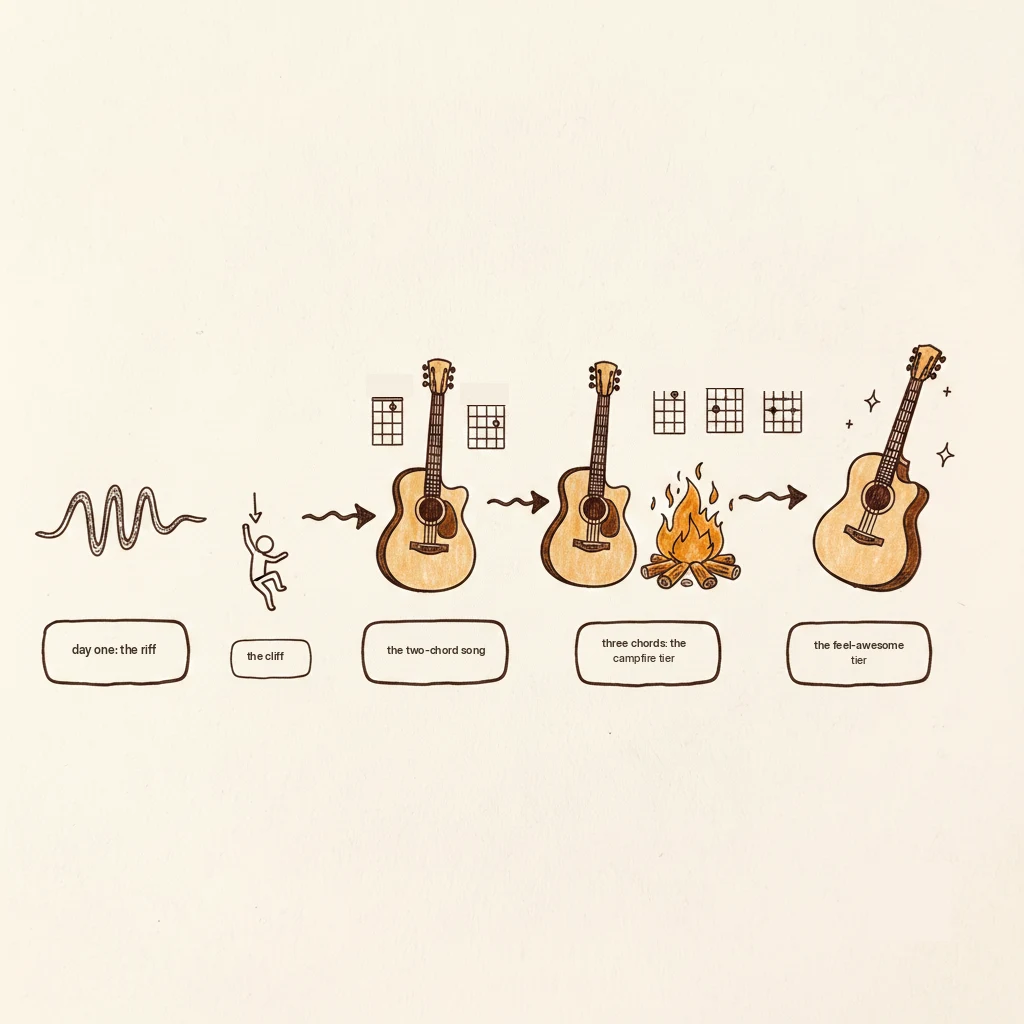
Week one: a riff and a one-finger song
Riffs are day-one dopamine. They sound like real music before your chords are any good.
- Smoke on the Water and Come As You Are. The classic starter riffs. You’ll have them in an afternoon.
- Seven Nation Army. One finger, one string. It sounds huge and it’s almost free.
Month one: finish a two-chord song
This is the rung most people skip, and it’s the important one.
- Horse with No Name. Two chords. I’ll be honest the way that thread was honest: making both chords cleanly, and switching between them in time, will take a little while. That’s not you being slow. That’s the actual skill, and this song is where you build it. Do not let yourself learn a sixth riff until this song is playable front to back.
Month two: three-chord campfire songs
Now you string the chords together into full songs people recognize.
- Bad Moon Rising and Knockin’ on Heaven’s Door. Three chords each, and you already know how they go.
- Brain Stew (spaced-out power chords, which sneak in the muting technique that makes electric guitar work).
The carrot: songs that feel awesome
Keep these in view so the boring parts have a payoff.
- For Whom the Bell Tolls is about the easiest song that instantly makes you feel like a real electric player.
- Wish You Were Here, Good Riddance (Time of Your Life), and About a Girl when you want to sit and play a whole thing.
And yes, Wonderwall. There’s a reason “and here’s Wonderwall” is a joke. It’s a fine strum trainer, the meme is just the price of admission. Learn it anyway.
What to buy, and what not to
You barely need to buy anything here, which is my favorite kind of page.
A clip-on tuner. About $15 to $20. An out-of-tune guitar sounds bad no matter how well you play, and a beginner can’t tell the difference between “I played it wrong” and “the guitar was out of tune.” A tuner removes that whole category of quitting. Cheapest confidence you’ll ever buy.
Hal Leonard’s First 50 Songs You Should Play on Acoustic Guitar. About $10 to $15. A real, sequenced beginner songbook so you’re not hunting the internet for tabs of wildly different quality.
Flaws, said plainly: you don’t strictly need it. The free option below covers the same ground.
The free one worth naming: JustinGuitar. It’s the best free structured course out there, and I’ll say so plainly, because the whole point of this site is telling you the truth about what to spend. If nothing’s getting finished by month three, that’s the moment a real teacher earns their rate.
That one strum pattern, down-down-up-up-down-up, works on a shocking number of songs because it lines up with the backbeat, the pulse your foot taps to without thinking. Pop, rock, folk, and country songs mostly share the same four-beats-per-bar skeleton with the emphasis landing on beats two and four. That strum puts your strongest downstrokes right on that skeleton and fills the gaps with light upstrokes. So once your hand owns the pattern, it fits song after song without you relearning anything. You’re not memorizing a hundred rhythms. You’re learning one, and letting the songs borrow it.
Pick one two-chord song, probably Horse with No Name, and refuse to learn a sixth riff until you can play it start to finish. Sing along if you can. A finished bad song beats five perfect intros, every time.
If you buy through my links the site earns a little coffee money. Doesn’t change the price, doesn’t change my answer.
If you’re figuring this out, you’re probably also wondering:
Gus Harmon
Gus spent three decades running sound wherever somebody needed it: bar bands, weddings, school shows, and twelve years of Sunday mornings. He can't sing a note. He can make sure you're heard. Now he writes so normal people can buy the right thing the first time.