← first chords, first songs, at any age
Guitar Chords for Beginners: Eight Grips Carry Everything
Beginner guitar comes down to about eight open chord shapes plus one strumming pattern, learned in song-pairs, and the real skill is practicing the switch between them, not the shapes themselves.
 Gus Harmon · Updated July 8, 2026 · how I decide
If you buy through my links the site earns a little. It's never why I pick things.
Beginner guitar comes down to about eight to ten open chord shapes: E, A, D and their minor versions, then G, C, and an easy stand-in for F. One strumming pattern carries hundreds of songs while you learn them. Learn the shapes in pairs that show up in real songs, practice the SWITCH between them more than the shapes themselves, and only as fast as you can do it cleanly. Practice makes permanent, not perfect.
The order that actually works
Here’s the thing most chord charts get wrong: they hand you thirty shapes with no clue which to learn first. You don’t need thirty. You need about eight, in an order that gives you real songs fast.
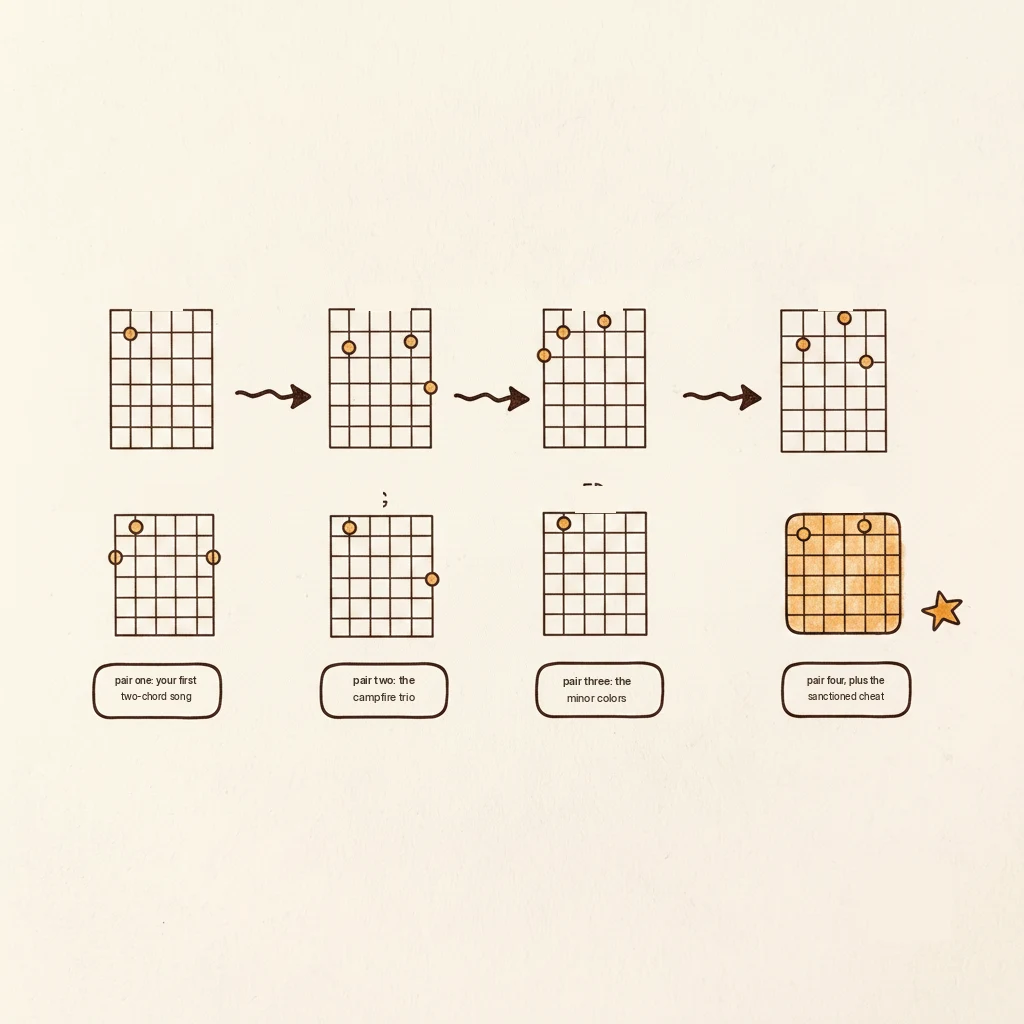
Start with E, A, and D, and their minor cousins Em, Am, and Dm. These sit under your fingers easily. Then add G and C, the two that unlock a huge chunk of pop and folk. Save F for last, and use the friendly version (more on that in a second).
That’s the whole beginner toolkit: A, Am, C, D, Dm, E, Em, G, and an F you can actually play. Add B7 when a song asks for it. With those and one strum, you’re into hundreds of songs.
Learn them in pairs, not one at a time
Don’t grind a single shape in isolation. Learn them two at a time, in pairs that live together in real songs. E and A are a pair. G and C are a pair. Am and Dm are a pair. When you learn a pair, you can immediately play something, and playing something is what keeps you off the quit cliff.
The switch is the skill (this is the whole secret)
Beginners think the hard part is holding the shape. It isn't. The hard part is moving from one shape to another in time without stopping. That switch IS guitar. Once you can change chords cleanly, you can play. So practice the change, not the chord.
There’s a simple drill for it. Pick two chords, set a timer for one minute, and count how many clean switches you make back and forth. Tomorrow, beat today’s number. That’s it. You’re not chasing a big number, you’re chasing yesterday’s.
And practice honestly. As one player put it, practice makes permanent, so don’t repeat mistakes and expect to magically get it right. Only play as fast as you can play it accurately. Slow and clean beats fast and sloppy every single time, because sloppy is what you’re teaching your hands to keep doing.
The F chord, early and honest
You’ll hit F and it’ll make you angry, because the “real” F is a barre chord (one finger flattened across all six strings) and that’s genuinely a month-three fight, not a week-one shape. So don’t fight it yet. Play Fmaj7 instead, the easy stand-in. It sounds right in almost every beginner song, and every teacher on earth quietly assigns it. Use it and tell no one.
Sore fingertips are a phase, not a verdict
Your fingertips will hurt for about two weeks. Then calluses form and it stops. That tenderness is not a sign you’re doing it wrong or that guitar isn’t for you. It’s the toll everyone pays. Twenty minutes a day builds the calluses faster and hurts less than one long painful hour, so keep the sessions short and frequent.
”Notes,” chords, and tabs: which one do I need?
A lot of beginners aren’t sure whether they should be learning notes, chords, or tabs. Quick, kind answer: for playing songs, you want chords, the grips on this page. If you want to play riffs (the guitar lines you hum, like the openings everybody knows), that’s tabs, a different and equally easy thing. Actual music notation, reading notes off a staff, is a later-if-ever concern that most guitar players never need. Nobody’s making you learn it.
For free structure, JustinGuitar is the name I’d point you to. It’s free, it’s good, and its beginner chord path lines up with everything on this page. No reason to reinvent it.
Skip this unless you like the nerdy part. Open chords (the beginner shapes) ring louder and sweeter than barre chords, and there's a physical reason. In an open chord, several strings sound "open," vibrating their full length with nothing pressing them down, so they resonate freely and sustain. A barre chord clamps a finger across everything, damping that free ring, which is part of why barre chords also feel like harder work: your hand is doing what an open string does for free.
E and A tonight, back and forth, until the switch is boring. Then Horse with No Name is yours by Friday, because it's basically those two chords. And when F makes you angry, play Fmaj7 and tell no one. Everyone does.
Questions people actually ask
Which guitar chords should I learn first?
Start with E and A, then D, then their minors (Em, Am, Dm), then G and C, and save F (as the easy Fmaj7) for last. Learn them in pairs that appear in real songs so you can play something right away, and drill the switch between each pair.
What are the basic guitar chords for beginners?
The core set is about eight shapes: A, C, D, E, G, plus the minors Am, Em, Dm, with B7 and an easy F (Fmaj7) close behind. Those cover a huge share of popular songs. Add one strumming pattern and you can play along with hundreds of tunes.
What’s the easiest song to play?
Something with just two chords and a simple strum, like Horse with No Name, is a great first target: you learn one chord pair and you’ve basically got the whole song. Pick a song you already know by heart, because knowing the tune tells your hands when to change.
Working on your first chords, you're probably also wondering:
Gus Harmon
Gus spent three decades running sound wherever somebody needed it: bar bands, weddings, school shows, and twelve years of Sunday mornings. He can't sing a note. He can make sure you're heard. Now he writes so normal people can buy the right thing the first time.