← first chords, first songs, at any age
Guitar Lessons for Beginners: Free Structure, Paid Hands
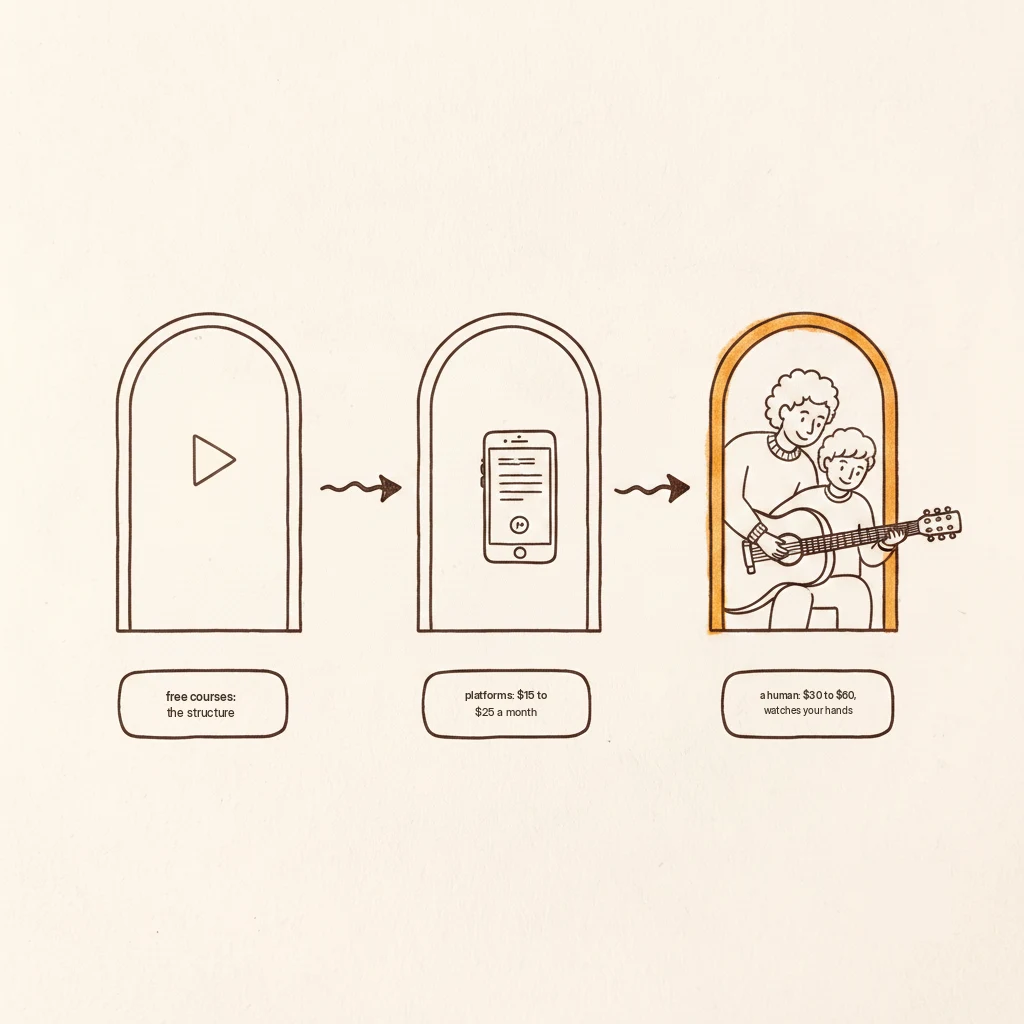
Guitar lessons come three ways: free structured courses (JustinGuitar is the internet's pick), $15 to $25 a month platforms, and a $45 to $70 an hour human teacher whose real value is watching your hands.
 Gus Harmon · Updated July 8, 2026 · how I decide
If you buy through my links the site earns a little. It's never why I pick things.
Guitar lessons come in three honest flavors. Free structured courses (JustinGuitar's beginner grades are the internet's near-unanimous pick) will genuinely take you a long way for nothing. Subscription platforms run $15 to $25 a month for more polish and the same job. A human teacher runs $45 to $70 an hour, and their irreplaceable value isn't information, it's watching YOUR hands and giving you a reason to practice this week. Guitar has no standard curriculum, so audition a teacher like anyone you're paying.
Start with the free thing, because it’s actually the best thing
Here’s the thing, and it’s rare that the free option is also the top recommendation: for structured beginner guitar, JustinGuitar is what the whole internet points to, and the internet is right. People say things like “if there was a Justin for every instrument, the world would be a better place,” and “his stuff is free, and I bought things from him just so I could give him money.” That’s not marketing. That’s players.
Why does it work when so many lessons don’t? Because it’s graded, it goes in a real order, and it uses actual songs as the practice, so you’re always playing music, not drilling in a void. That last part is the thing a lot of paid lessons never manage to do.
The uncomfortable truth about guitar teachers
Guitar teaching is unregulated. Anybody can hang a shingle, and there's no agreed-on curriculum the way piano has. That cuts both ways. Some teachers are brilliant. Some will have you doing rote memorization for years with no sense of a pattern, and the big-box store lesson rooms are a common place that happens. The lottery is real, so you audition. Ask a prospective teacher one question: "what will I be able to play in three months?" A good one gives you a real, specific answer. A bad one waffles.
So what does paying for a human actually buy?
Not information. The information is free and on Justin’s site. What a good teacher buys you is three things a screen can’t:
- Hands-on correction. They watch YOUR wrist, YOUR thumb, YOUR death grip on the neck, and fix the bad habit before it sets. A video can’t see you.
- Accountability. Somebody’s expecting you Thursday, so you practice Wednesday. That pressure is worth real money for a lot of people.
- Taste. A good teacher assigns songs you actually like and nudges you toward what’ll help.
Those are worth $60 an hour WHEN the free structure stalls out or your hands start hurting. If things are going fine, they’re a luxury, not a need.
And the platforms?
The subscription sites (the GuitarTricks and Pickup type, $15 to $25 a month) are good, well-produced, and perfectly fine. Honest read: they’re polish on the same information Justin gives away. If slicker video and a tidy app help you stick with it, that’s a real reason to pay. Just know you’re buying production, not secret knowledge.
The only question that decides if any of it works
Free, subscription, or human, the whole thing comes down to one question: is practice actually happening between the lessons? That's the entire conversion. The best teacher on earth does nothing for a student who doesn't pick the guitar up midweek, and a motivated self-teacher on a free course flies. Spend your money on whatever gets YOU to practice, and don't spend it on anything that doesn't.
And practice honestly while you’re at it: practice makes permanent, so slow and clean beats fast and sloppy, because sloppy is a habit too.
Skip this unless you like the nerdy part. The reason guitar never standardized its teaching, while piano and violin have century-old graded methods, is basically its bloodline. Piano and the orchestral instruments grew up inside conservatories, with exams and official method books. Guitar came up as a folk and popular instrument, learned on porches and in garages and passed hand to hand, so it never grew a single official curriculum. That's why it's a teaching lottery, and also why the free, self-taught path has always worked for it.
Justin's grade one, free, starting tonight. Then book a single human lesson around week six just to have your hands checked. That one $40 catches the bad habits before they calcify, and by then you'll know whether you want the weekly ritual or you're happy on your own.
Questions people actually ask
What’s the best way to learn guitar for beginners?
Start with a free, structured course (JustinGuitar’s beginner grades are the consensus pick) because it’s graded, ordered, and built around real songs. Add a human teacher only when you stall or your hands hurt, mainly to fix physical habits a video can’t see. The method matters less than whether you practice between sessions.
Do I need a guitar teacher, or can I teach myself?
Plenty of people teach themselves with free structured courses and do great. A teacher’s real value is watching your hands, keeping you accountable, and picking songs you’ll like, which is worth paying for if self-teaching stalls out. If you’re practicing regularly on a free course and progressing, you may not need one at all.
How much do guitar lessons cost?
A human teacher typically runs $45 to $70 an hour. Subscription platforms are $15 to $25 a month. And the best structured beginner course, JustinGuitar, is free. A smart middle path is the free course plus one or two paid single lessons to have your technique checked in person.
Getting started, you're probably also wondering:
Gus Harmon
Gus spent three decades running sound wherever somebody needed it: bar bands, weddings, school shows, and twelve years of Sunday mornings. He can't sing a note. He can make sure you're heard. Now he writes so normal people can buy the right thing the first time.