
Microphones for a Church Choir (Fewer Than You Think)
A church choir shares one or two condenser mics on stands, about one mic per 15 or 20 singers, so a small choir needs two mics and about $300, and placement is the real work.
 Gus Harmon · Updated July 8, 2026 · how I decide
If you buy through my links the site earns a little. It's never why I pick things.
A church choir doesn’t get individual microphones. The whole choir shares one or two condenser mics on stands, or hung from the ceiling, placed a couple of feet in front of and above the front row. One properly placed mic covers 15 or 20 singers. For a small choir, two mics and about $300 does it. The expensive part is placement, not hardware.
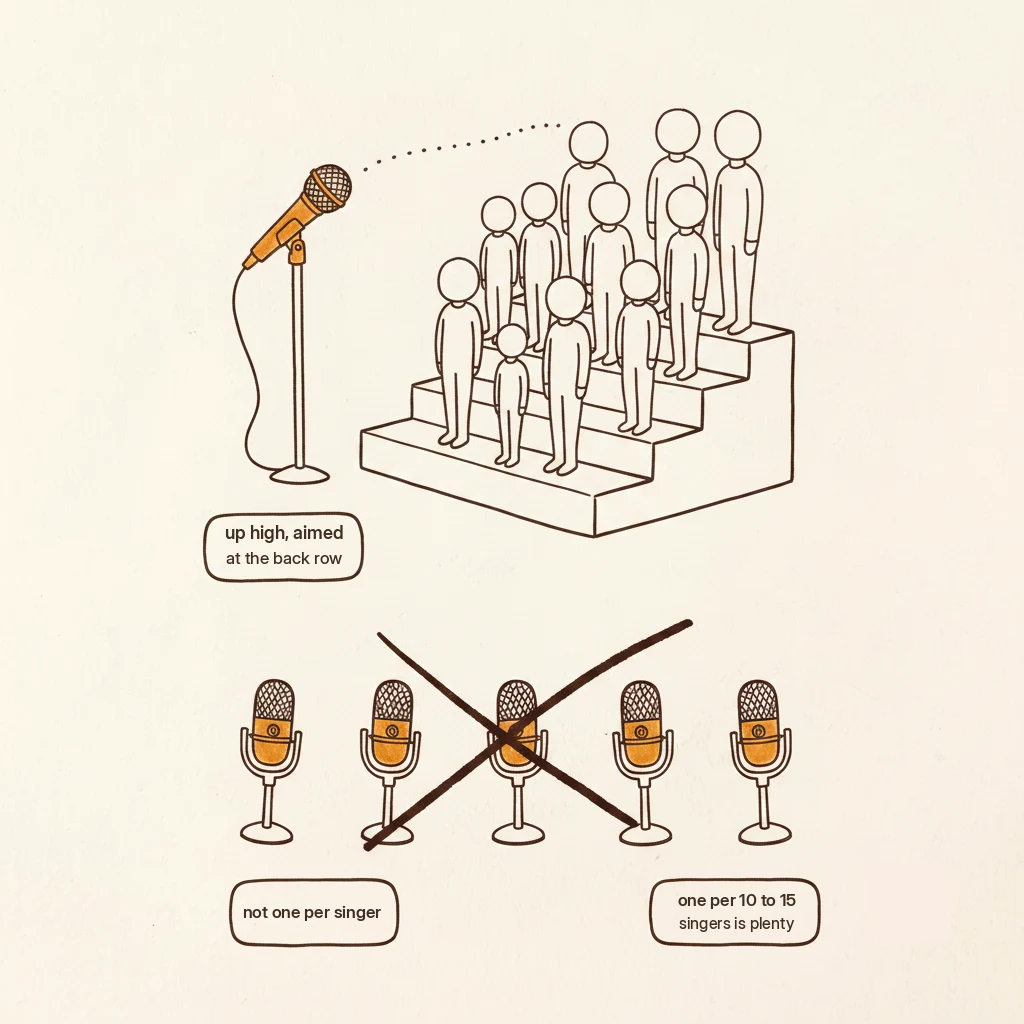
The choir director says the choir can’t be heard on the stream, and now it’s your problem. You’re picturing what you saw on the talent shows: one singer, one microphone, twenty-five singers, twenty-five microphones. Throw that picture out. It’s the wrong model and it’ll cost you a fortune.
Here’s the thing, and it’s the fact this whole page turns on: one mic covers ten to fifteen singers. So a twenty-five-voice choir needs two mics, not twenty-five. I mixed choirs for twelve years, and the reason is simple. A choir isn’t a pile of soloists. It’s one instrument, and the blend between the voices IS the sound. You want to capture that blend, not chop it into pieces.
Why not just give everyone a wireless mic
Three reasons, and they’re all real. Cost, times twenty-five, is absurd. The singers’ hands are full of hymnals. And handing everyone a mic destroys the very thing you’re trying to record, the balance the choir creates on its own by listening to each other. The keyword the pros use is reinforcement. You’re reinforcing the sound the choir already makes in the room, not replacing it.
Twenty-five mics actually sound worse than two, and here’s why. The same voice reaches two nearby mics a hair apart in time, because sound takes a moment to travel and the mics sit at slightly different distances. When you blend those two versions, some frequencies reinforce and others cancel out, and the result is a thin, hollow, phasey sound, like the mics are arguing about what they heard. The more mics you pile on, the more arguments. Two well-placed mics don’t fight. That’s the whole reason less is more here.
Placement is the actual product
The mics matter less than where you put them. Two to three feet in front of the front row, above head height, angled down at the singers. And keep your two mics well apart from each other, at least three times farther apart than they are from the choir, or you get that same hollow, arguing sound. Far from each other, close to the singers. That spacing is most of the job.
The budget ladder
Tight budget, small choir: a pair of SM58s on tall stands genuinely works. It’s not a compromise story, it’s a real option, same as it is everywhere else on this site.
The proper tool, though, is a small-diaphragm condenser, the slim pencil-shaped mics made for exactly this, either on stands or hung from the ceiling. A pair runs about two to four hundred dollars. There’s a flagship tier above that, the Earthworks and DPA class, and a volunteer church does not need it. I’ll say that plainly so nobody feels behind for skipping it.
If you go with condensers, know one thing: they need power. There’s a button on your mixer labeled 48V or phantom power. Press it, or the condenser mic just sits there dead. That’s the whole mystery, one button.
Two things that quietly ruin it
Get the choir out of the floor monitors. Choir mics feeding the choir’s own wedge speaker is a feedback machine. Choirs balance themselves acoustically, so they usually don’t need to hear themselves piped back at all.
And the room comes first. A boomy, echoey room swallows the choir before any microphone can save it. So if the sanctuary is boxy and loud, the free Saturday setup comes before you buy a single mic.
Two condensers on tall stands, three feet off the front row, pointed at the back row’s chins, and press the 48V button. If it still sounds thin, the room’s eating it, and that’s the setup post, not a new microphone.
If you buy through my links the site earns a little coffee money. Doesn’t change the price, doesn’t change my answer.
If you’re figuring this out, you’re probably also wondering:
Gus Harmon
Gus spent three decades running sound wherever somebody needed it: bar bands, weddings, school shows, and twelve years of Sunday mornings. He can't sing a note. He can make sure you're heard. Now he writes so normal people can buy the right thing the first time.