
Wireless Microphones for Church (Without the Mid-Sermon Dropout)
For a church, plan on about $350 to $900 per channel for reliable wireless like the Shure BLX or SLX-D, one channel per person up front, and wire everyone who stands still.
 Gus Harmon · Updated July 8, 2026 · how I decide
If you buy through my links the site earns a little. It's never why I pick things.
For a church, a wireless system means a handheld, lapel, or headset mic plus a receiver that plugs into your mixer. Plan on about $350 to $900 per channel for the reliable class, the Shure BLX or SLX-D, one channel per person who talks or sings up front. Cheaper systems exist. Dropouts mid-sermon are why churches buy twice.
Nobody trained you for this. You inherited the sound booth, or you volunteered, and now you’re supposed to know what “wireless system” even means. That’s fine. Sit down, ten minutes.
I spent twelve years on my own church’s sound board, so I’ll skip the sales pitch. The thing you’re actually afraid of is real: the mic cutting out in the middle of the sermon, in front of everyone. That’s a public failure, and it’s the whole reason cheap wireless is a false economy. So let’s buy it once.
Count people, not microphones
Here’s the thing that reframes the whole purchase. Don’t shop for “mics.” Shop for channels, and a channel is one person talking or singing at the same time as another.
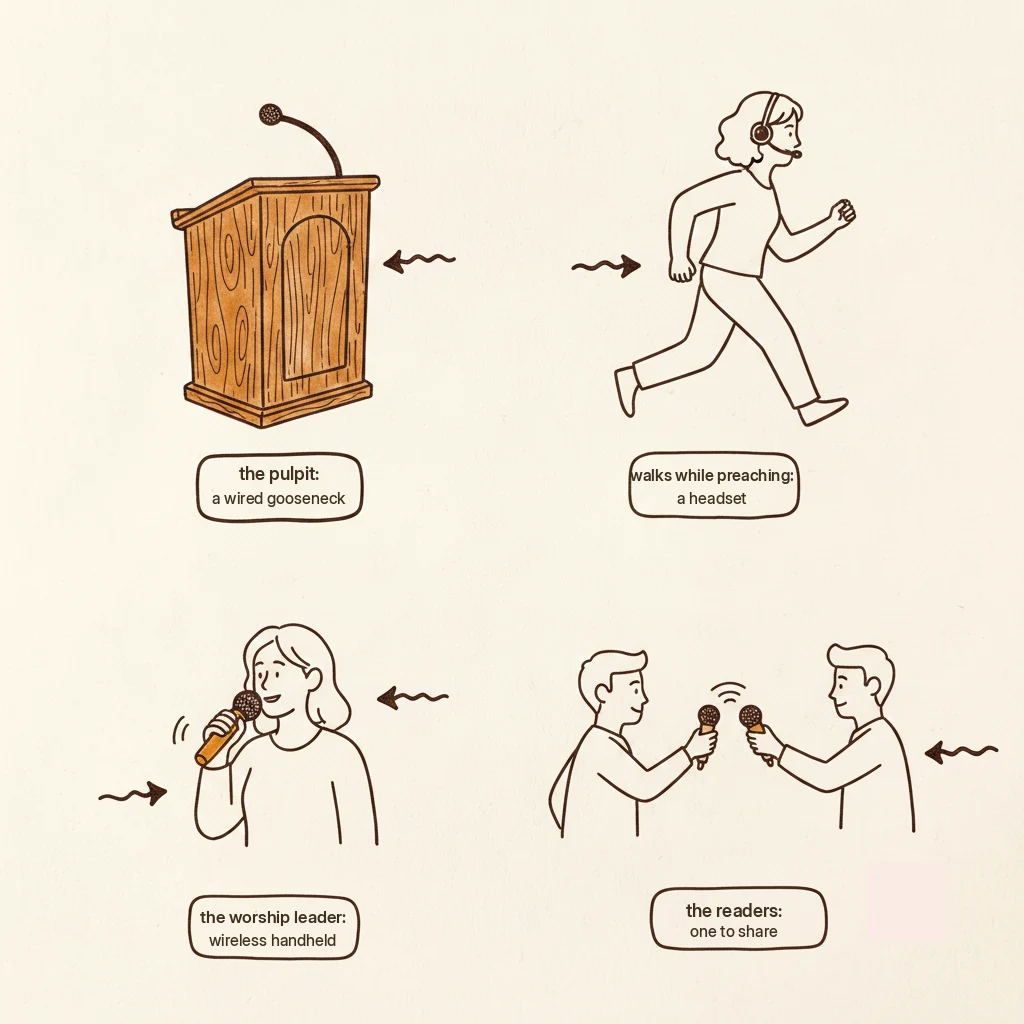
Walk your service in your head. The preacher at the pulpit can often be a wired podium mic. A preacher who walks needs a headset or a lapel. The worship leader wants a handheld. Readers and announcements can share one handheld passed around. Count how many of those happen at once, and that’s your channel count. Most small churches need two, maybe three. One church board member put it perfectly: “we just need two wireless mics, basically.” Often that’s the truth.
The boring brands that don’t cut out
Every shelf shows you the same names, so let me translate them. Shure BLX is the entry-level reliable system. Shure SLX-D is the digital step up, and a professional installer put it plainly: SLX-D is “the cheapest wireless I’d ever sign my name to for an install.” Sennheiser makes equivalents. Think of these as the boring brands that just don’t drop out.
Wireless mics share the air with TV stations, phones, and everything else broadcasting nearby, and that crowded air is where dropouts come from. The eighty-dollar “UHF professional” four-mic kits use a dumb, fixed analog channel, so when something else steps on that channel, your mic dies mid-word. The digital systems like SLX-D are smart: they scan the air, find an empty lane, and hop to a clean one on their own. That self-scanning is most of what the extra money buys, and in a room full of people holding phones, it’s worth it.
The other half of reliability is free: batteries. Fresh or freshly charged every single service. Because volunteers rotate, the system has to survive whoever’s on the schedule this week, so make it a ritual, not a hope.
If that’s the whole year’s budget
I’m not going to pretend six hundred dollars a channel is nothing. For a lot of churches, that’s the entire annual gear budget, and a hundred bucks is a board-meeting conversation. So here’s the honest downshift: one good channel for whoever moves beats four cheap ones that drop out. And wired mics still work perfectly for anyone who stands in one place. A wired SM58 on the pulpit, about a hundred dollars, is not a compromise, it’s the right tool.
One bonus if you stream the service: the same wireless feed that fills the room also feeds the stream. One system, two audiences.
A few traps. Those eighty-dollar four-mic “professional” systems are dropout machines. Buying mismatched frequencies over years leaves you with mystery wiring nobody understands. And a lapel mic clipped wrong rustles against clothing, which is the number one complaint, so clip it where nothing brushes it.
One reliable channel for whoever walks, the BLX if the budget’s tight, the SLX-D if it can stretch. Wired 58s for everyone who stands still. And a battery charger parked by the sound desk with a Sunday-morning ritual around it.
If you buy through my links the site earns a little coffee money. Doesn’t change the price, doesn’t change my answer.
If you’re figuring this out, you’re probably also wondering:
Gus Harmon
Gus spent three decades running sound wherever somebody needed it: bar bands, weddings, school shows, and twelve years of Sunday mornings. He can't sing a note. He can make sure you're heard. Now he writes so normal people can buy the right thing the first time.