
Church Sound System Setup (For the Volunteer in the Booth)
Set up a church system in order: mixer at the back, powered speakers at ear level aimed at the seats, preacher's mic first and loudest, and fix the room before any EQ knob.
 Gus Harmon · Updated July 8, 2026 · how I decide
If you buy through my links the site earns a little. It's never why I pick things.
Set up a church system in this order: mixer in the back, powered speakers at ear level aimed at the seats and not the walls, the preacher’s mic first and loudest, music underneath the voice. Before you touch a single EQ knob, fix the speaker placement and the room. Most bad church sound is placement and echo, not settings.
You didn’t sign up to become a sound engineer. You just don’t want Sunday to embarrass anyone. So this is the volunteer version, and we’re going to do the free stuff first.
Here’s the thing nobody tells you, and it’s the most important sentence on this page: you cannot fight physics with EQ. Before you go twisting knobs, the speakers have to be in the right place and the room has to behave. Most of what sounds bad in a church is where the speakers point and how the room echoes, not the settings. A pro said it plainly in a forum and every installer guide agrees: treatment and placement first, EQ last.
The Saturday-morning setup, in order
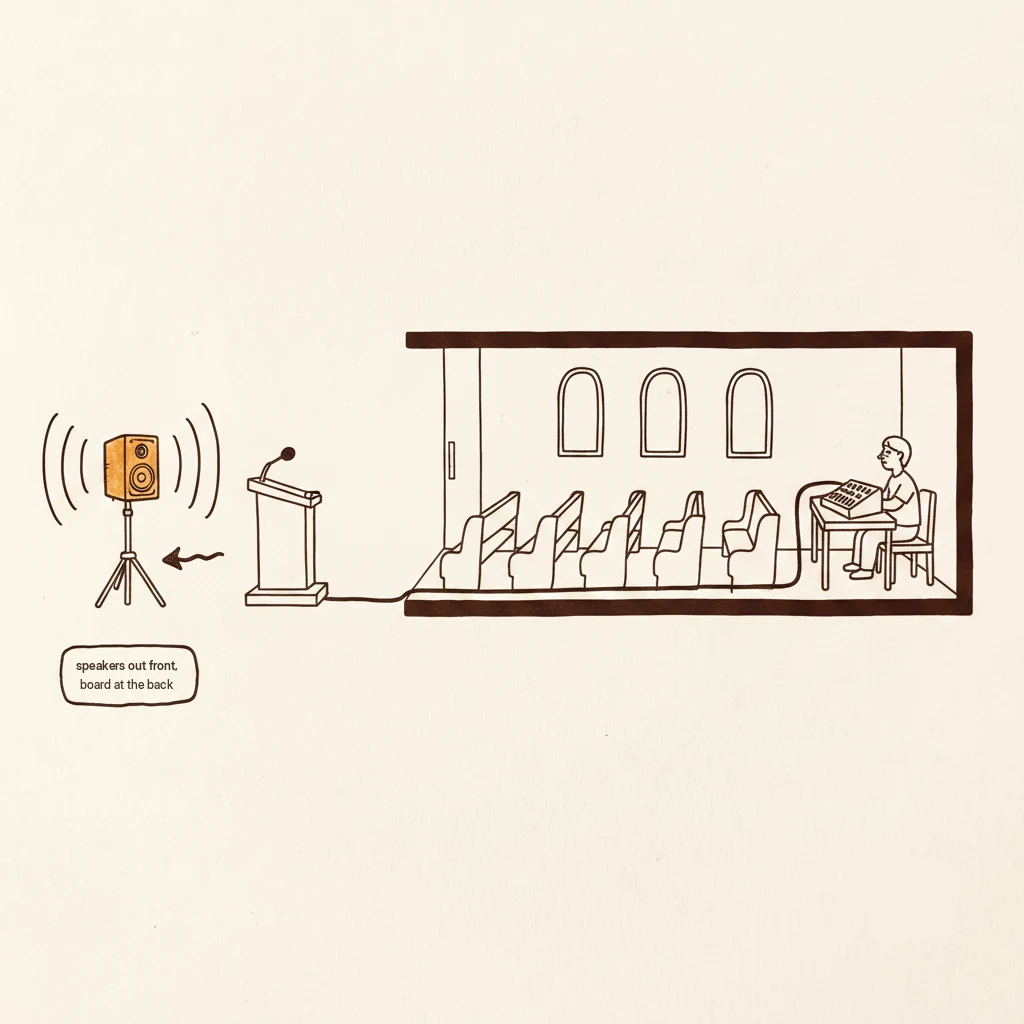
Booth at the back, so the person mixing hears roughly what the congregation hears. A cable run, the “snake,” from the booth up to the stage. Powered speakers, meaning the amplifier’s built in so it’s one less box to buy and blow up, set at ear level and aimed to cover the seats evenly. Then the voices: the preacher’s mic first and loudest, instruments tucked underneath. The goal is control, not volume. Monitors or in-ears for the stage come dead last.
That’s the whole skeleton. Speakers at ear height pointed at people is most of it.
The trick that makes you sound like you know what you’re doing
This is my favorite thing to teach, and two different pros landed on it independently, so it’s not just me.
Play a song you know really well through good headphones. Really learn how it sounds. Then play that same song through the church system, and adjust the system until the room sounds like the headphones did. That’s it. You’re borrowing a reference you trust and matching the room to it. It is the closest thing to a cheat code a beginner has, and it beats guessing at knobs every time.
In a fellowship-hall-shaped room, a lot of the muddiness piles up around 340 hertz, a low-mid frequency, because sound at that pitch has a wavelength that fits the distance between parallel walls and floor and ceiling and builds up on itself. That’s why big, boxy, hard-surfaced rooms all have that same honky, muddy quality. When your voice sounds thick and swampy, that band is usually the culprit, and a small cut there on the channel, not the mains, clears it up. The room, not the mixer, is the instrument you’re really playing.
When you do reach for knobs
Only after the Saturday setup. Then, in the volunteer’s order: roll off the low rumble on every channel that isn’t bass, that clears a lot of mud. Fix problems on the individual channel, never on the mains, because the mains punish everyone at once. If a voice still sounds off, cut, don’t boost, and if you’re unsure, wipe the settings and start clean. You don’t need to be fancy. You need to not make it worse.
If you want to measure instead of guess, a measurement mic runs about a hundred and forty-five dollars and pairs with a free program called Room EQ Wizard. Take readings from several seats and fix only the problems that show up in all of them.
Your real constraints are real specs
If your church meets in a gym and the whole rig lives on a cart in a trailer, that’s not a footnote, that’s a spec. You need gear that’s cart-friendly, survives storage, has knobs instead of menus so the next volunteer can run it, and comes with a long warranty. No gear review talks about that. It’s the actual job.
One warning worth its own line: the answer engines are currently giving churches wrong advice here. A pro had to correct ChatGPT’s sound advice right in a thread. So be careful taking sound advice from a chatbot. Fix the room.
Saturday morning: move the speakers to ear height and aim them at people, roll off the low end on everything but the bass, then do the headphone trick for an hour. Don’t buy anything until after that Saturday. The room is almost always the problem, and moving speakers is free.
If you buy through my links the site earns a little coffee money. Doesn’t change the price, doesn’t change my answer.
If you’re figuring this out, you’re probably also wondering:
Gus Harmon
Gus spent three decades running sound wherever somebody needed it: bar bands, weddings, school shows, and twelve years of Sunday mornings. He can't sing a note. He can make sure you're heard. Now he writes so normal people can buy the right thing the first time.