
← first chords, first songs, at any age
The Best Piano for a Beginner (Digital vs Acoustic)
The best piano for most beginners is a digital piano with 88 weighted keys in the $450 to $700 range, because the real dividing line isn't digital vs acoustic, it's weighted vs unweighted keys.
 Gus Harmon · Updated July 8, 2026 · how I decide
If you buy through my links the site earns a little. It's never why I pick things.
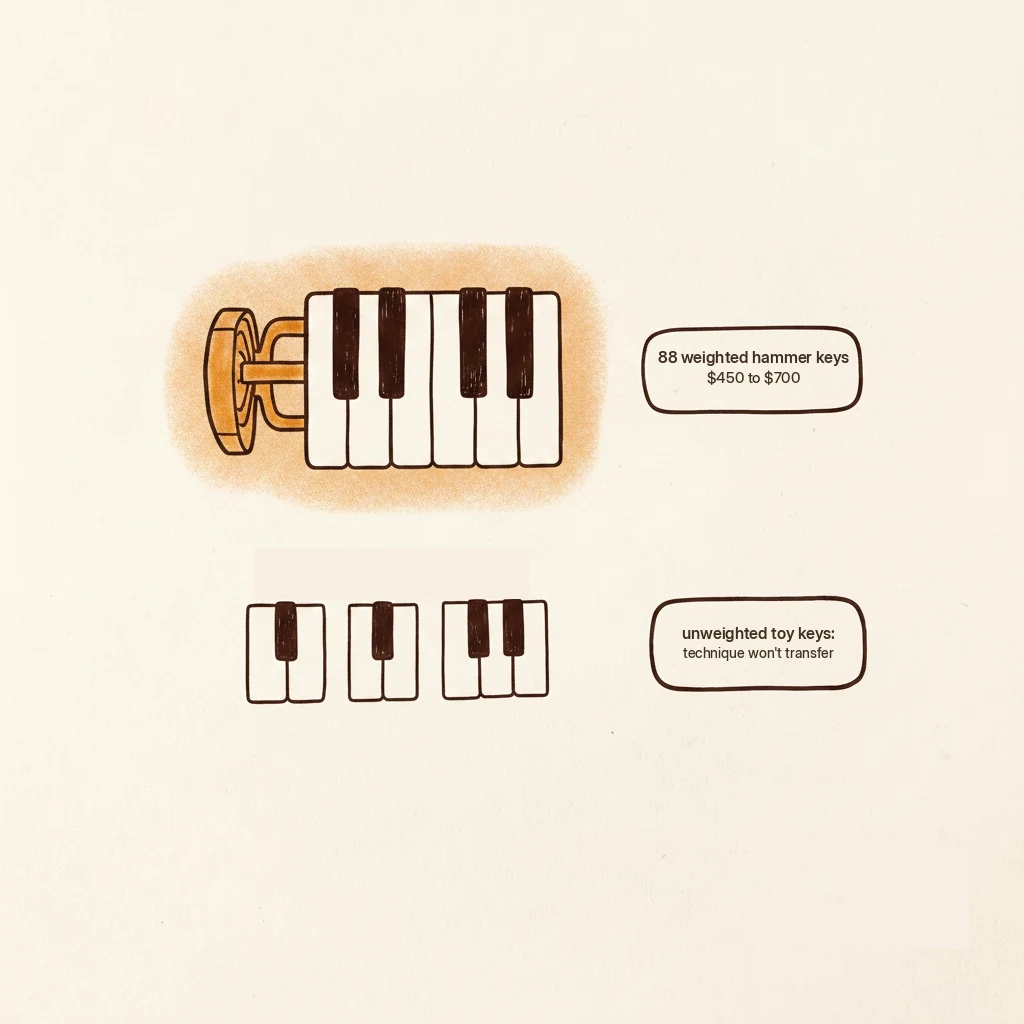
The best piano for most beginners is a digital piano with 88 weighted keys in the $450 to $700 range. You get quiet practice through headphones, no tuning bills, and a key feel that makes your technique transfer to any real piano later. An acoustic is better ONLY when it's a genuinely good one (a $3,000-plus new upright or a teacher-checked used piano), because a free dying upright teaches worse than a $500 digital. The real dividing line isn't digital vs acoustic. It's weighted vs unweighted keys.
Everyone argues the wrong question
Here’s the thing. People agonize over digital versus acoustic, and that’s the wrong fight. The question that actually decides whether your beginner’s money was well spent is weighted versus unweighted keys.
Weighted keys push back like a real piano, because inside a real piano each key swings a little hammer, and that resistance is what builds proper hand strength and control. Unweighted keys (the light, springy kind on cheap keyboards) feel like toys and teach a hand that then can’t play a real piano. So the trap at every price is buying unweighted, and the win at every price is buying weighted. Get that right and the digital-vs-acoustic question mostly answers itself.
Why a digital is the usual right answer
For most beginners, a weighted 88-key digital piano is simply the smart buy, and not as a compromise. It genuinely wins on things that matter to a real household:
- Headphones. Practice at 11pm and nobody else in the house has to hear the same four bars forty times. That’s a peace treaty in a small home.
- No tuning. An acoustic piano needs tuning a couple of times a year, at $100-plus a visit, forever. A digital never does.
- Volume control, apps, and it fits. You can turn it down, plug in learning apps, and move it yourself instead of paying movers.
Best all-around beginner pick
A Yamaha P-145 class weighted digital runs about $500 at Sweetwater. Eighty-eight weighted keys, clean piano sound, the reliable boring-brand choice that just works.
Flaws, said plainly: it's a slab, so budget another $80 to $120 for a proper stand, bench, and pedal so posture is right from day one.
Best feel a small step up
A Roland FP-10 or FP-30X class is about $550 to $700 at Sweetwater. A touch nicer key action and sound for not much more, still fully portable.
Flaws, said plainly: past this you're paying for furniture cabinets and wood, which is fine but not more piano for a beginner to learn on.
When an acoustic is actually the better call
An acoustic piano’s real edge is touch and tone: the subtle dynamics a serious, classical-bound kid will eventually want. But, and this is the whole point, only when the acoustic is GOOD.
Somebody is always offering a free piano. Read this before you say yes. A dying old upright with sticky keys and dead tuning pins teaches WORSE than any weighted digital, and it'll cost you $400 to move and $300 to try to tune before it disappoints everybody. Free pianos are frequently the most expensive pianos. The only safe used-acoustic path is one a piano tuner or teacher has actually checked, and a good used upright that passes runs $1,000 to $2,500.
The price map, plainly
- $450 to $700: a weighted 88-key digital. This is the answer for almost everyone.
- $1,000 to $2,000: furniture-cabinet digital pianos. You’re paying for the wood and the looks, which is fine if you want it in the living room.
- $3,000-plus: a genuinely good new acoustic upright.
- Used acoustic: only with a teacher’s or tuner’s ears on it first. Never sight unseen, never on family guilt.
For brands, stick with the boring reliable names: Yamaha, Roland, and Kawai all make trustworthy weighted digitals in the beginner range. And avoid the classic trap: a 61-key unweighted “piano” bundle at $200 dressed up to look like the real thing. It’s a keyboard, not a piano, and its light keys teach the wrong hand.
Skip this unless you like the nerdy part. "Weighted" keys are simulating a real piano's guts. In an acoustic, pressing a key throws a felt hammer at a string, and the weight of that hammer is what your finger feels pushing back. A good weighted digital rebuilds that resistance mechanically so your hand works exactly as hard as it would on the real thing. That's why technique built on weighted keys transfers straight to a concert grand, and technique built on springy unweighted keys collapses the moment you sit at a real piano.
The $550 weighted Yamaha, headphones, and a real bench. Put the $80 you saved by not chasing the fancier model toward a first month of lessons. And if Grandma's upright is on offer, let the piano tuner's $100 house call make the call, not the family guilt.
Questions people actually ask
What kind of piano should a beginner buy?
For almost everyone, a digital piano with 88 weighted keys in the $450 to $700 range. It gives you real key feel, silent headphone practice, and no tuning bills. An acoustic is only the better choice when it’s a genuinely good instrument, either an expensive new upright or a used one a teacher has inspected.
Are weighted keys really necessary for a beginner?
Yes, they matter more than anything else on the spec sheet. Weighted keys push back like a real piano and build the hand strength and control that transfer to any piano later. Light, unweighted keys teach a hand that then struggles on a real instrument, which is why a cheap unweighted “piano” is the true trap.
Is a free acoustic piano worth taking?
Only if a tuner or teacher checks it first. A worn-out upright with sticky keys and dead tuning pins plays worse than a $500 digital, and you’ll spend hundreds moving and tuning it before it disappoints. Free pianos are often the most expensive ones. A weighted digital is usually the safer, cheaper choice.
If you buy through my links the site earns a little coffee money. Doesn’t change the price, doesn’t change my answer.
Choosing a piano, you're probably also wondering:
Gus Harmon
Gus spent three decades running sound wherever somebody needed it: bar bands, weddings, school shows, and twelve years of Sunday mornings. He can't sing a note. He can make sure you're heard. Now he writes so normal people can buy the right thing the first time.