
← your kid's instrument: costs, rentals, sticking with it
A Cello for a Beginner (Rent It; It's Never Too Late)
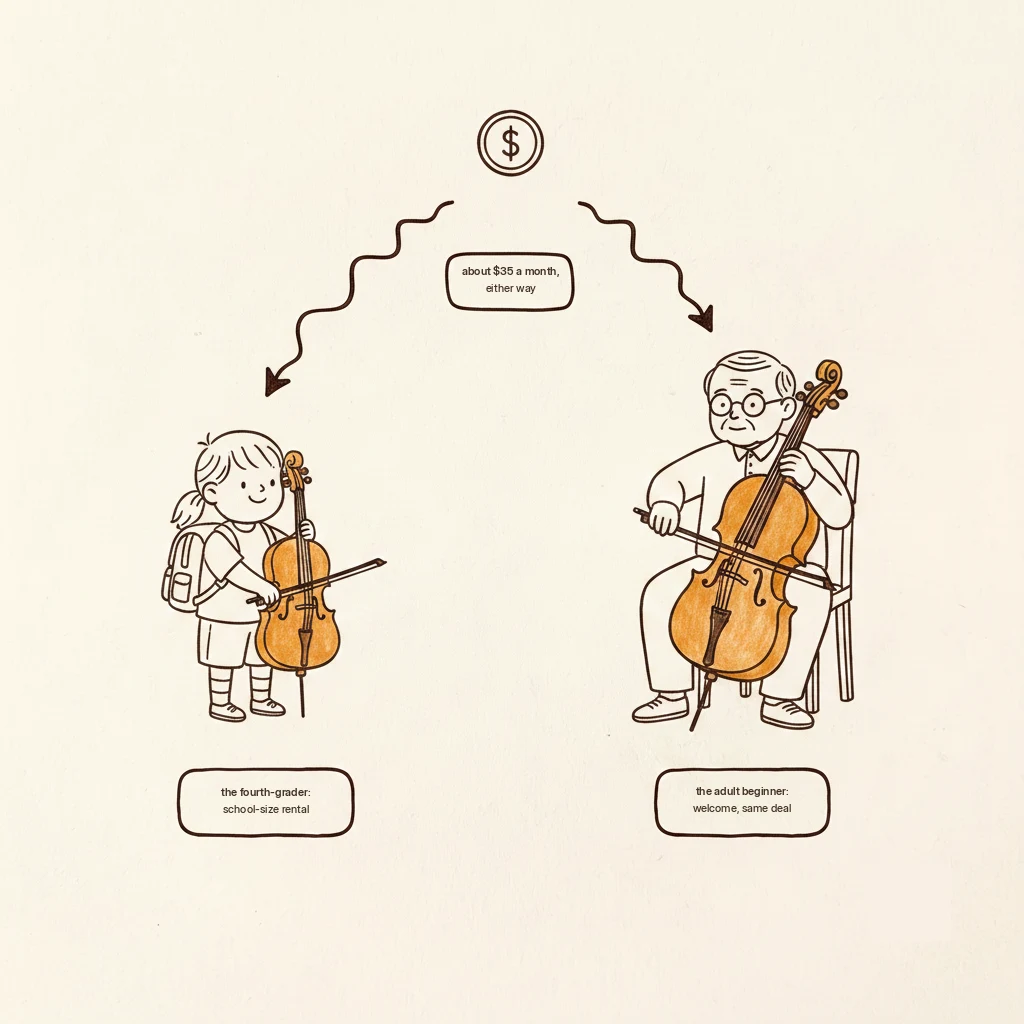
A beginner cello is a rental, about $35 a month sized to the player, because cellos are the most size-sensitive and expensive instrument in the orchestra, and the $300 internet cello is a prop.
 Gus Harmon · Updated July 8, 2026 · how I decide
If you buy through my links the site earns a little. It's never why I pick things.
A beginner cello is a rental: about $35 a month, sized from quarter up to full, swapped as a kid grows, because cellos are the most size-sensitive and expensive instrument in the school orchestra. Many schools keep loaners too. Buying starts at teacher sign-off, $1,000-plus used from a string shop. The $300 internet cello is a prop at twice the size.
The cello is the highest-stakes buy in the whole orchestra room, most expensive, most size-sensitive, so it’s the one where “rent” isn’t a cop-out, it’s the answer. And it’s also the door where I most want to say something to the grown-ups reading. Hang on, I’ll get there.
Rent it. Really.
A sized rental from a string shop or school program. About $35 a month. Cellos come in fractional sizes (quarter, half, three-quarter, full), and a growing kid needs to swap up as they grow, which rentals let you do free. Many schools also keep loaner cellos, so your kid might play the school’s at school and only need a home instrument, or none at all.
Flaws, said plainly: it’s a monthly cost with no ownership yet. Given how fast kids outgrow sizes and how much a cello costs to buy, that’s a feature, not a bug.
The $300 internet cello is the same trap, twice the size
Everything true of the cheap internet violin is true of the cheap internet cello, just bigger and more expensive to fix. The setup, the bridge, the soundpost (a small dowel standing inside the body that’s crucial to the sound), the string height, is half of whether the thing is playable, and box-cellos get all of it wrong. Buy only from a string shop, only when the teacher says it’s time, and expect $1,000-plus used for something genuinely good. Watch out, too, for “cello outfit” bundles, the corners get cut on the bow and the case, which are exactly the parts you can’t skimp on.
Now, the grown-ups
If the beginner here is you, read this. The cello world may be the kindest room in all of music toward adult beginners. Online, a two-year adult beginner applying to music school drew 176 cheers, a three-month self-teacher got 183, both met with gentle, specific coaching: “more bow,” “left elbow up,” “relax the squeezing thumb, tension causes future problems.” One wrote simply, “playing the cello has been a longtime dream.” Never-too-late isn’t a slogan on this instrument. It’s the observed culture. If you’ve been scared to start, the room you’re scared of is the warmest one there is.
Same rental math for you, just a full-size cello from day one. And the practice law that runs through the whole string world: ten honest minutes a day beats a weekend marathon, because the muscle memory compounds daily.
Teaching yourself, honestly
It happens, mostly where no local teacher exists, and it can genuinely work. The real risk is physical: tension and posture. That squeezing thumb and dropped elbow the online room keeps correcting can turn into strain over time. So if you go solo, get periodic video check-ins with any string teacher, even occasionally. That’s the rail that keeps a self-taught cellist healthy.
Two cheap things people forget: a rockstop (the little disc or strap that keeps the endpin from sliding across the floor) and rosin for the bow, together about $25, and nothing plays right without them. If the program hasn’t given you a book, Suzuki Cello Book 1 plus an Essential Elements for Strings book is the standard pair (confirm the editions).
Pitch on a string instrument comes from how far you press the string down to shorten it, and the cello’s strings are long and under serious tension, far more than a violin’s. That means the spacing between notes is wide (a beginner’s hand has to stretch) and the strings themselves are stiff and heavy to press. Now add a setup flaw: if the string height is even a little too high, pressing those thick, taut strings all the way to the fingerboard takes real hand strength, and a kid (or a new adult) just doesn’t have it yet, so the notes buzz, choke, or go sharp, and the hand cramps in minutes. On a violin a bad setup is discouraging. On a cello, with all that extra tension and scale, it’s nearly unplayable. That’s the whole reason a shop-set-up rental beats a $300 box: the shop cuts that string height to where a real beginner’s hand can actually win.
Rent the size they hand you, and buy the rockstop the same day. And if the dreamer in question is you, the room you’re scared of is the kindest one in music. Ten minutes a day.
If you buy through my links the site earns a little coffee money. Doesn’t change the price, doesn’t change my answer.
If you’re figuring this out, you’re probably also wondering:
Gus Harmon
Gus spent three decades running sound wherever somebody needed it: bar bands, weddings, school shows, and twelve years of Sunday mornings. He can't sing a note. He can make sure you're heard. Now he writes so normal people can buy the right thing the first time.