
Church Livestream Audio: Why the Stream Sounds Empty
A church livestream sounds bad two different ways: it sounds empty (add a room mic aimed at the pews, about $100 to $200 a pair) or it sounds wrong (give the stream its own mix).
 Gus Harmon · Updated July 8, 2026 · how I decide
If you buy through my links the site earns a little. It's never why I pick things.
Church livestreams go bad in two different ways, and they need two different fixes. If yours sounds empty (dead air between words, no congregation, no room), add one or two ambient mics aimed at the pews and mixed in low, about $100 to $200 for a pair. If it sounds wrong (harsh, off, nothing like being there), the stream needs its own mix on a separate output, not the one you send to the room.
First, listen to your own stream with your eyes closed
Here’s the thing. Before you buy or change anything, pull up last Sunday’s stream, close your eyes, and just listen. You’ll hear one of two problems, and knowing which one you have is most of the job.
Does it sound empty? The preacher talks, then nothing. No congregation, no room, no life between the words. That’s a presence problem.
Or does it sound wrong? Everything’s there but it’s harsh, unbalanced, thin, nothing like sitting in the pew. That’s a mix problem. Different problem, different fix. Don’t spend a dime until you know which one you’re chasing.
The empty fix: one mic pointed at the room
If the stream sounds dead, the microphones are only hearing the people at the front. The congregation singing, the responses, even the room’s own quiet, none of it reaches the stream. You fix that with what the pros call crowd mics, which is just a mic or two aimed at the pews and mixed in low.
Not loud. Low. Just enough that the AMENs and the singing read as a room full of people. The stream stops feeling like an empty hall and starts feeling inhabited.
The room-presence fix
A matched pair of small condenser mics runs about $100 to $200 for the two, plus roughly $80 for stands and cable to hang or stand them over the congregation. Sold at Sweetwater and Amazon. A matched pair aimed at the room is the standard answer here.
Flaws, said plainly: these go to the STREAM mix only. Put them in the room mix and you'll get feedback and mud.
The wrong fix: the stream needs its own mix
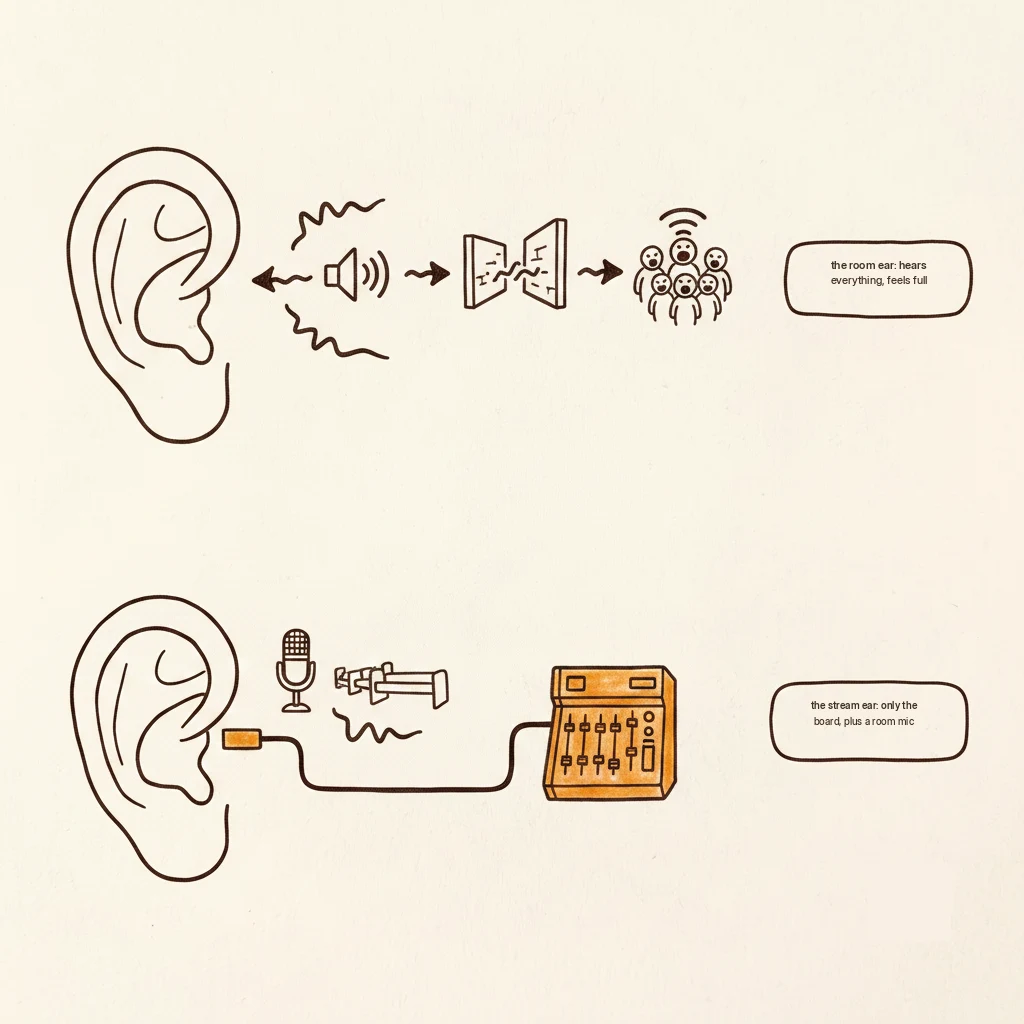
Here’s the part nobody tells the new volunteer. The mix you send to the sanctuary speakers is built to work WITH the room. It leans on your walls, your live acoustics, the natural sound of bodies in seats. The stream never hears any of that. It only hears the soundboard.
So the room mix, piped straight to the stream, lies. It’s compensating for a room the stream can’t hear. Working sound engineers say it flat out: room and stream are usually such different mixes that the stream needs its own. The fix is a separate output. Most church digital boards have a spare mix bus sitting unused. You send the stream its own balance and you set that balance on headphones, not by ear in the room.
Room and stream are two different mixes. Build the stream mix wearing headphones, listening to exactly what the online folks will hear. It's the same headphone-reference skill you'd use tuning the room, pointed at a second audience.
And this matters more than it sounds. Streaming built your church a second congregation: the shut-ins, the travelers, the ones who can’t make it in. They deserve a mix, not a leftover.
Fix the room before you fix the stream
One honest caution. If your actual sanctuary sounds boomy and bad in person, the stream can’t out-mix that. Every microphone is carrying the room’s problems into the feed. Sort the room out first, then come back and build the stream its mix.
Skip this unless you like the nerdy part. The room is an instrument the stream never gets to hear. When you stand in the sanctuary, your ears blend the speakers, the wall reflections, and the bodies around you into one sound, and your room mix is quietly tuned to all of that. The stream feed taps off before any of it happens. It's like judging a meal by reading the shopping list. That's why a room that sounds full and warm in person can arrive online as a thin, close voice against silence.
Two traps to skip. Buying nicer cameras to fix an audio complaint (the picture was never the problem). And a USB “streaming mic,” which is a podcaster’s desk tool, not something that belongs on a church board.
One mic pointed at the pews, mixed just loud enough that the AMENs read. Then one Saturday hour building the stream its own mix on headphones. The shut-ins will hear the difference by Sunday.
Questions people actually ask
How do you make your church live stream sound better?
Diagnose first. Listen to your own stream with your eyes closed. If it sounds empty, add a room mic aimed at the congregation, mixed low. If it sounds harsh or off, give the stream its own separate mix built on headphones. Those two fixes cover almost every complaint.
What are ambient mics for worship?
Ambient mics, sometimes called crowd mics, are microphones aimed at the congregation and the room instead of at a person. Mixed in quietly, they let the stream hear the singing, the responses, and the life of the room, so the feed feels like a full sanctuary instead of a closed booth.
What is the best microphone for live streaming church?
There isn’t one magic mic, because the usual problem isn’t the mics up front at all. It’s that the stream has no room sound and no mix of its own. A modest matched pair for the room plus a separate stream mix beats any single expensive microphone you could bolt on.
If you buy through my links the site earns a little coffee money. Doesn’t change the price, doesn’t change my answer.
If you're wrangling church sound, you're probably also wondering:
Gus Harmon
Gus spent three decades running sound wherever somebody needed it: bar bands, weddings, school shows, and twelve years of Sunday mornings. He can't sing a note. He can make sure you're heard. Now he writes so normal people can buy the right thing the first time.