
The Best Microphone for a Church (the Whole Map, by Job)
A church doesn't need one microphone, it needs four or five jobs covered: preacher, worship vocals, choir, livestream, and Q&A, and most churches do it all with wired SM58s under a grand.
 Gus Harmon · Updated July 8, 2026 · how I decide
If you buy through my links the site earns a little. It's never why I pick things.
A church doesn’t need “a microphone.” It needs four or five jobs covered: the preacher (a handheld at a fixed pulpit, a headset if they walk), worship vocals (SM58-class handhelds), the choir (one mic per 15 or 20 singers, aimed from in front), the livestream (an ambient mic so the room sounds alive online), and Q&A. Count the people talking at once, not the mics in the drawer.
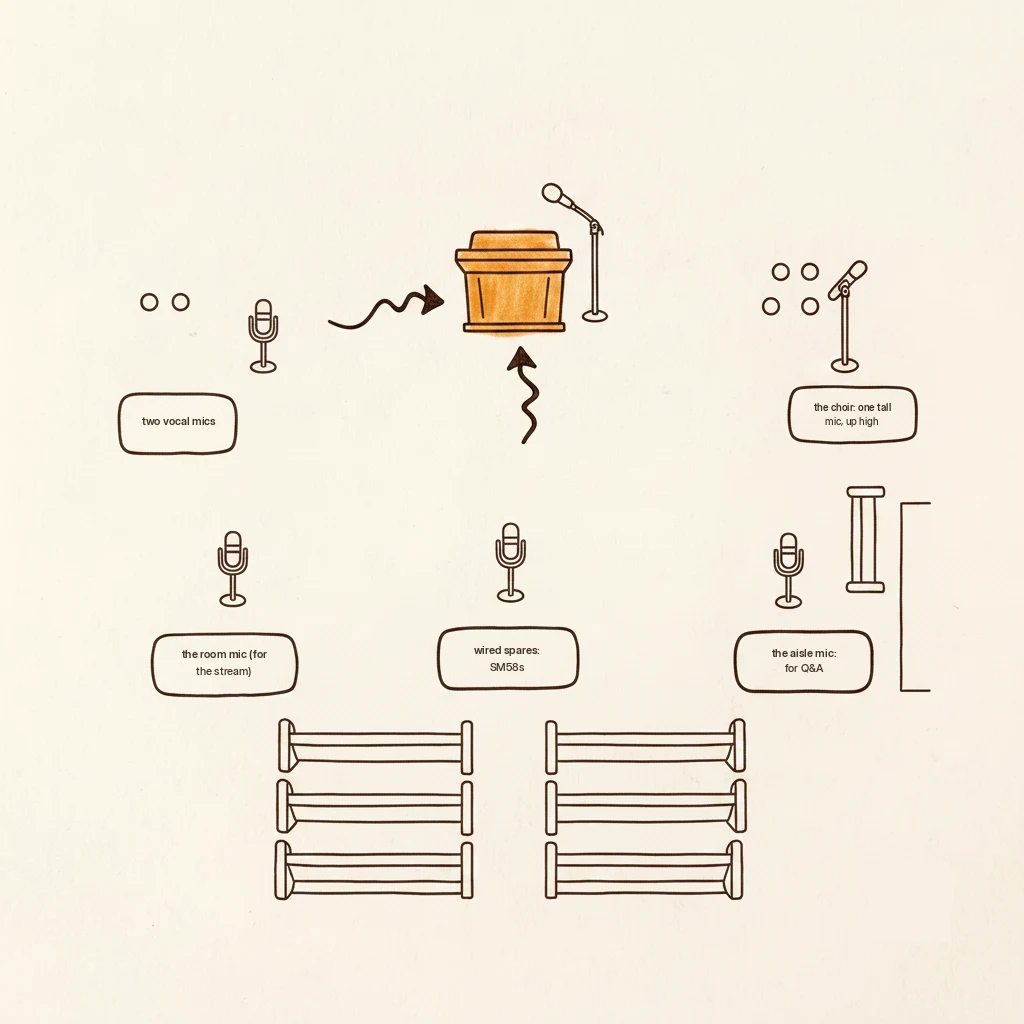
You got sent to “figure out the mics” after a board meeting, and every list you found just names a model without asking what you’re doing with it. So here’s the truth that reorganizes the whole problem: a church needs a handful of jobs covered, and the microphone follows the job. Let me map it, and point you to the right page for each one.
The one law: count channels, not mics
How many people talk or sing at the same time? That number, not the number of mics in the drawer, is what your sound system actually needs to handle (each simultaneous voice is a “channel” on the mixer). A church with a preacher, two worship singers, and a shared announcement mic needs the system to handle those at once, and that’s it. Most churches own way more dead microphones than they ever needed. Count the simultaneous voices and the whole thing gets smaller and cheaper.
The jobs, and the page for each
| The job | What it wants | Where to go deep |
|---|---|---|
| The preacher | A handheld at a fixed pulpit, or a headset if they walk the stage | Wireless mic for preaching |
| Worship vocals | Wired SM58-class handhelds | The SM58, in full |
| The choir | One mic per 10 to 15 singers, aimed from in front, and kept out of the monitors | Microphones for the choir |
| The livestream | One or two ambient mics so the room sounds alive online | Church livestream audio |
| Announcements / Q&A | One shared handheld on a straight stand | (covered below) |
The core buys, honestly
A pair of wired Shure SM58s. About $110 each. This is the standard vocal mic, the boring, reliable one that doesn’t cut out. Wired, so no batteries, no dropouts, no fuss. Two of these cover worship vocals and double as the announcement mic.
Flaws, said plainly: they’re corded, so the singer stays put. For anyone who stands and sings, that’s fine, cords are cheaper and more reliable than freedom you don’t need.
A Shure BLX wireless handheld or headset. About $350 to $400. Buy wireless only for the person who actually moves, usually the preacher. Everyone else stays wired.
Flaws, said plainly: wireless costs about double a wired mic and adds batteries to manage. Worth it for the walking preacher, wasted on a stationary singer.
Wired first, wireless only where it’s needed
The pros’ own first question is “do you even need wireless?” Wired handhelds cost about half as much and never drop out in the middle of a sermon. Wireless is for the walking jobs only, the preacher who roams, maybe a worship leader who moves. Everything else: wire it and forget it.
And the traps that fill every church’s dead-mic drawer: passing one lapel mic around (they’re built for one mouth at one fixed distance, they sound bad the second you move them), buying a gooseneck podium mic for someone who walks, buying five identical mics because it felt thorough, and the soundbar-grade “church package” that covers nothing well.
One thing no microphone can fix
A boomy, echoey room defeats every microphone on this map. If people can’t understand the preacher, the answer is almost never a better mic, it’s the room and where things are placed. Soften the hard surfaces and get the speakers in front of the mics before you spend another dollar on microphones. The best mic in a bad room still sounds like a bad room.
Your mixing board has a fixed number of inputs, called channels, and each microphone that’s live at the same time needs its own channel to be heard and controlled. Here’s the money-saving part: mics that are never used simultaneously can often share, or simply take turns, so ten microphones might only ever need four or five channels live at once. That matters because the mixer (and the cost, and the complexity) scales with simultaneous channels, not with how many mics you own. So the budget question isn’t “how many microphones,” it’s “what’s the most voices we’ll ever have going at one moment”, and for most small churches that honest number is surprisingly low. Size the system to that, and you stop buying a rig for a megachurch you don’t have.
Two wired 58s, one wireless for whoever actually walks, the choir counted instead of guessed, and one mic pointed at the room for the stream. That’s most churches, done, under a grand, and start with the room, not the shopping list.
If you buy through my links the site earns a little coffee money. Doesn’t change the price, doesn’t change my answer.
If you’re figuring this out, you’re probably also wondering:
Gus Harmon
Gus spent three decades running sound wherever somebody needed it: bar bands, weddings, school shows, and twelve years of Sunday mornings. He can't sing a note. He can make sure you're heard. Now he writes so normal people can buy the right thing the first time.