
Speakers for a Church Sound System (Poles First, Flying Later)
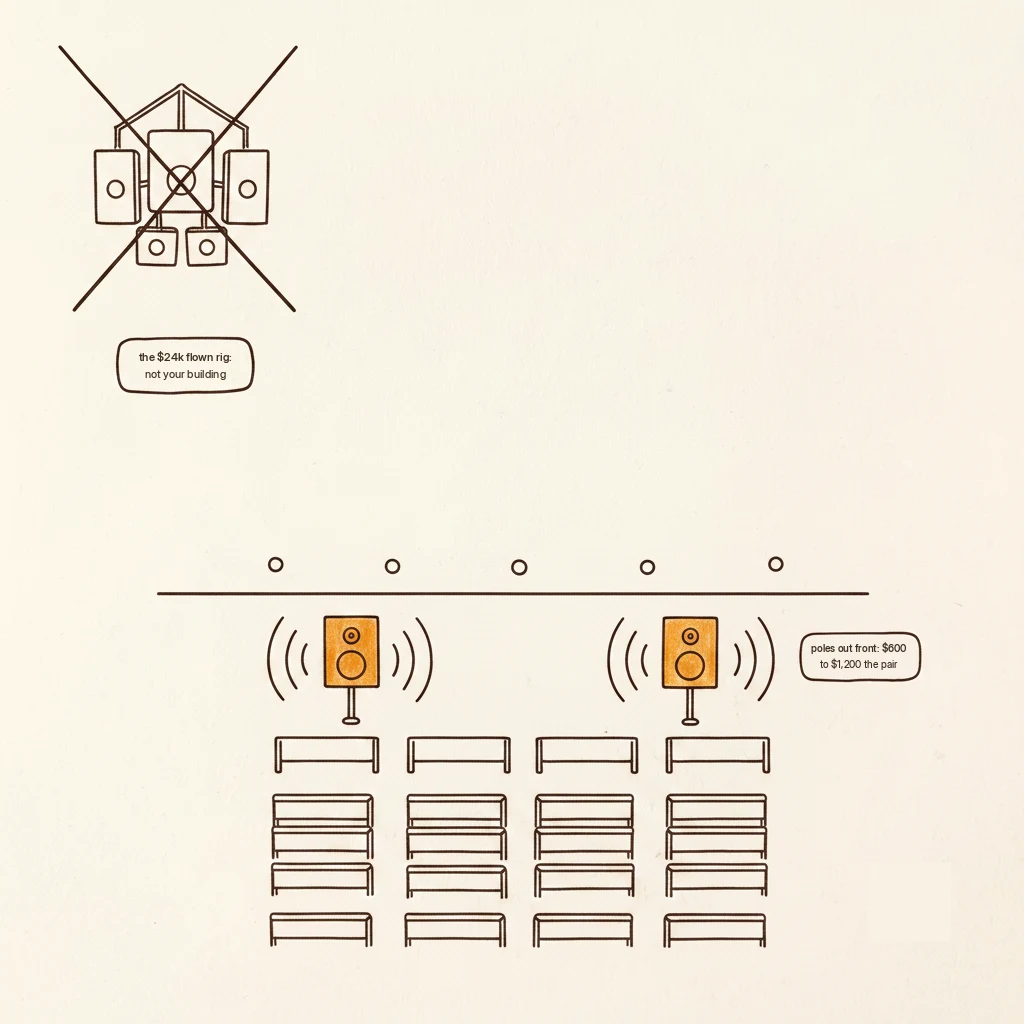
For a church under about 200 seats, the answer is two powered speakers on poles, placed in front of the microphones, a $600 to $1,200 pair, not a $24,000 install.
 Gus Harmon · Updated July 8, 2026 · how I decide
If you buy through my links the site earns a little. It's never why I pick things.
For a church under about 200 seats, the answer is two powered speakers on poles, 10 to 12 inch, from the boring reliable brands, placed in front of the microphones, not behind them. That’s a $600 to $1,200 pair, not a $24,000 install. Flying speakers from the ceiling and taming a bad-echo room are where you pay a pro.
You got volunteered, you got a quote that made your stomach drop, and Sunday keeps coming. I spent twelve years behind a little church board, so let me sit down next to you on this one. Most of what you were told you need, you don’t. Here’s the honest version.
The whole answer, for a normal-size sanctuary
Two powered speakers, up on poles, out in front of where your microphones are. That’s it. That covers most churches under a couple hundred seats.
“Powered” just means the amplifier is built into the speaker, so it’s one power cord and one cable from the mixer, no separate rack of amps to wire or understand. That’s the volunteer-proof choice, and it’s what you want.
For that setup you’re looking at a $600 to $1,200 pair of 10 or 12 inch speakers, plus about $80 to $120 for the pair of poles to stand them on. If someone quoted you twenty-four thousand dollars, that quote was for a fully designed, ceiling-flown install, a real thing that some rooms need, but almost certainly not this thing.
The placement rule that matters more than the brand
Put the speakers in front of the microphones. That one choice kills most of your feedback before you ever touch an equalizer. Feedback is a loop: the mic hears the speaker, sends it back, the speaker plays it louder, and it screams. If the speakers are out front, aimed at the congregation and away from the mics, that loop never closes. Get this right and a cheap system sounds good. Get it wrong and no speaker on Earth will save you.
And the harder truth underneath it: the room matters more than the speaker. A boomy, echoey sanctuary swallows any speaker you buy. If people can’t understand the sermon, the fix is usually softening the room (curtains, panels, anything to stop the echo off hard walls) before it’s spending more on gear.
When to DIY and when to pay the pro
Here’s the clean line:
- Speakers on stands, in a normal room: you can do this yourself. Genuinely. Two powered speakers, two poles, plug them in out front.
- Flying speakers from the ceiling, a balcony to cover, or a room with a bad echo: pay the professional. This is where the install fee earns its keep, and it’s not a job to learn on a ladder.
There’s also a nice middle path a lot of pastors land on: install it yourselves, then hire a tech for one afternoon just to tune it. Best of both.
A pair of powered 12-inch speakers (JBL EON, EV ZLX, or Yamaha class) plus poles. About $600 to $1,200 for the pair, plus $80 to $120 for stands. These are the boring, reliable names, the Shure-58 of speakers, the ones that just keep working through Sunday after Sunday.
Flaws, said plainly: they sit on visible poles rather than tucking into the ceiling, and a big or echoey room will still need help. For most small churches, that’s a fine trade for saving five figures.
”Wireless speakers for the church?”
Mostly no. The wireless part of a church system is the microphones, not the speakers. Even so-called wireless speakers still need power cords running to them, and running the actual audio to them wirelessly invites the two things you can least afford in front of a congregation: delay and dropouts. Keep the speakers wired. Spend the wireless budget on good handheld mics instead.
Watch out, too, for the “church package” bundle sold with no one ever looking at your room, for buying speakers before treating an echoey space, and for anyone selling you a subwoofer before the congregation can even understand the sermon. Clarity first, thump never.
Picture the sound as a circle it wants to run in: mouth, into the microphone, out to the speaker, through the air, and, if the speaker is behind or beside the mic, right back into that same microphone to go around again, louder each lap, until it howls. The whole art of stopping feedback is refusing to let that circle close. Put the speaker in front of the mic line and aim it at the people, and the sound leaving the speaker travels away from the microphones instead of back into them. The loop is broken by geometry alone, before any fancy processing. That’s why a well-placed cheap rig beats a badly placed expensive one every single Sunday.
Two powered twelves on poles, out in front of the mic line, wired. Spend the “wireless” budget on good handheld mics instead, and put whatever’s left toward some curtains for the back wall. The room will thank you louder than the speakers will.
If you buy through my links the site earns a little coffee money. Doesn’t change the price, doesn’t change my answer.
If you’re figuring this out, you’re probably also wondering:
Gus Harmon
Gus spent three decades running sound wherever somebody needed it: bar bands, weddings, school shows, and twelve years of Sunday mornings. He can't sing a note. He can make sure you're heard. Now he writes so normal people can buy the right thing the first time.