
← hear yourself back, without a studio
A Microphone for Voice Acting (One Next Step, Not Twelve)
For voice acting at home, a used AT2020 with a used interface (about $150) recorded in your quietest closet gets you audition-quality, and you can rent the $1,000 mic later.
 Gus Harmon · Updated July 8, 2026 · how I decide
If you buy through my links the site earns a little. It's never why I pick things.
For voice acting at home, the honest ladder is short: a used AT2020 with a used interface (about $150 total), or a Rode NT1 (about $160 new, plus an interface) when auditions start landing. Record in the quietest closet you own, because in voice-over the closet isn’t a hack, it’s the standard home booth. About $150 to $300 gets audition-quality.
I read a voice actor online mid-meltdown: “I’m having an existential crisis over microphones. Oh god, did I not realize I’d be all over the place?” Three months in on a cheap mic, drowning in buyer’s guides that each list twelve microphones. If that’s you, breathe. You don’t need twelve options. You need one next step, and I’m going to give you exactly one.
The one next step
A used AT2020 plus a used Focusrite Scarlett interface. About $150 total off a used-gear site like Reverb. That’s the consensus starter answer among working voice actors, and it stops there. The AT2020 is a clean condenser, the Scarlett is the box that connects it to your computer and powers it. When auditions start actually landing, the settle-in upgrade is a Rode NT1 (about $159), but that’s later.
Flaws, said plainly: used means checking the listing and the seller, and the condenser demands a quiet room (see below). That’s the price of buying smart instead of buying twelve.
That’s the recommendation. One rig. If you want to know why, and how to make it sound pro for free, keep reading.
The setup is a closet (yes, really)
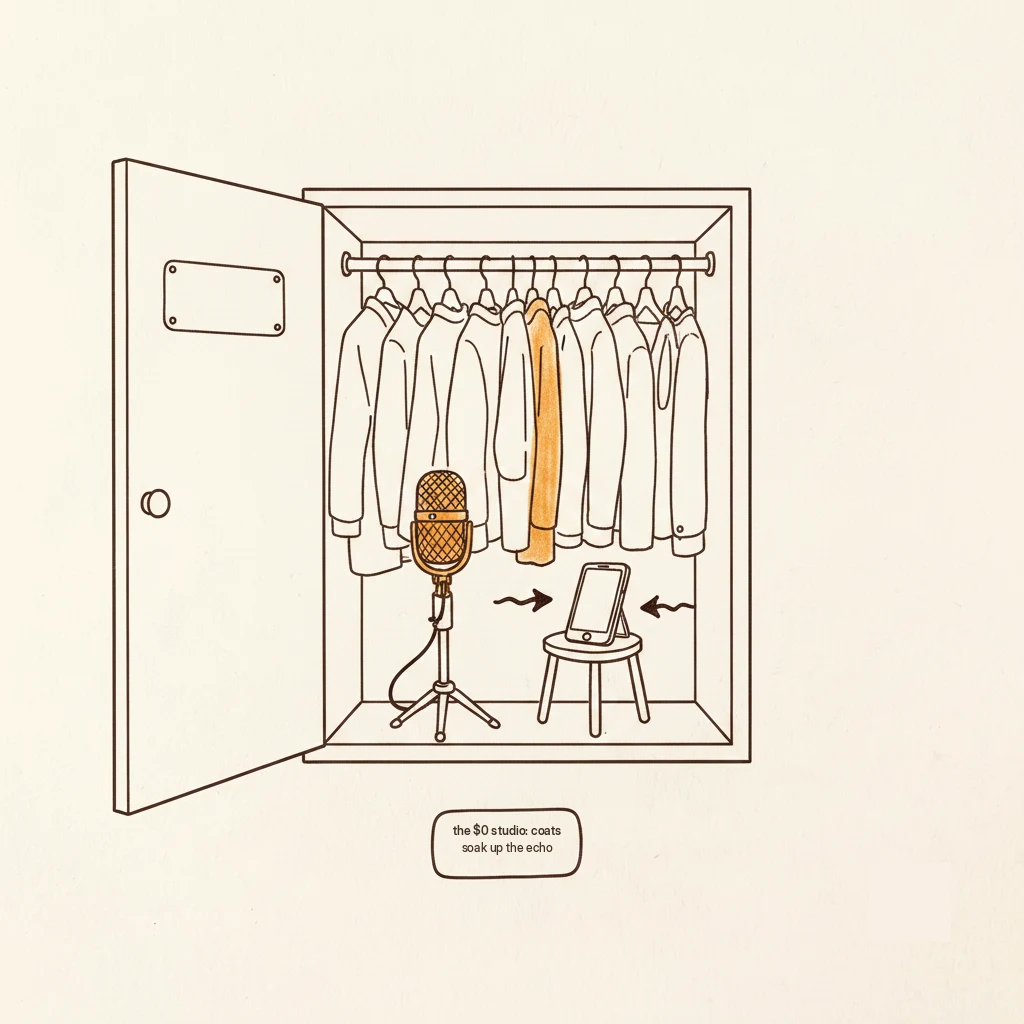
In voice-over, the room matters more than the mic, and the standard home studio is a closet full of clothes. Voice work wants dry and dead-quiet, no room echo at all, and hanging clothes are fantastic sound absorbers. This isn’t a broke-beginner hack that you graduate out of. Working pros record in closets. Blankets, a small space, clothes all around you, mic on a short stand. That’s the booth.
When it records too quiet (it’s almost never the mic)
New condenser, and your recording comes back faint? Before you blame the gear, walk this ladder, because it’s almost always one of these:
- The gain knob on the interface is turned down. Bring it up.
- Some mics are just gain-hungry (the NT1 is a bit quiet by nature and wants more gain than you’d expect).
- Your recording software’s input setting is wrong (in Audacity, the MME-versus-WASAPI dropdown trips people up constantly).
- The mic is facing backwards. This is the classic. On a Rode, the word “Rode” should be facing you. Sing into the wrong side and everything sounds distant and thin.
That’s the same family of problems as any “why is my recording bad” question, just wearing voice-over clothes.
The rent-a-mic secret
Here’s an industry open secret worth its weight: those thousand-dollar mics you see in studios rent for about twenty bucks for a weekend. So when you land a gig that genuinely calls for a specific high-end mic, you rent it for that gig. You do not buy a $1,000 microphone on spec to audition. Audition on your $150 rig in your closet, and rent the fancy glass the week someone’s paying you to use it.
One warning on the very cheap end: some budget mics (the Maono class gets named for this) have a hollow body resonance, one voice actor said theirs “sounds like a small gong” and “every noise gets picked up.” A used AT2020 sidesteps that whole problem for similar money.
And honest order of operations: a USB mic got that panicking actor through their first three months, and it could get you through your first six. Upgrade when your room is fixed, not before. A great mic in a bad closet loses to a modest mic in a good one.
Why does voice-over want a bone-dry, dead room while singers can get away with a livelier one? Two reasons: consonants and edits. Voice acting lives on crisp consonants, the t’s, k’s, and s’s that make speech intelligible, and any room echo smears those into mush that sounds amateur instantly. Second, VO gets edited heavily, lines cut, rearranged, and butted together, and if each take carries its own little tail of room reverb, the edits don’t match and you hear the seams. A singer’s long, sustained notes hide a bit of room, and music is more forgiving of a natural space. Speech isn’t. So the closet full of clothes, which kills the echo dead, is doing real technical work: clean consonants and invisible edits. It’s not just quiet, it’s dry, and dry is the voice actor’s whole game.
Used AT2020, used Scarlett, the deepest closet in the house, and spend what you saved on one hour with an audio person to set your gain correctly once. Then rent the fancy mic the week somebody actually pays you for it.
If you buy through my links the site earns a little coffee money. Doesn’t change the price, doesn’t change my answer.
If you’re figuring this out, you’re probably also wondering:
Gus Harmon
Gus spent three decades running sound wherever somebody needed it: bar bands, weddings, school shows, and twelve years of Sunday mornings. He can't sing a note. He can make sure you're heard. Now he writes so normal people can buy the right thing the first time.