
← hear yourself back, without a studio
A Microphone to Record Music (One Mic, Honestly)
One microphone records most home music: a $109 dynamic like the SM57 for amps and a normal room, or a $119 condenser like the AT2020 for acoustic instruments in a quiet room.
 Gus Harmon · Updated July 8, 2026 · how I decide
If you buy through my links the site earns a little. It's never why I pick things.
One microphone records most home music. A $109 dynamic (the SM57/58 family) handles guitar amps, drums in a pinch, and vocals in a normal room. One $119 condenser (AT2020 class) handles acoustic guitar, piano, and vocals in a quiet room. Where you put the mic changes the sound more than which mic it is. Multi-mic rigs are chapter three, not chapter one.
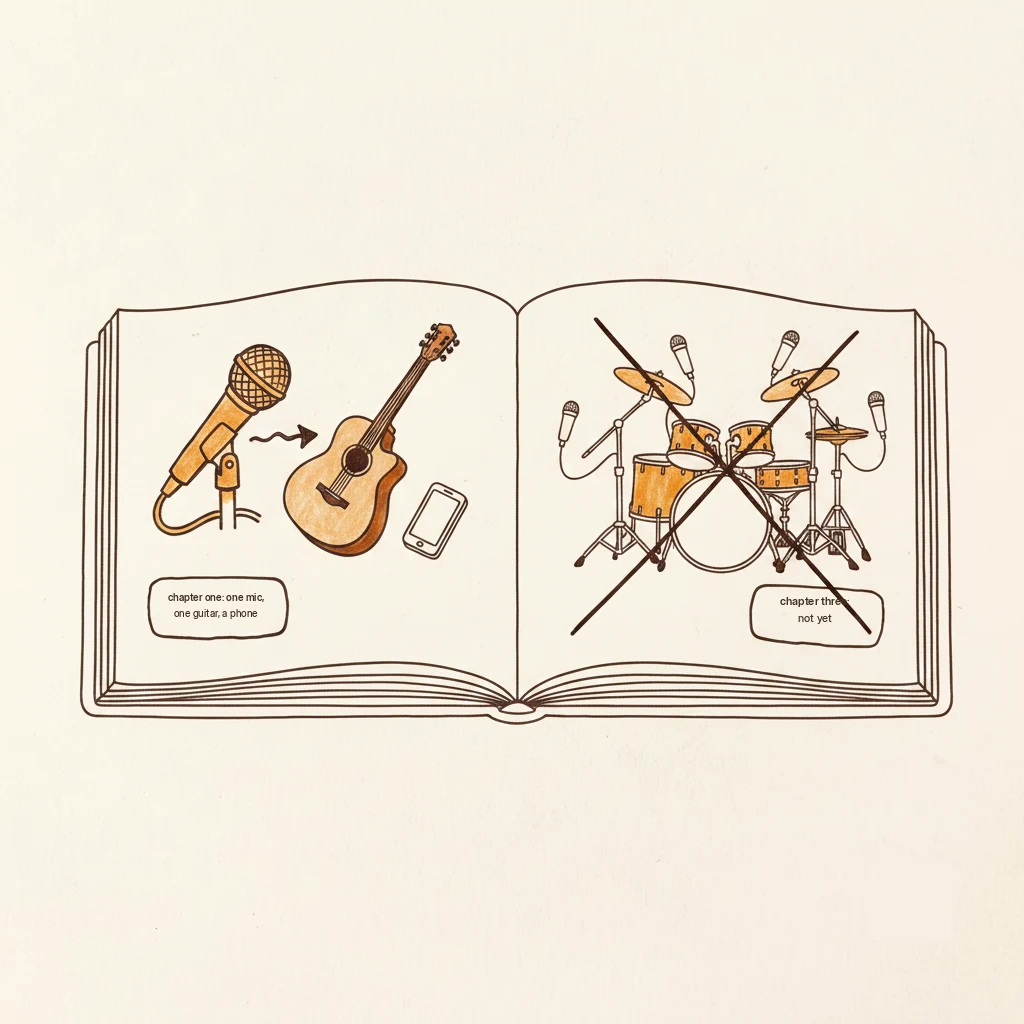
You’ve got an instrument, a phone full of song ideas, and zero microphones, and every “best mics for recording” list you open assumes you already own a whole cabinet of them. One drum-recording thread literally opens at four microphones and a rack. That’s not where you start. Let me get you recording with one.
The one-mic answer
Two mics cover almost everything a beginner records, and you only need one of them to start:
- A Shure SM57 (or its twin the SM58), about $110. This is the do-everything dynamic, the rugged one that ignores the room. It’s the honest answer in nearly every recording situation: guitar amps, a drum kit in a pinch, and vocals in a normal, untreated room. Nearly indestructible, and it never leaves a studio once it arrives.
- An AT2020, about $119. The condenser alternative, for when your room is quiet and your source is delicate: acoustic guitar, piano, soft vocals. It hears more detail, and more noise, so it wants a quiet space.
Which one? It’s the same fork as always: noisy or live-in room, get the SM57. Quiet room and acoustic sources, get the AT2020. That’s the whole decision.
Placement beats purchases
Where you put the mic changes the sound more than which mic you bought. A recording engineer said it plainly about drums: the placement of the kit in the room is the most important part, and most people just shove the kit wherever it fits and wonder why it sounds bad. Moving a microphone six inches, closer, farther, off to one side, is free, and it’s audible. Before you spend another dollar on gear, spend an hour moving the one mic around. That’s where the real sound lives.
For an acoustic guitar, a classic starting spot is pointing the mic at where the neck meets the body, around the twelfth fret, not straight into the sound hole (which booms). Try it, move it, listen. The mic is a camera, and you’re learning where to stand it.
The interface gate (say it once)
Those $99 mics are XLR, the professional plug, so like the others they need an audio interface (the usual Scarlett is about $170; budget boxes start near $60) between the mic and the computer. So the true entry cost is roughly $200 to $300, not $99. If you’d rather skip the box entirely, a USB condenser is the one-cable compromise, less flexible, much simpler.
The ceiling, named honestly
Yes, “real” drum recording uses four mics (kick, snare, and two overheads), and engineers have famous techniques with names. But here’s the encouraging half of that truth: some beloved records were cut on far less. Bands have made whole albums on three mics, kick, snare, and a single overhead. Insiders improvise constantly, one trick is sticking an SM57 in front of the kick drum, pointed up, and using it as a whole-kit room mic. The point isn’t the fancy setup. The point is that great music has been captured on almost nothing, so you can start with one mic and no shame.
Skip the “recording package” bundles, the ones boxing a mic with headphones and an arm for one tidy price. The microphone in that box is exactly where they cut the cost. Buy the $99 mic on its own and add a cheap stand and cable. You’ll spend about the same and end up with a mic that’s actually worth keeping.
And before any purchase: today’s idea goes into the phone’s voice memo. The real mic is for the keeper version of a song, the one you’ve decided is worth capturing properly. Don’t let gear-shopping become the thing you do instead of writing.
The 57 and the 58 are essentially the same microphone inside, the same rugged dynamic capsule, just dressed differently (the 58 has a ball grille for vocals, the 57 a bare end for instruments). That capsule is heavy and simple, which makes it nearly impossible to overload, it’ll sit an inch from a screaming guitar amp or a snare drum and just take it, where a sensitive condenser would distort or even be damaged. It also doesn’t need a delicate quiet room, because its very toughness means it mostly hears whatever’s shoved right up against it and ignores the rest. That combination, indestructible, unfazed by loud sources, indifferent to the room, is why the same $99 mic ends up on stages, in studios, in front of amps, and on your kitchen-table demos. It’s not the best at any one job. It’s good enough at every job and impossible to kill, which is a rarer and more useful thing.
One SM57, one cable, one interface. Record the song today. Buy the second mic the day you can say out loud what the first one is missing, and not a day sooner.
If you buy through my links the site earns a little coffee money. Doesn’t change the price, doesn’t change my answer.
If you’re figuring this out, you’re probably also wondering:
Gus Harmon
Gus spent three decades running sound wherever somebody needed it: bar bands, weddings, school shows, and twelve years of Sunday mornings. He can't sing a note. He can make sure you're heard. Now he writes so normal people can buy the right thing the first time.