
← quieter kits and household peace treaties
Quiet Drumsticks (Rods, Brushes, and the Cymbal Truth)
Quiet drumsticks are real, rods at about $25 cut the volume roughly in half, but they quiet the drums, not the cymbals, which are usually what the neighbors hear.
 Gus Harmon · Updated July 8, 2026 · how I decide
If you buy through my links the site earns a little. It's never why I pick things.
Quiet drumsticks are real: rods (bundled dowels, about $25, roughly half the volume), brushes (the quietest, about $20), and low-volume sticks like the Vic Firth SD5 Echo. But they quiet the drums, not the cymbals, and cymbals are usually what the neighbors hear. The full quiet ladder ends at mesh heads and an electronic kit.
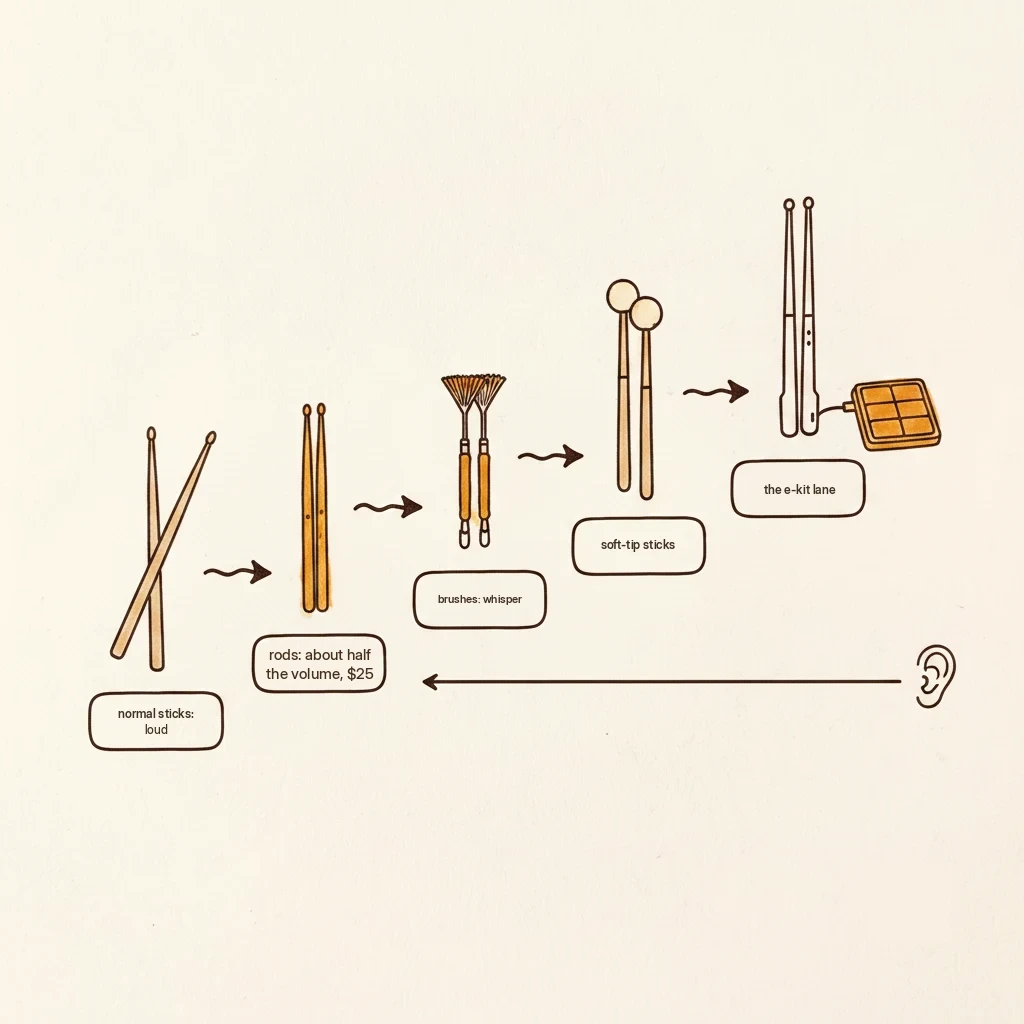
You want the $25 fix before the $400 one, which is exactly the right instinct. So let me give you the honest ladder, cheapest first, and one truth that every product listing conveniently leaves out: the sticks are not the loud part.
The quiet ladder, cheapest first
- Rods. About $25. These are bundles of thin dowels instead of a solid stick, and they cut the volume roughly in half while still feeling and playing like sticks. This is the first thing to buy.
- Brushes. About $15 to $25. The quietest option, down around conversation level on the drums, but they’re a different technique (a sweep, not a hit), so they change how you play more than rods do. You get jazz brushwork thrown in free.
- Low-volume sticks, like the Vic Firth SD5 Echo. About $15 to $18. A thinner, lighter stick that one player called a “low-volume secret weapon.” Real sticks, just quieter.
- Mesh heads and low-volume cymbals. A couple hundred dollars, converting your acoustic kit toward practice volume.
- An electronic kit. The real answer past a certain point, and its own conversation.
The truth nobody prints: it’s the cymbals
If you switch to rods and you’re still getting the “too loud” complaint, stop looking at your sticks and look at your cymbals. Cymbals are where hard hitters overplay, and that metallic crash-wash is usually the loudest thing coming off a kit. Quiet sticks fix the drums. Only lighter technique and low-volume cymbals fix the cymbals. A cover-band drummer already on hot rods can still get told he’s too loud, and it’s almost always the crash, not the sticks.
So spend one practice session hitting the cymbals half as hard as you think you need to. That’s a free upgrade, and it does more for the neighbor situation than any stick you can buy.
Settle the argument with a recording
Here’s the move that ends both the neighbor fight and the “am I actually too loud” doubt: record yourself from the next room, with your phone, door closed. That’s roughly what the person on the other side of the wall hears, and it’s the honest referee. Sometimes it proves you’re fine. Sometimes it proves the cymbals are the problem. Either way you stop guessing.
And a fair word on all this: the ignorance runs both ways. Some drummers genuinely can’t play quietly and need to learn dynamics. And some rooms and some neighbors will complain no matter what. Respect both truths.
A pair of hot rods. About $25. Roughly half the volume, still feel like sticks, no technique change required. The single best first move for a too-loud kit.
Flaws, said plainly: they wear out faster than solid sticks (the dowels splinter over time), and they don’t touch the cymbals. Cheap enough that neither matters much.
The quietest “drumstick” of all
The quietest place any drumstick can land is a practice pad. About $25 to $35, and it’s near-silent, perfect for building the fundamentals and stick control that every song rides on. The one thing to know: a pad, mesh heads, and quiet sticks all handle the airborne noise, but they can’t fix the kick-drum thump traveling down through the floor to the room below. That’s structure-borne, it goes through the building itself, and no stick solves it. If downstairs is the problem, that’s an e-kit-and-riser conversation.
Be a little wary of the word “silent” in the marketing, too. Nothing acoustic is silent. The honest numbers are “about half” for rods and “conversation level” for brushes on the heads. Anyone promising true silence from a stick is selling you the word.
Why do cymbals carry through walls when the drums don’t as much? It comes down to frequency and how sound gets through a wall. A drum, especially with rods, makes a lower, shorter, more contained thump. A cymbal makes a bright, ringing, high-frequency wash that lingers, and those higher frequencies both travel efficiently through the air and set thin, light barriers (like a hollow interior wall or a door) vibrating like a speaker. Low thumps mostly need mass or the structure itself to travel. So the cymbal’s shimmer sails through the drywall while much of the drum sound gets stopped by it. That’s why your neighbor’s complaint is nearly always about the crash, even when you feel like the whole kit is the problem.
Rods this week, and spend one practice session hitting the cymbals half as hard, that’s the free upgrade. Record yourself from the next room to settle whether it’s working. If the knock on the door keeps coming, an electronic kit is the real peace treaty.
If you buy through my links the site earns a little coffee money. Doesn’t change the price, doesn’t change my answer.
If you’re figuring this out, you’re probably also wondering:
Gus Harmon
Gus spent three decades running sound wherever somebody needed it: bar bands, weddings, school shows, and twelve years of Sunday mornings. He can't sing a note. He can make sure you're heard. Now he writes so normal people can buy the right thing the first time.