
← your kid's instrument: costs, rentals, sticking with it
A Violin for a Beginner (Skip the Violin-Shaped Objects)
A beginner violin is a rental first, $20 to $35 a month sized to the player, because the $30 to $100 Amazon violin isn't a real violin, it's a prop that makes beginners blame themselves.
 Gus Harmon · Updated July 8, 2026 · how I decide
If you buy through my links the site earns a little. It's never why I pick things.
A beginner violin is a rental first: $20 to $35 a month, sized to the player, swapped as a kid grows. The $30 to $100 Amazon violin is not really a violin. Players call them VSOs, violin-shaped objects, props with strings. When it’s time to own one (your teacher will say when), a set-up instrument from a violin shop runs $300 to $600 used.
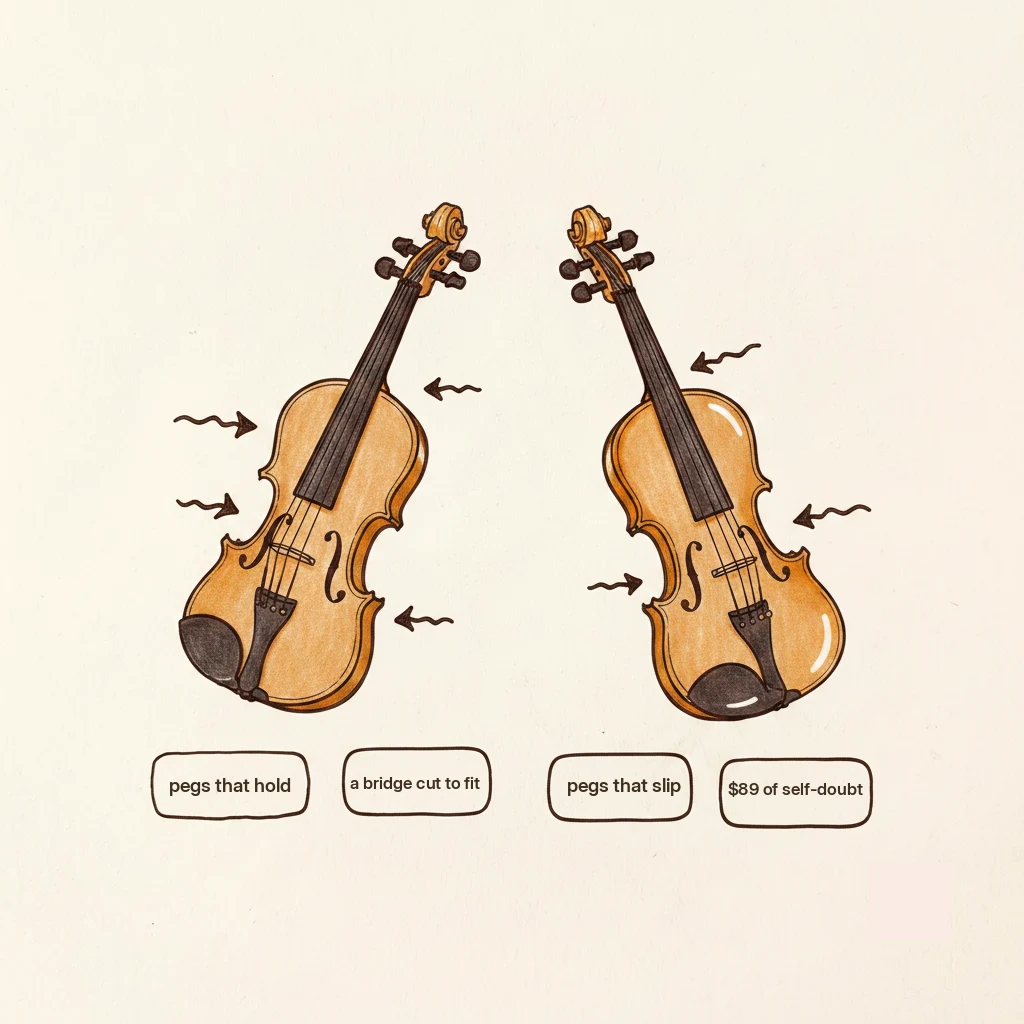
Here’s the thing about the violin that flips this whole page around. On most instruments, the danger is overspending. On the violin, the danger is the cheap trap, and it’s cruel in a specific way: a bad violin makes the beginner blame themselves. So before anything else, let me steer you clear of it.
Why the $89 “violin” is the one wrong answer
Players have a name for the $30 to $100 internet violin: a VSO, a violin-shaped object. One put it plainly, it’s “not a violin meant for playing,” it’s “a disposable prop.” And the problem isn’t just that it sounds bad.
A bad violin makes the beginner blame themselves. The bridge sits too high, so the strings are brutal to press. The pegs won’t hold, so it drifts out of tune constantly. The strings are junk, so nothing rings. And a beginner cannot tell the difference between “this instrument is fighting me” and “I’m bad at this.” Every one of those flaws reads as personal failure. One player described renting a decent violin after struggling on a cheap one: “it was like suddenly I could sorta play.” The object failed. Not the kid.
That’s the whole reason rent-first beats buy-cheap here. It’s not snobbery. It’s protecting a beginner’s confidence from a rigged instrument.
Rent first, and let the kid grow into it
A rental from a violin shop or a program like Music & Arts. About $20 to $35 a month, and it comes properly set up so it actually plays. The magic for kids: violins come in fractional sizes (quarter, half, three-quarter, full), and rentals swap sizes free as the kid grows. Many programs put your payments toward a purchase later, too.
Flaws, said plainly: you’re paying monthly and you don’t own it yet. That’s exactly the point. You get a playable, correctly sized instrument without gambling on a purchase before you know the kid will stick.
When it’s time to actually buy
Buy when the teacher says the word, not before. And when you do:
- Go to a violin shop, not a marketplace. At this level, the setup (how the bridge, pegs, and strings are adjusted) matters more than the brand name.
- Expect $300 to $600 used for a genuinely playable student instrument. Under about $300 is where players report hitting a real wall.
- There are decent factory names (Eastman, Century Strings, and others), but they’re hit or miss, so demo at a shop rather than ordering blind.
Already got the shiny Christmas one? No shame
If Santa already delivered a Cecilio-class violin, breathe, there’s no lecture here. That was a loving guess at a confusing product. Do this: rub fresh rosin on the new bow for a few minutes so it actually grips (a bare bow makes no sound and feels broken). Leave the bridge alone, it just stands there under string tension, never glue it. Then take it to a shop for a $20 once-over. It might get you to “practice-able” while you sort out a rental.
For adults
Same rental math, just full-size from day one. And it is absolutely not too late. The learning-slow-but-steady rule from the string world applies: ten honest minutes a day beats a weekend marathon. Nobody in that shop is judging a grown beginner. They’re glad you came.
Quick answers to the small stuff
A violin has four strings (tuned G, D, A, E, low to high), and that’s part of why it’s expressive but hard, no frets to tell your finger where the note is. Which brings up self-teaching: the violin is honestly the hardest self-teach in this whole catalog. No frets means every note is found by ear, and bad posture can actually cause injury over time. If you go solo, at least get periodic video check-ins with a teacher. And yes, the letter-note “training wheel” sheets and first-position songs are a real starting point once you’ve got an instrument that plays.
On a violin, the height of the strings above the fingerboard is measured in fractions of a millimeter, and it’s set by exactly how the bridge is cut and where the neck sits. Get that height a hair too high and pressing a string to the board takes real hand strength, more than an eight-year-old’s fingers have, so the notes buzz or choke and the kid tires in minutes. The cheap violins ship with bridges cut carelessly (or worse, a bridge just glued on crooked), and there’s no cheap fix. A good shop setup files that bridge to the right height, fits the pegs so they turn smoothly and hold, and suddenly the same beginner can actually press the strings. That millimeter of setup is the difference between an instrument that teaches and one that defeats. It’s why the shop’s cheap violin outplays the internet’s shiny one every time.
Rent, sized to the player, and buy nothing until the teacher says the word. If Santa already delivered the shiny one, no shame: rosin the bow, book the $20 shop once-over, and start the rental paperwork the same week.
If you buy through my links the site earns a little coffee money. Doesn’t change the price, doesn’t change my answer.
If you’re figuring this out, you’re probably also wondering:
Gus Harmon
Gus spent three decades running sound wherever somebody needed it: bar bands, weddings, school shows, and twelve years of Sunday mornings. He can't sing a note. He can make sure you're heard. Now he writes so normal people can buy the right thing the first time.