← first chords, first songs, at any age
Violin Lessons for Beginners (the One Instrument That Earns Them)
Violin is the rare beginner instrument where a teacher genuinely earns the $30 to $60 an hour, but the teacher is an audition you hold, and the community's rule is blunt: don't quit violin, quit your teacher.
 Gus Harmon · Updated July 8, 2026 · how I decide
If you buy through my links the site earns a little. It's never why I pick things.
Violin is the one beginner instrument where lessons genuinely earn their money. There are no frets to tell you where the notes are, posture mistakes can actually hurt you, and good tone is as much mental as physical. Rates run the standard $30 to $60 an hour. Here's the part nobody says out loud: the teacher is an audition YOU hold. If a teacher is chronically late, vague about your goals, or leaves your confidence smaller, walk. The community's own rule is blunt: don't quit violin, quit your teacher.
Why violin actually needs a teacher (when guitar doesn’t)
Here’s the thing. On a guitar, frets tell your fingers exactly where each note lives. A violin has none. The note is a spot on a bare string that you find by ear and by muscle memory, and building that ear takes a real person listening and correcting in the moment. A video can’t hear your out-of-tune D.
There’s also a safety piece people skip. Violin posture and bow tension, done wrong for months, cause real strain and injury, and you can’t see your own shoulder creeping up. And tone on a violin is famously as psychological as it is physical: tension in your body becomes tension in the sound. A good teacher manages both the hands and the head. That’s the case for paying.
The rule that matters most: quit your teacher, not the violin
The single most important thing the violin community says to beginners is this: don't quit violin, quit your teacher. Just because someone's famous or advanced doesn't mean they're the right teacher for YOU. Fit beats reputation every time. If you're miserable, it's very often the pairing, not the instrument, and definitely not you.
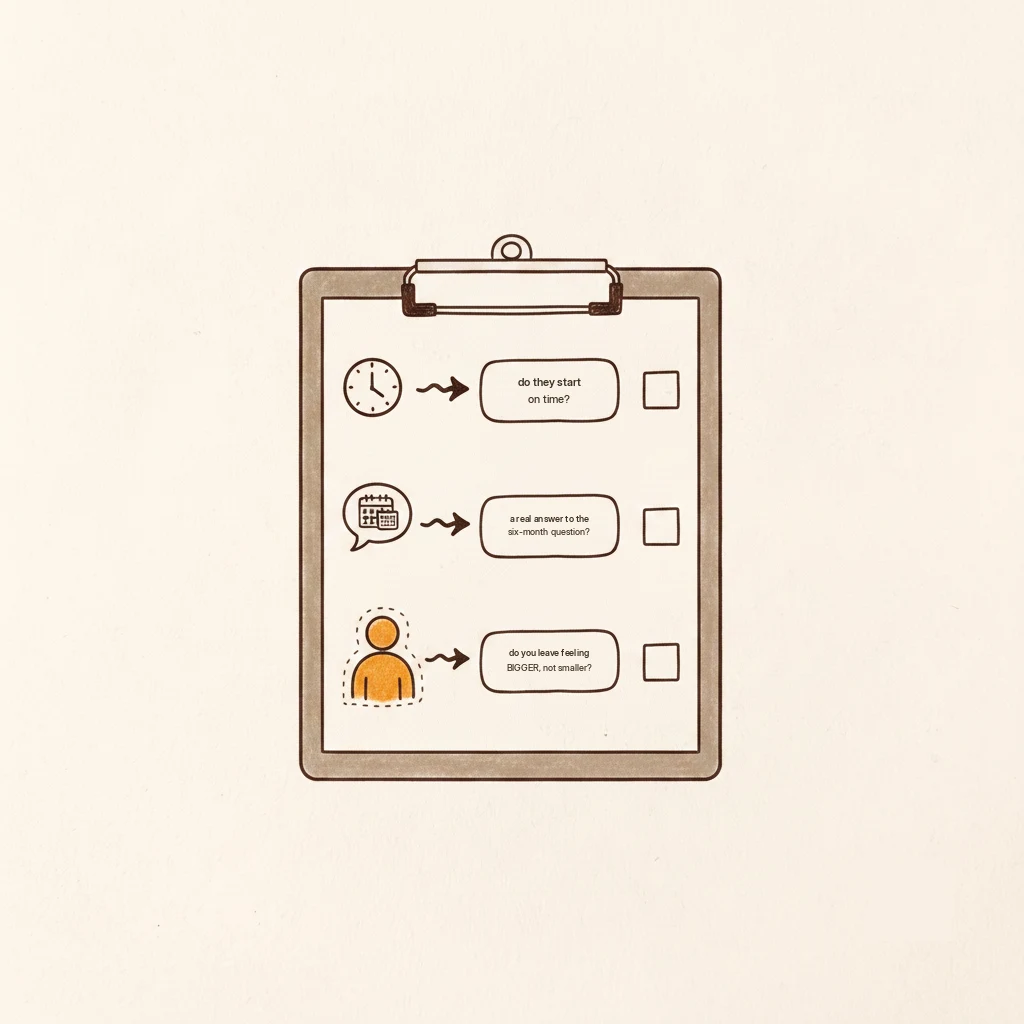
So here are the leave signals, plainly. Chronically late or canceling. Constantly moving the goalposts so you never feel progress. And the big one: you walk out of lessons feeling smaller than you walked in. A good lesson should leave you feeling good. That’s not a bonus, that’s the whole point. If a lesson consistently shreds your confidence, that was your last lesson with that person. The violin is hard enough without paying rent to a critic.
The audition you hold
Interview two teachers before you pick one. Ask each the same question: “what will I be able to play in six months?” Watch what happens. A good teacher lights up and gives you a real, specific answer. A weak one waffles or makes you feel silly for asking. You’re the one paying, so you’re the one auditioning. Act like it.
The adult question, answered honestly
If you’re an adult reading this after somebody told you it’s “too late to get really good,” here’s the truth. Your brain at 22 or 42 learns just fine. Ten years of steady, moderate practice gets an adult to amateur-orchestra good, able to play major symphonic works, not perfectly, but really play them. Will you be a concert soloist starting now? No. But almost nobody wanted that anyway. The aim is to enjoy the violin and the music, and that’s wide open at any age. Tone is the long game, the genuinely hard part, and it rewards patience.
For the kids
For young beginners, the Suzuki method is the standard path, and its Book 1 is full of real little songs, not dry drills, so kids are playing music quickly. Violin also starts earlier than most instruments: a four or five year old can manage a tiny sized violin and hold a bow, because it’s built for small bodies in a way a trumpet isn’t. Private lessons run $30 to $60 an hour, with shorter half-hour slots for little ones.
And the same test decides everything: is practice happening between lessons? That’s the whole ballgame, kid or adult.
Skip this unless you like the nerdy part. The no-frets thing changes learning completely. On a fretted instrument, the metal bar guarantees the pitch, so your job is just to press the right space. On a violin, the exact pitch lives entirely in your fingertip's memory of where to land, calibrated by your ear catching every tiny miss. That's why beginners sound rough and why the ear and the hand have to grow together. You're not learning positions, you're growing a pitch sense.
Interview two teachers before picking one. Ask each what you'll play in six months and watch whether they light up. And if a lesson ever leaves you feeling smaller than you walked in, that was the last one. The violin's hard enough without renting a critic.
Questions people actually ask
Do you need lessons to learn violin?
More than almost any other instrument, yes. With no frets, your ear and fingers have to learn pitch together, which needs a real person listening and correcting. Posture and bow tension also carry injury risk you can’t self-diagnose. You can dabble alone, but violin is the instrument where a teacher genuinely earns the money.
Is it too late to learn violin as an adult?
No. Adult brains learn violin fine. With ten years of steady practice you can reach amateur-orchestra level and play real symphonic music. What’s off the table is becoming a concert soloist from a late start, which almost no adult beginner wanted anyway. The goal is to enjoy playing, and that’s available at any age.
How much do violin lessons cost?
The standard range is $30 to $60 an hour, with shorter, cheaper half-hour slots common for children. More important than the rate is the fit: interview a couple of teachers, ask what you’ll be able to play in six months, and leave any teacher who shrinks your confidence, no matter their price or reputation.
Weighing violin, you're probably also wondering:
Gus Harmon
Gus spent three decades running sound wherever somebody needed it: bar bands, weddings, school shows, and twelve years of Sunday mornings. He can't sing a note. He can make sure you're heard. Now he writes so normal people can buy the right thing the first time.