
← your kid's instrument: costs, rentals, sticking with it
Violin vs Viola: How to Tell Them Apart (and Which to Pick)
Same shape, two instruments: a violin has a thin top E string and a 14-inch body; a viola is bigger, tuned lower, and always in demand. The choice isn't permanent, so rent the sound you like.
 Gus Harmon · Updated July 11, 2026 · how I decide
If you buy through my links the site earns a little. It's never why I pick things.
First, the question nobody wants to ask out loud
There’s a post I think about a lot. A guy gets an instrument, brings it home, and asks the internet: did I buy a violin or a viola? Ninety people answered. He took it to a violin shop, and even the shop guy said it “might” be one or the other.
So if you’re holding an instrument right now and you genuinely don’t know which one it is, you’re in good company. This happens to owners. It happens to shops. The two instruments are the same shape, and nothing on the outside says the name.
The tells, in the order you can actually check them
Look at the strings first. A violin’s top string, the E, is nearly as thin as fishing line. A viola doesn’t have it. Instead, a viola has a thick low C string at the other end. Thin top string means violin. Thick bottom string means viola.
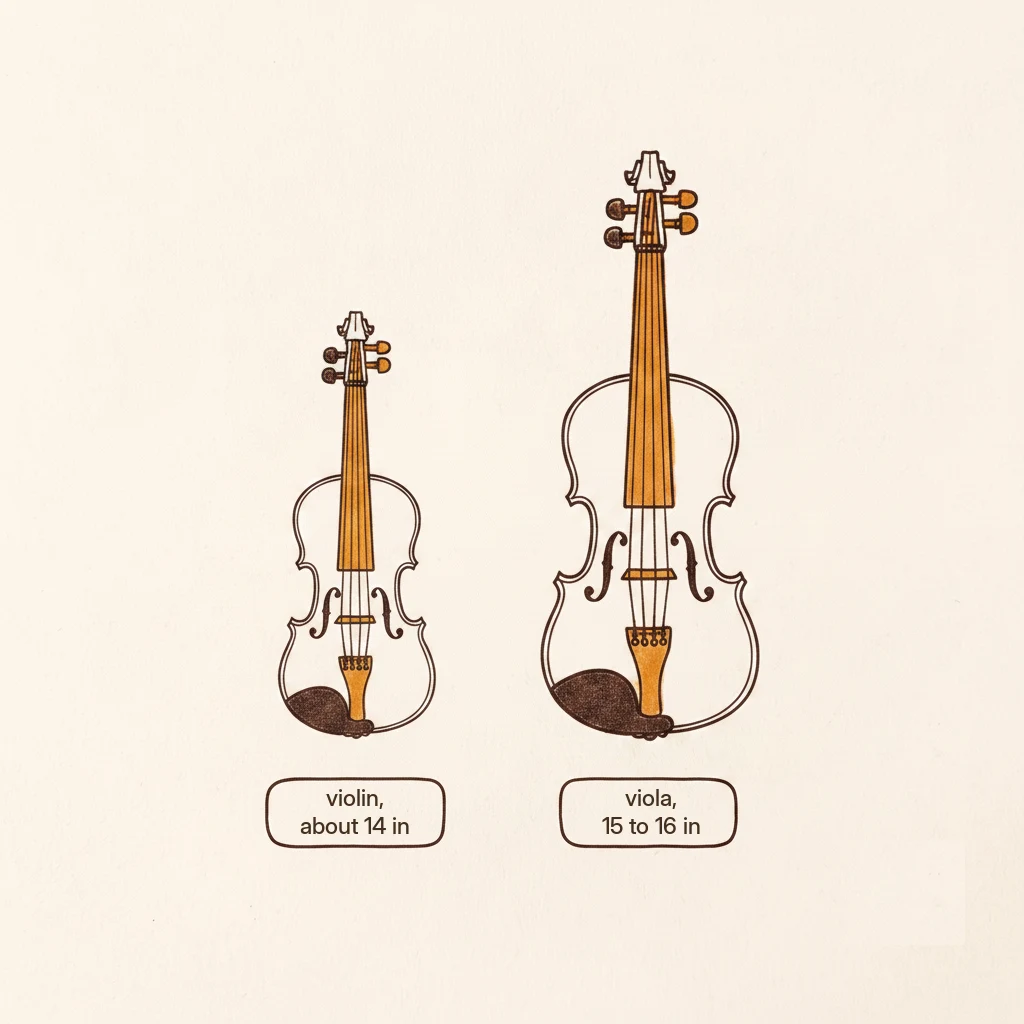
Then measure the body. Just the wooden body, top to bottom, not the neck and scroll. A full-size violin comes in at about 14 inches. Adult violas mostly run 15 to 16 inches. Yamaha’s own guide puts violas anywhere from 12 to 18 inches, because violas come in kid sizes too, which is exactly why the strings are the better tell.
Look inside. There’s usually a paper label visible through the f-holes (the swirly openings on the front). It often names the maker and the instrument.
Tune-test it. If the strings settle happily into G, D, A, E from thickest to thinnest, it’s a violin. A viola sits a fifth lower: C, G, D, A.
If you’re choosing between them
Now the other reader: the one deciding which to start, or which the kid starts. Here’s the sentence that lowers the stakes, and I want it early: this is not a permanent choice.
In a thread where a new student agonized over exactly this, the calmest answer was that violin and viola are fundamentally the same instrument: learn either properly and you can play the other. The bowing, the posture, the left hand, it all transfers. You are not signing a contract.
So the choice comes down to a few honest differences.
| Violin | Viola | |
|---|---|---|
| The sound | Bright, high, carries the melody | Deeper, warmer, the section everyone leans on |
| Finding a teacher | Easy, they're everywhere | Fewer, though many violin teachers also teach viola |
| Getting a seat | Crowded field | Ensembles are always short on violists |
| Sheet music | Endless | Less of it, and it uses its own clef |
That third row is worth saying plainly. The advice from players in that same thread: go viola, there’s never enough of them. If the goal is playing WITH people someday, community orchestra, church group, school ensemble, the viola is the instrument that gets asked to join.
One more thing the spec pages never mention: at the cheap end, violas often sound better than violins at the same price. A budget instrument doesn’t have to manage that thin, demanding E string, and the extra body size gives the sound more room. A rental-grade viola flatters a beginner a little more than a rental-grade violin does.
The honest part about the spotlight
The violin carries the melody. It gets the solos, the Vivaldi, the attention. The viola holds the middle of the sound together, and in most pieces that’s supporting work.
Some people hear that and want the spotlight. Some people hear it and relax, because being the backbone without the pressure sounds like exactly the right job. Both are correct answers. It only goes wrong when someone picks the violin for the attention but hates pressure, or picks the viola to be agreeable and spends years wishing for the melody.
If you're figuring this out, you're probably also wondering:
Gus Harmon
Gus spent three decades running sound wherever somebody needed it: bar bands, weddings, school shows, and twelve years of Sunday mornings. He can't sing a note. He can make sure you're heard. Now he writes so normal people can buy the right thing the first time.