
Powered vs Passive Speakers, in Normal Words
A powered speaker has the amplifier built in: wall plug, signal cable, sound. A passive speaker is just the speaker and needs a matched separate amp. For church halls, karaoke and one-room PAs, powered is the hard-to-get-wrong answer.
 Gus Harmon · Updated July 11, 2026 · how I decide
If you buy through my links the site earns a little. It's never why I pick things.
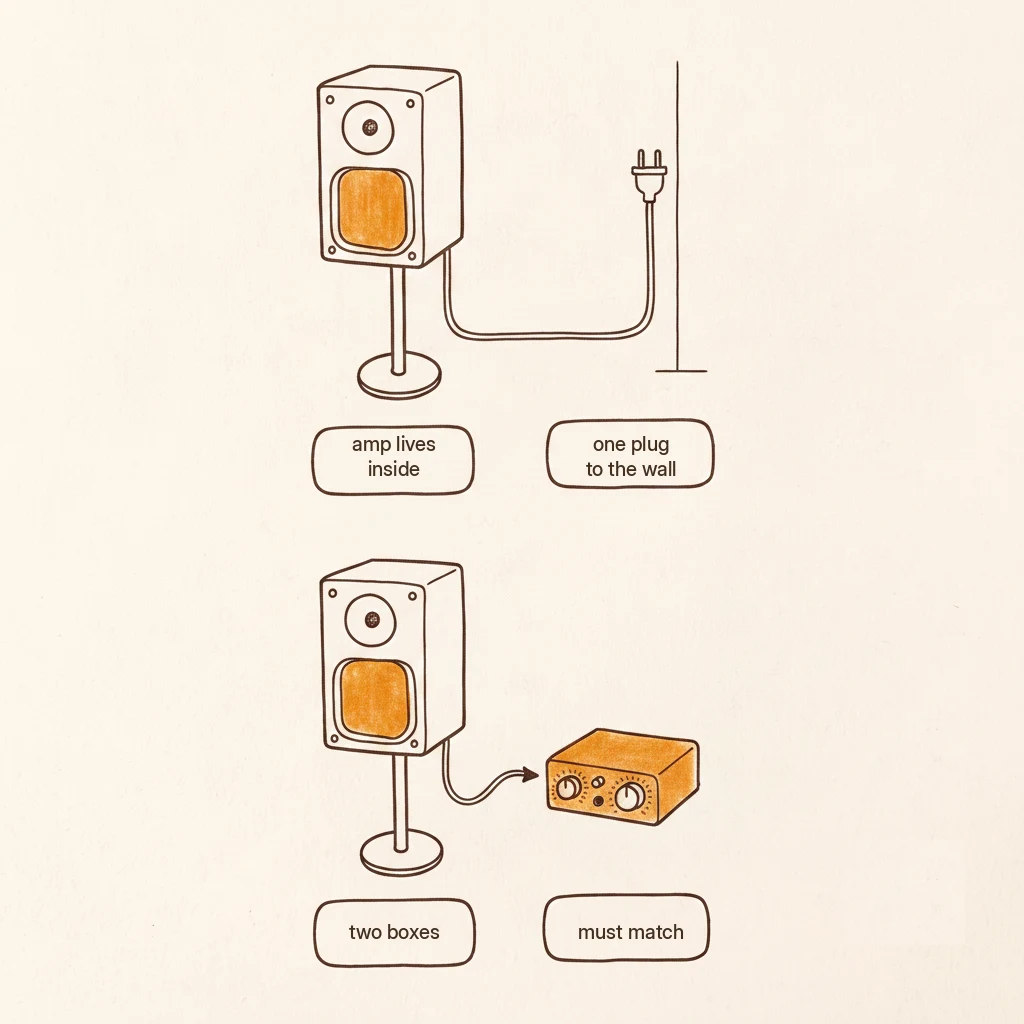
Where the amplifier lives
That’s the entire difference. Every speaker needs an amplifier to make sound. The only question is whether the amp lives inside the speaker cabinet or in a separate box.
Powered (also sold as “active”): amp inside. Each speaker needs a wall outlet and a signal cable from your mixer. Everything is pre-matched at the factory, which means the classic beginner disaster, amp and speaker mismatched until one of them dies, is engineered out of the box.
Passive: just the cone in a cabinet. It needs an amplifier chosen to match its power handling and impedance, connected with speaker wire. Get the match right and it’s glorious. Get it wrong and you cook something.
If you’ve ever plugged a microphone straight into a speaker and heard nothing, this is the same lesson one shelf over: the sound world runs on hidden middle boxes, and “powered” just means the middle box comes pre-installed.
Why the pros you see still use passive
Installed systems in big rooms are usually passive: the amps sit in a rack in a closet where they can be serviced, and the speakers hang high where power outlets don’t reach. If somebody ELSE designs and runs your system, passive has real virtues. That’s the integrator’s world, and if you’re reading quotes from one, I translated those quotes here.
But for a system YOU run, the calculus flips completely. In the long church-audio thread where a congregation was staring down a $24,000 quote, the practical consensus for a small room was powered speakers on poles plus a used mixer, a few thousand dollars, run by volunteers. Fewer boxes, fewer cables, nothing to mismatch on a Sunday morning.
| Powered | Passive | |
|---|---|---|
| Boxes to buy | Speaker (amp inside) | Speaker + matched amp |
| Can you mismatch it? | No | Yes, expensively |
| Each speaker needs | An outlet + signal cable | Speaker wire only |
| Who it's for | Rooms run by regular people | Installed rigs with a tech |
That third row is the one honest cost of powered: every powered speaker needs wall power. A speaker on a pole across the room means a cable run across the room. Plan the outlets before you plan the poles.
What the good ones cost
The workhorse class here is the powered 12-inch speaker on a pole: JBL’s EON series and Yamaha’s DBR line are the boring, reliable names, roughly $600 to $1,200 a pair. For a karaoke rig or a garage, the budget lane runs down to about $165 for something like the Rockville powered speaker in the karaoke stack guide.
One more honest note: the audiophile world genuinely prefers passive speakers, because swapping amplifiers IS the hobby. Different game entirely. This page is about rooms where the goal is a working microphone, not a listening chair.
If you buy through my links the site earns a little coffee money. Doesn’t change the price, doesn’t change my answer.
If you're figuring this out, you're probably also wondering:
Gus Harmon
Gus spent three decades running sound wherever somebody needed it: bar bands, weddings, school shows, and twelve years of Sunday mornings. He can't sing a note. He can make sure you're heard. Now he writes so normal people can buy the right thing the first time.